







Understanding Creatine: Everything You Need to Know
Creatine monohydrate is the most researched supplement in sports nutrition — over 1,000 peer-reviewed studies spanning more than three decades. The ISSN, ACSM, and ADA all recognize it as safe and effective. Here's every common question answered with the actual evidence, not marketing copy.
What is creatine?
Creatine is a molecule your body produces naturally from three amino acids — arginine, glycine, and methionine — primarily in the liver and kidneys. About 95% of your body's creatine is stored in skeletal muscle as phosphocreatine, with the remaining 5% in the brain, heart, and other tissues.
Phosphocreatine functions as a rapid-access energy reserve. When your muscles need energy for explosive, high-intensity efforts — a heavy deadlift, a sprint, the last rep of a set — they burn through ATP (adenosine triphosphate) almost instantly. Phosphocreatine donates its phosphate group to regenerate ATP, allowing your muscles to sustain output for a few more seconds before other energy systems take over.
Your body produces roughly 1-2 grams of creatine per day. Omnivores get an additional 1-2 grams from meat and fish. Supplementing with creatine monohydrate increases intramuscular creatine stores by 20-40%, which translates to more available phosphocreatine, faster ATP regeneration, and measurably better performance during high-intensity exercise.
What does creatine actually do?
The meta-analyses are consistent. Creatine supplementation combined with resistance training produces 5-15% greater improvements in strength and power output, approximately 1-1.4 kg more lean mass gained compared to training with placebo, reduced body fat percentage (-0.88% in the 2024 Desai meta-analysis), faster recovery between sets and between training sessions, and emerging benefits for cognitive function, particularly memory and processing speed under stress or sleep deprivation.
It's the single most effective legal performance supplement available. No other dietary supplement has this depth of evidence for improving strength, power, lean mass, and exercise capacity.
How much should I take?
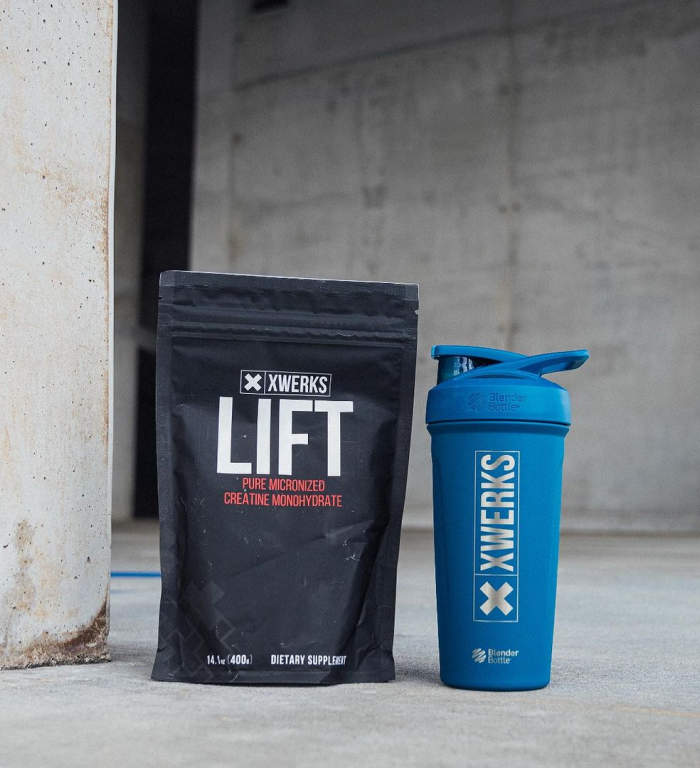
5 grams per day, every day. That's one scoop of XWERKS Lift. This is the dose used in the vast majority of positive creatine studies and is the ISSN's maintenance recommendation.
A loading phase (20g/day split into 4 doses for 5-7 days) is optional. It saturates your muscles faster (~1 week vs. ~3-4 weeks), but produces the same endpoint as consistent daily dosing at 5g. If you'd rather avoid the temporary water weight and mild GI discomfort that a loading phase can cause, just start at 5g/day and wait. Read the full dosing guide →
When should I take it?
Timing doesn't matter. Creatine works by gradually saturating your muscle stores over days and weeks — it's not an acute performance booster like caffeine. There's no "creatine timing window." Take it whenever you'll remember to take it consistently: with breakfast, in your post-workout shake, mixed into your coffee, or stirred into water before bed. Consistency is the only variable that matters.
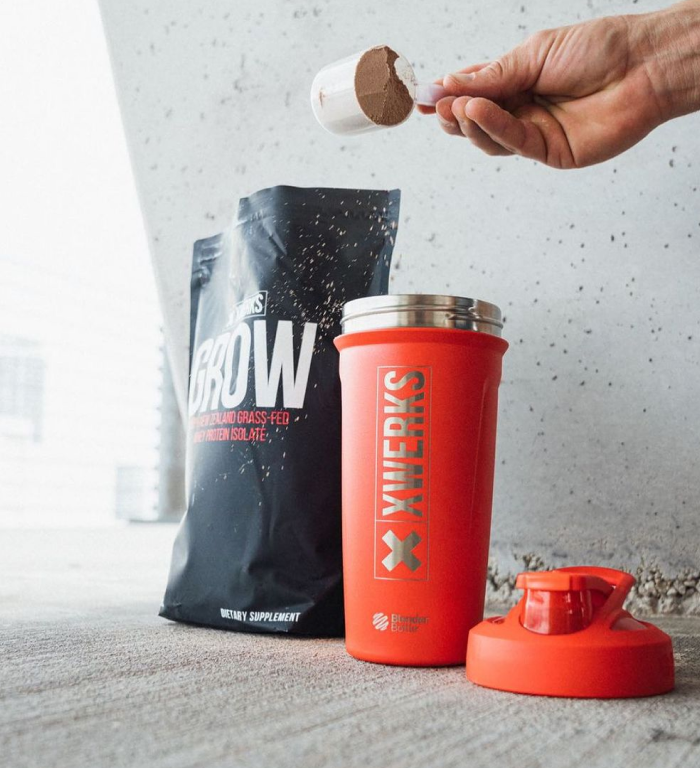
The simplest protocol: mix one scoop of Lift into one scoop of Grow. Two supplements, one shake, done.
Which form of creatine is best?
Micronized creatine monohydrate. No alternative form — not creatine HCL, not buffered creatine (Kre-Alkalyn), not creatine ethyl ester, not liquid creatine — has outperformed monohydrate in any peer-reviewed head-to-head study. Most cost 2-3x more while delivering identical or inferior results. Monohydrate is the form used in virtually every positive creatine study ever published. At roughly $0.12 per gram, it's also the cheapest.
"Micronized" means the particles have been reduced to a smaller size, which improves solubility and mixability in liquid. Same molecule, better user experience.
Does creatine cause hair loss?
No. This myth traces to a single 2009 study of 16 rugby players that showed a temporary DHT increase but never measured hair. It has never been replicated. In 2025, the first study to actually examine hair follicle health in creatine users (Lak et al., JISSN) found no effect on DHT, testosterone, hair density, follicular count, or hair thickness over 12 weeks. The ISSN's position: "The current body of evidence does not indicate that creatine supplementation increases total testosterone, free testosterone, DHT or causes hair loss/baldness." Read the full breakdown →
Does creatine cause bloating?
Creatine draws water into muscle cells (intracellular hydration), not under the skin. You may gain 1-3 lbs in the first week or two — this is water stored inside your muscles, not subcutaneous bloating. It supports muscle fullness and protein synthesis. It's not the kind of "bloating" people associate with feeling puffy or heavy. If you skip the loading phase and start at 5g/day, most people notice minimal or no water weight change.
Will creatine make me gain weight?
Your scale weight may increase by 1-3 lbs initially from intracellular water. Over weeks and months of training, creatine users also gain more lean mass than non-users — which is a good thing. If you're tracking body composition rather than just scale weight, creatine improves the ratio: more muscle gained, more fat lost, lower body fat percentage compared to the same training without creatine.
Is creatine safe?
Yes. The ISSN's 2017 position stand — the most comprehensive safety review available — states: "There is no scientific evidence that the short- or long-term use of creatine monohydrate has any detrimental effects on otherwise healthy individuals." Creatine does not damage healthy kidneys, does not cause dehydration when adequate water is consumed, does not affect liver function, and is safe for both men and women at recommended doses.
One practical note: creatine supplementation temporarily raises blood creatinine levels (a metabolic breakdown product). If you're getting blood work done, tell your doctor you take creatine so they can interpret kidney markers correctly. This is a predictable lab artifact, not a sign of kidney damage.
Should I take creatine on rest days?
Yes. Creatine works by maintaining saturated muscle stores over time. Skipping rest days would allow your stores to begin depleting. Take your 5g every day — training days and rest days alike. Consistency is what matters, not timing around workouts.
Does creatine work for women?
Yes — and the case may be even stronger for women than for men. Women have 70-80% lower endogenous creatine stores, 20% lower synthesis rates, and 30-40% lower dietary intake. This means supplementation corrects a proportionally larger deficit. Research shows benefits for strength, body composition, bone health, cognitive function, and mood — with emerging evidence for particular benefits during perimenopause and menopause.
Should vegans and vegetarians take creatine?
Absolutely. With zero dietary creatine intake, plant-based eaters have the lowest baseline muscle creatine stores of any population. Research consistently shows that vegetarians experience a greater increase in muscle creatine and a greater improvement in exercise capacity from supplementation compared to omnivores. Creatine monohydrate is synthetically produced and fully vegan-compatible.
Can I mix creatine with protein / coffee / other supplements?
Yes to all. Creatine is stable in solution and doesn't interact negatively with protein, caffeine, carbohydrates, or other common supplements. Lift is unflavored and dissolves cleanly, so it goes into anything — protein shakes, coffee, water, smoothies, juice — without changing the taste. The old concern that caffeine "cancels out" creatine has been largely debunked by recent research showing the two work through independent pathways.
Does creatine expire?
Creatine monohydrate is one of the most chemically stable supplement ingredients available. Stored in a cool, dry place in a sealed container, it maintains potency for years past the printed expiration date. If your creatine has turned into a solid clump (from moisture exposure), it may have partially degraded — but this is a storage issue, not an inherent instability. Powder stored properly will outlast most things in your supplement cabinet.
Does creatine break a fast?
No. Creatine monohydrate contains zero calories, zero carbohydrates, zero protein, and zero fat. It does not stimulate an insulin response. You can take it during a fasting window without breaking your fast by any reasonable definition.
Who benefits from creatine?
The short answer: almost everyone who exercises, and potentially people who don't. The research supports benefits for strength and power athletes (5-15% improvements), endurance athletes (improved recovery between high-intensity efforts), older adults (muscle preservation, strength, potentially cognitive function and bone health), women (who have lower baseline stores and may benefit proportionally more), vegans and vegetarians (who get zero dietary creatine), GLP-1 medication users (where muscle preservation during weight loss is critical), and anyone interested in cognitive function and brain health.
The Quick-Reference Summary
What: Creatine monohydrate — the most researched supplement in sports nutrition.
How much: 5g per day, every day. No loading phase required.
When: Anytime. Consistency > timing.
Which form: Micronized creatine monohydrate. Nothing else outperforms it.
Hair loss: No. Debunked by the 2025 RCT.
Bloating: Intracellular water, not subcutaneous. Skip loading to minimize.
Safe: Yes. ISSN confirms no adverse effects in healthy individuals.
Vegan: Yes. Synthetically produced, no animal ingredients.
Cost: ~$0.60/day. The cheapest effective supplement available.
One Ingredient. 1,000+ Studies. $0.60/Day.
XWERKS Lift — pure micronized creatine monohydrate. 5g per scoop, 80 servings, unflavored, nothing else in the bag.
SHOP LIFT →Deep Dives
Each of these topics has its own full-length article with the complete research:
What Is Micronized Creatine? — Why monohydrate outperforms every alternative form.
How Much Creatine Should I Take? — Loading vs. maintenance, dose by body weight.
Creatine Timing: Before or After Workouts? — What the studies say about timing.
Does Creatine Cause Hair Loss? — The myth, the 2025 RCT, the definitive answer.
Does Creatine Help with Weight Loss? — Three meta-analyses on body composition.
Creatine for Women — Lower baseline stores, greater relative benefit.
Creatine for Older Adults — Muscle, bone, brain: the aging evidence.
Creatine for GLP-1 Users — Preserving muscle during pharmacotherapy weight loss.
Should Vegans Take Creatine? — Why plant-based athletes benefit most.
The Brain-Boosting Benefits of Creatine — Cognitive function beyond the gym.
References
1. Kreider RB, et al. International Society of Sports Nutrition position stand: safety and efficacy of creatine supplementation in exercise, sport, and medicine. JISSN. 2017;14:18.
2. Antonio J, et al. Common questions and misconceptions about creatine supplementation: what does the scientific evidence really show? JISSN. 2021;18(1):1-16.
3. Antonio J, et al. Part II. Common questions and misconceptions about creatine supplementation. JISSN. 2025;22(1):2441760.
4. Desai I, et al. The effect of creatine supplementation on resistance training-based changes to body composition. J Strength Cond Res. 2024;38(10):1813-1821.
5. Lak M, et al. Does creatine cause hair loss? A 12-week randomized controlled trial. JISSN. 2025;22(sup1):2495229.
6. Smith-Ryan AE, et al. Creatine supplementation in women's health: a lifespan perspective. Nutrients. 2021;13(3):877.