Should Vegans and Vegetarians Take Creatine?
Yes — and the case for it is arguably stronger than for omnivores. Dietary creatine comes almost exclusively from meat and fish. If you eat neither, your muscle and brain creatine stores depend entirely on what your body can synthesize on its own — and research consistently shows that's not enough to reach the levels associated with optimal performance and cognitive function.
The Creatine Gap in Plant-Based Diets
Your body produces creatine endogenously from three amino acids — arginine, glycine, and methionine — primarily in the liver and kidneys. This internal production generates roughly 1-2 grams per day. Omnivores supplement this with an additional 1-2 grams per day from meat, fish, and poultry. Vegans get effectively zero dietary creatine, and most vegetarians get very little (small amounts may come from eggs and dairy, but these are negligible compared to meat sources).
The result is a measurable deficit. Burke et al. found that vegetarians had significantly lower baseline muscle creatine stores compared to omnivores. When both groups supplemented with creatine, the vegetarians experienced a greater increase in muscle creatine levels — their stores had more room to fill. This isn't surprising: if you start with less, you have more to gain from supplementation.
A 2025 narrative review published in Nutrients confirmed this pattern, noting that vegans and vegetarians "often have reduced creatine stores due to the absence of creatine-rich animal products in their diet" and that supplementation "can improve both physical and cognitive performance while supporting adherence to plant-based diets."
Physical Performance: Bigger Gains from Supplementation
The research on creatine and physical performance in vegetarians tells a consistent story: because plant-based eaters start with lower muscle creatine stores, they tend to experience a proportionally greater response to supplementation.
Burke et al. demonstrated that after a creatine loading protocol, vegetarians showed a greater increase in muscle creatine and total creatine compared to omnivores. This elevated response was associated with an improved ability to exercise — the vegetarians gained more from the same supplementation protocol because they were starting from a lower baseline.
A 2025 study in vegans and vegetarians (Koeder et al.) found that 7 days of creatine supplementation (0.3 g/kg/day) increased muscle creatine by 18.8 mmol/kg and total creatine by 30.8 mmol/kg, along with increases in body mass (+1.56 kg) and fat-free mass (+1.15 kg). The placebo group showed no changes. The body composition improvements from creatine that are well-established in the general population appear to be at least as strong — and potentially stronger — in plant-based athletes.
This makes intuitive sense. Creatine works by increasing phosphocreatine stores in muscle, which allows faster ATP regeneration during high-intensity exercise. If your stores are depleted because you're not getting any dietary creatine, supplementation has a larger effect than it does for someone whose stores are already partially topped up from their steak dinner.
Cognitive Function: The Brain Creatine Connection
Your brain consumes roughly 20% of your body's total energy despite making up only 2% of your body weight. Creatine plays a critical role in brain energy metabolism — the phosphocreatine system operates in the brain just as it does in muscle, providing a rapid-access energy reserve for neurons during periods of high cognitive demand.
A study by Benton & Donohoe (2011) examined 128 young women — roughly half vegetarian — who supplemented with either creatine (20g/day for 5 days) or placebo. The result: creatine supplementation improved memory specifically in the vegetarians but not in the meat-eaters. The authors concluded that vegetarians were "more sensitive to supplementation with creatine" for cognitive function. Meat-eaters, whose brain creatine was presumably already elevated from dietary intake, showed no additional benefit.
A 2024 meta-analysis of 16 clinical trials (Xu et al.) found that creatine supplementation may improve cognitive function broadly — particularly memory, attention, and information processing speed. While the meta-analysis wasn't limited to vegetarians, the Benton finding suggests that the cognitive benefits may be most pronounced in people whose baseline creatine levels are lowest — exactly the situation vegans and vegetarians find themselves in.
A study by Rae et al. (2003) found that creatine supplementation improved cognitive performance — specifically working memory and intelligence processing speed — in a vegetarian cohort. However, it's worth noting that a 2024 systematic review by Sandkühler et al. cautioned that some earlier positive findings may need replication, and that the effect on cognition in non-stressed, well-rested individuals may be smaller than initially reported. The evidence is promising but still developing.
Is Creatine Monohydrate Vegan?
Yes. This is a common concern, but it's straightforward: synthetic creatine monohydrate is produced from sarcosine and cyanamide through a chemical synthesis process. It does not contain animal-derived ingredients. It is not extracted from meat. The manufacturing process is entirely synthetic.
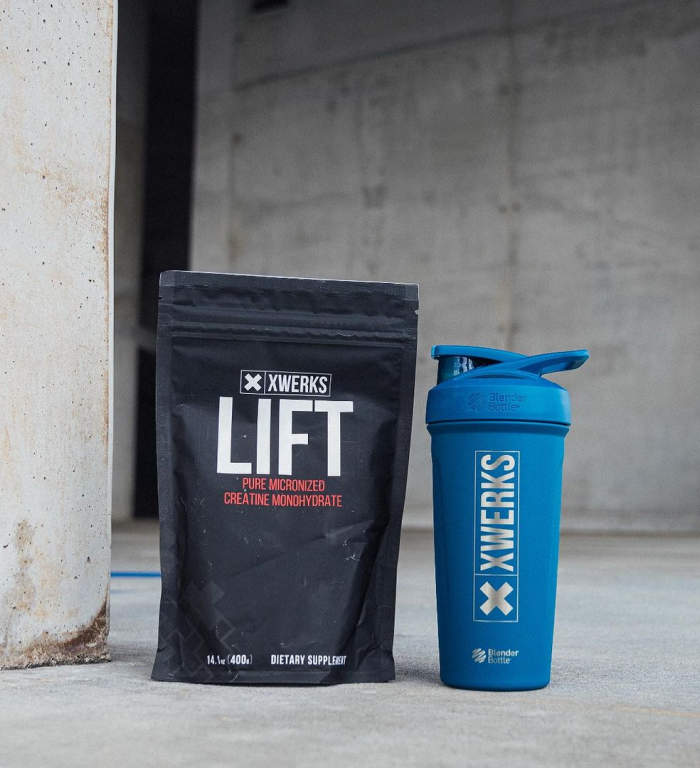
XWERKS Lift is pure micronized creatine monohydrate — nothing else in the bag. No animal-derived ingredients, no gelatin capsules, no dairy, no fillers. It is compatible with vegan and vegetarian diets.
Dosing for Vegans and Vegetarians
Daily dose: 5g per day, every day, including rest days. This is the same dose recommended for omnivores and is the amount used in the vast majority of positive creatine studies. There's no evidence that vegans need a different dose — the 5g/day maintenance dose is sufficient to saturate muscle stores regardless of dietary background.
Loading phase: Optional. A loading phase (20g/day split into 4 doses for 5-7 days) accelerates saturation from ~3-4 weeks to ~1 week. Given that vegans start with lower stores, some practitioners suggest that a loading phase may be more noticeable for plant-based athletes. But it's not required — consistent daily dosing at 5g achieves the same endpoint, just more gradually.
Timing: Doesn't matter. Take it whenever you'll remember to take it consistently. Mix it into your morning smoothie, your post-workout shake, your coffee, or a glass of water. Lift is unflavored and dissolves cleanly.
Hydration: Creatine draws water into muscle cells. Stay well-hydrated — aim for 2.5-3+ liters of water per day, especially during a loading phase or if you're training in heat.
What About Getting Creatine from Food on a Plant-Based Diet?
You can't. Not in meaningful amounts. Creatine exists almost exclusively in animal muscle tissue. There are no plant foods that contain creatine in nutritionally significant quantities.
Your body can synthesize creatine from the amino acids arginine, glycine, and methionine — all of which are available in plant foods (nuts, seeds, legumes, soy, whole grains). But endogenous synthesis maxes out at roughly 1-2g per day, which research suggests is insufficient to fully saturate muscle creatine stores. This is the whole reason supplementation exists: to bridge the gap between what your body makes and what your muscles (and brain) can optimally use.
For omnivores, diet provides about half their daily creatine and supplementation provides the rest. For vegans, supplementation provides all of it. The supplement isn't optional for plant-based athletes who want the full performance and cognitive benefits — it's the only source.
Safety
The ISSN's 2017 position stand states clearly: "There is no scientific evidence that the short- or long-term use of creatine monohydrate has any detrimental effects on otherwise healthy individuals." This safety profile applies equally to vegans and vegetarians. Creatine does not affect kidney function in healthy people, does not cause dehydration when adequate water is consumed, and does not interact negatively with plant-based diets.
If you're taking creatine and getting blood work done, mention it to your doctor — creatine supplementation raises blood creatinine levels (a breakdown product), which can be misinterpreted as a kidney function issue if your physician doesn't know you're supplementing.
The Bottom Line
Vegans and vegetarians are arguably the population that benefits most from creatine supplementation. With zero dietary creatine intake, plant-based eaters have lower baseline muscle and brain creatine stores — which means supplementation produces a proportionally greater response in both physical performance and potentially cognitive function.
Creatine monohydrate is synthetically produced and fully vegan-compatible. The dose is the same as for omnivores: 5g per day, every day. The research consistently shows that vegetarians experience greater increases in muscle creatine, greater improvements in exercise capacity, and may benefit more from the cognitive effects of supplementation compared to meat-eaters.
If you eat a plant-based diet and take only one supplement, this is the one.
Pure Creatine. Nothing Else. Vegan-Compatible.
XWERKS Lift — 5g of micronized creatine monohydrate per scoop. Unflavored. No animal ingredients. No fillers. 80 servings.
SHOP LIFT →Further Reading
Understanding Creatine: Common Questions and Answers — Everything a beginner needs to know about creatine.
What Is Micronized Creatine? — Why monohydrate outperforms every alternative form.
The Brain-Boosting Benefits of Creatine — How creatine supports cognitive performance.
Does Creatine Help with Weight Loss? — Body composition benefits backed by three meta-analyses.
Does Creatine Cause Hair Loss? — The myth, the 2025 study, and the definitive answer.
What Does Creatine Do for Women? — The full evidence across the female lifespan.
References
1. Nutrients (2025). Creatine supplementation beyond athletics: benefits of different types of creatine for women, vegans, and clinical populations — a narrative review. Nutrients. 2025;17(1):95.
2. Burke DG, et al. Effect of creatine and weight training on muscle creatine and performance in vegetarians. Med Sci Sports Exerc. 2003;35(11):1946-1955.
3. Benton D, Donohoe R. The influence of creatine supplementation on the cognitive functioning of vegetarians and omnivores. Br J Nutr. 2011;105(7):1100-1105.
4. Rae C, et al. Oral creatine monohydrate supplementation improves brain performance: a double-blind, placebo-controlled, cross-over trial. Proc R Soc Lond B. 2003;270:2147-2150.
5. Xu C, et al. The effects of creatine supplementation on cognitive function in adults: a systematic review and meta-analysis. Front Nutr. 2024;11:1424972.
6. Koeder C, et al. Muscle creatine levels and sprint performance in young adult vegans and vegetarians after 7 days of creatine monohydrate supplementation. Eur J Appl Physiol. 2025.
7. Kreider RB, et al. International Society of Sports Nutrition position stand: safety and efficacy of creatine supplementation. JISSN. 2017;14:18.