What Is Micronized Creatine? And Why It's the Only Form That Matters
Creatine is the most researched performance supplement in history. The supplement industry has created dozens of "advanced" forms to sell you something new. The science says they're all unnecessary. Here's why micronized creatine monohydrate remains the gold standard.
If you've shopped for creatine recently, you've encountered an overwhelming number of options: creatine monohydrate, micronized creatine, creatine HCL, buffered creatine, creatine ethyl ester, creatine magnesium chelate, liquid creatine, and various branded proprietary forms with names designed to sound more sophisticated than the original.
Here's what the International Society of Sports Nutrition (ISSN) says, plainly: "Creatine monohydrate is the most effective ergogenic nutritional supplement currently available to athletes in terms of increasing high-intensity exercise capacity and lean body mass during training." They also state that no alternative form of creatine has demonstrated superior muscle creatine uptake compared to monohydrate.
Micronized creatine is simply creatine monohydrate with smaller particles. Same molecule. Same benefits. Better practical experience. That's the whole story — and it's enough.
What "Micronized" Actually Means
Micronization is a mechanical process that reduces the particle size of creatine monohydrate by approximately 20 times. Standard creatine monohydrate particles are relatively large and coarse, which is why they tend to settle at the bottom of your glass, resist dissolution, and can leave a gritty texture. Micronized creatine particles are typically 10-20 micrometers in diameter — small enough to dissolve smoothly in water without clumping or residue.
Critically, micronization does not change the chemical structure of creatine monohydrate. The molecule is identical. The amino acid content is identical. The way your body absorbs and uses it is identical. What changes is the physical behavior of the powder — how it mixes, how it feels, and how consistently you receive the full dose (because nothing is stuck to the bottom of your glass).
What the Research Actually Shows
The ISSN conducted a comprehensive review of several hundred studies on creatine supplementation. Their findings are about as unambiguous as sports nutrition science gets:
Over 70% of studies found significant improvements in exercise performance and capacity, with average strength and power gains ranging from 5-15%. Long-term studies show that creatine users gain roughly twice as much lean body mass as those taking a placebo. Short-term studies demonstrate increases in maximum power output (1RM) of 5-15%, improvements in single-effort sprint performance of 1-5%, and increased total work performed during repetitive sprint and high-intensity interval protocols.
These aren't marginal effects. For a competitive athlete or serious trainee, 5-15% more power and twice the lean mass gains is the difference between progressing and plateauing.
Beyond performance, the ISSN also confirmed that creatine monohydrate supplementation "is not only safe, but possibly beneficial in regard to preventing injury and/or management of select medical conditions when taken within recommended guidelines." They found no scientific evidence that short- or long-term use has detrimental effects in otherwise healthy individuals.
Why Other Forms of Creatine Are a Waste of Money
The supplement industry thrives on novelty. If everyone already uses creatine monohydrate — the proven, affordable, effective form — there's no margin for premium pricing. So manufacturers create "advanced" versions and charge 2-3x more. Here's what the research shows about the most popular alternatives:
Creatine HCL (Hydrochloride): Marketed as requiring lower doses due to "superior absorption." A 2024 study directly comparing creatine HCL and creatine monohydrate found both were effective for improving muscle strength, hormones, and body composition — but HCL showed no advantages over monohydrate. You're paying more for the same outcome.
Buffered Creatine (Kre-Alkalyn): Claims to resist stomach acid breakdown better than monohydrate. A controlled study found buffered creatine was not more beneficial than monohydrate, with no differences in side effects either. The buffering adds cost without adding benefit.
Creatine Ethyl Ester (CEE): Marketed as having better absorption. Research found that CEE is actually less effective than creatine monohydrate at increasing muscle creatine content. Some studies found it performed no better than placebo. This one actively underperforms.
Liquid Creatine: Creatine breaks down into creatinine (an inactive waste product) when left in liquid form over time. Pre-dissolved creatine supplements are inherently less stable and likely deliver less active creatine per serving than the label claims.
Micronized vs. Standard Monohydrate: The Practical Differences
Think of it like grinding coffee beans finer — the coffee is the same, but the extraction is more consistent and the texture is smoother. You get the full dose in every sip instead of leaving residue at the bottom of the cup.
For athletes who mix creatine into water (rather than a thick shake), the solubility difference is significant. Standard monohydrate in plain water is gritty and unpleasant. Micronized monohydrate dissolves cleanly, which means you can add it to any beverage — water, juice, your protein shake, your pre-workout — without noticing it.
How to Take Micronized Creatine
Dosing: Keep It Simple
Daily maintenance dose: 5 grams per day. That's one scoop of XWERKS Lift. Take it at the same time every day for consistency. The ISSN recommends 3-5g/day for maintenance, with 5g being the most commonly studied and simplest dose to remember.
Loading phase: Optional. You can saturate your muscles faster by taking 20g/day (split into four 5g doses) for 5-7 days, then dropping to 5g/day. But this is purely a speed thing — taking 5g/day without loading reaches the same saturation level, it just takes 3-4 weeks instead of one. Most people skip the loading phase to avoid the temporary water weight and bloating it can cause.
What to Mix It With
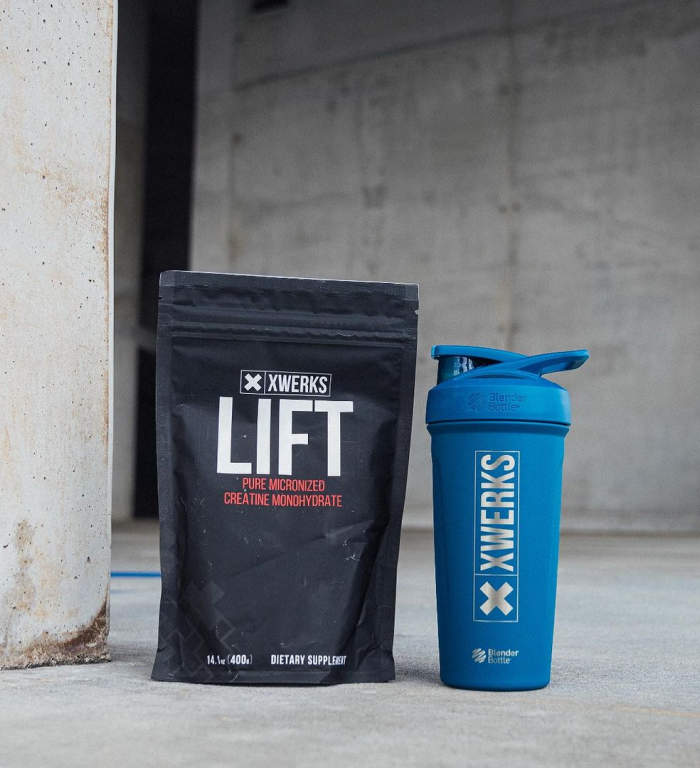
Micronized creatine is unflavored, which is intentional — it lets you add it to literally anything without changing the taste. Water, coffee, juice, a protein shake, a pre-workout drink, or a smoothie all work. XWERKS Lift is designed to be stackable: mix it with Grow for a post-workout protein + creatine shake, or add it to Ignite before training.
Stay Hydrated
Creatine is hydrophilic — it pulls water into muscle tissue. This is part of its mechanism of action (cell volumization supports muscle protein synthesis), but it also means you need to stay adequately hydrated. Aim for at least half your body weight in ounces of water per day, and more on training days. Dehydration while taking creatine can exacerbate any minor GI discomfort.
Beyond Muscle: Emerging Benefits
The most exciting creatine research isn't about bigger biceps — it's about the brain, aging, and long-term health. Recent studies and reviews have highlighted several areas where creatine supplementation shows promise:
Cognitive function: The brain is a major consumer of ATP, and creatine supplementation has been shown to improve cognitive performance under conditions of sleep deprivation, stress, and aging. A systematic review (Avgerinos et al., 2018) found evidence that creatine may offer cognitive benefits for older adults in particular.
Healthy aging: Creatine supplementation combined with resistance training has been shown to improve muscle mass, bone mineral density, and functional performance in older adults — directly addressing the sarcopenia (age-related muscle loss) that is one of the largest contributors to loss of independence in aging.
Vegetarians and vegans: Because dietary creatine comes almost exclusively from meat and fish, individuals following plant-based diets typically have lower baseline muscle creatine stores. Supplementation may produce even greater relative benefits in this population.
These applications have pushed creatine far beyond its original niche as a bodybuilding supplement. It's increasingly recommended by physicians, dietitians, and longevity researchers as a daily supplement for anyone — not just athletes.
What to Look for in a Creatine Product
Pure micronized creatine monohydrate. One ingredient. No blends, no added carbs, no proprietary matrices, no unnecessary additives. If the label lists more than creatine monohydrate, you're paying for ingredients you don't need.
5g per serving. This is the clinically studied dose. Products with 2-3g per serving are underdosed — you'd need to double-scoop, which means the product actually costs more per effective dose.
Unflavored. Flavored creatine means added sweeteners, colorings, and flavor chemicals. Since you're going to mix it with something else anyway, unflavored is cleaner and more versatile.
Transparent label. You should see exactly one ingredient: micronized creatine monohydrate. XWERKS Lift contains nothing else — 5g per scoop, 80 scoops per bag, zero filler.
The Bottom Line
Micronized creatine is creatine monohydrate with smaller particles. The molecule is identical, the benefits are identical, and the decades of research supporting it are identical. What micronization adds is practical: better solubility, cleaner mixing, gentler digestion, and no gritty residue.
No alternative form of creatine — HCL, buffered, ethyl ester, or otherwise — has been shown to outperform monohydrate in controlled research. The ISSN is unequivocal: creatine monohydrate is the most effective ergogenic supplement available. Period.
Take 5g per day, every day, mixed into whatever you're already drinking. Be consistent. Stay hydrated. That's the entire protocol — and it works.
One Ingredient. 5 Grams. 80 Servings.
XWERKS Lift — pure micronized creatine monohydrate. Unflavored, stackable with any drink, and nothing else in the bag.
SHOP LIFT →Further Reading
Understanding Creatine: Common Questions and Answers
How Much Creatine Should I Take?
Creatine Timing: Before or After Workouts?
References
1. Kreider RB, et al. International Society of Sports Nutrition position stand: safety and efficacy of creatine supplementation in exercise, sport, and medicine. JISSN. 2017;14:18.
2. Antonio J, et al. Common questions and misconceptions about creatine supplementation: what does the scientific evidence really show? JISSN. 2021;18:13.
3. Jagim AR, et al. Analysis of the efficacy, safety, and cost of alternative forms of creatine available for purchase on Amazon.com. JISSN. 2022;19(1):63.
4. Avgerinos KI, et al. Effects of creatine supplementation on cognitive function of healthy individuals: a systematic review. Exp Gerontol. 2018;108:166-173.
5. Spillane M, et al. The effects of creatine ethyl ester supplementation combined with heavy resistance training on body composition, muscle performance, and serum and muscle creatine levels. JISSN. 2009;6:6.
6. Jagim AR, et al. A buffered form of creatine does not promote greater changes in muscle creatine content, body composition, or training adaptations than creatine monohydrate. JISSN. 2012;9:43.
7. Aggarwal P, Agarwal R. Comparative efficacy and pharmacokinetic parameters of micronized creatine monohydrate in active men. Cureus. 2026;18(2):e103091.