TL;DR
- Creatine is one of the most-researched and most-effective supplements available — but its benefits for golf are indirect. It doesn't directly help putting touch, short game, or course management. It supports the off-course training that builds rotational power, grip strength, and overall swing capacity.
- Where creatine genuinely helps golfers: off-course strength training (more reps, more volume, faster recovery between sets), age-related muscle preservation (sarcopenia in golfers over 50), modest cognitive support during fatigue, recovery between training sessions or back-to-back rounds.
- Standard protocol: 3-5g daily creatine monohydrate, every day, with or without loading. Loading (20g daily for 5-7 days) saturates muscles faster but isn't necessary. Take any time of day; consistency matters more than timing.
- Older golfers (50+) get particular benefit: creatine is one of the best research-backed interventions for muscle preservation and strength maintenance in aging adults, with some research supporting cognitive benefits as well.
- Skip: "golf-specific" creatine products, exotic forms (HCL, ethyl ester, nitrate) at premium prices, claims that creatine improves on-course performance directly, loading panic if you forgot a few days.
"Creatine for golf" is a search where honest framing matters because creatine is genuinely one of the most-effective supplements in sports nutrition — but its benefits for golf are largely indirect. The straightforward answer: creatine doesn't directly improve your putting touch, short game, course management, or the precision components of golf. What it does is support the off-course strength training that builds the physical capacity for better golf — rotational power, grip strength, club head speed, core stability, and the overall musculature that drives the swing. The ISSN position stand on creatine supplementation and exercise documents extensive research support for performance, muscle, and recovery effects across diverse athletic populations. Combined with age-related muscle preservation benefits (particularly relevant for golfers over 50), modest cognitive benefits during fatigue, and recovery support, creatine becomes a foundational supplement for golfers serious about playing well across decades. The protocol is simple (3-5g daily, every day, any form of monohydrate works) and the cost-benefit ratio is excellent (roughly $0.10-$0.20 per dose). The marketing complexity around creatine — "golf-specific" formulations, exotic forms, loading protocols — obscures what's actually a simple, well-established supplement. This guide covers what creatine actually does for golfers, where benefits are real vs marketing-driven, the simple protocol, age-specific considerations, and what to skip in creatine marketing aimed at golf.
What creatine actually does
Creatine is a naturally-occurring compound found in muscle tissue. It plays a role in the ATP-PCr energy system — the very rapid energy production used for short, high-intensity efforts (lasting roughly 5-15 seconds):
1. Phosphocreatine restoration: During brief explosive efforts (a heavy lift, a sprint, an explosive movement), muscle uses ATP for fuel. ATP is regenerated in seconds via the ATP-PCr system. Creatine supplementation increases muscle phosphocreatine stores, providing more rapidly-available ATP regeneration capacity.
2. More work per session: The practical result of higher PCr stores: more reps at a given weight, more total volume per session, slightly faster between-set recovery. Across weeks and months, this compounds into more total training stimulus and better adaptations.
3. Cell hydration and signaling: Creatine pulls water into muscle cells (the well-known "creatine bloat" of 2-4 lbs water weight at saturation). This intracellular hydration supports protein synthesis signaling. Some research suggests creatine has direct effects on muscle protein synthesis beyond the training-stimulus mechanism.
4. Cognitive effects: Brain tissue contains creatine and uses it for energy similarly to muscle. Avgerinos et al.'s systematic review of creatine and cognition documents effects on memory, processing, and mental fatigue, particularly in stressed or aging populations — conditions relevant to long tournament rounds.
5. Muscle preservation in aging: Combined with resistance training, creatine produces robust muscle preservation effects in older adults. Forbes et al.'s meta-analysis of creatine and resistance training in older adults shows the combination outperforms training alone for muscle and strength gains after 50.
What creatine doesn't do:
• Doesn't directly improve fine motor control or precision (putting touch, chipping)
• Doesn't fix swing flaws or technical issues
• Doesn't dramatically increase endurance (the ATP-PCr system handles brief efforts; longer sustained efforts use other systems)
• Doesn't substitute for training — it amplifies training adaptation, doesn't replace it
• Doesn't selectively benefit specific muscle groups; it supports all skeletal muscle
Where creatine genuinely helps golfers
Off-course strength training
Primary benefit areaGolfers who train off-course (resistance training, rotational power work, mobility) get substantial creatine benefit. The training session quality improves — more reps at a given weight, more total work, better between-set recovery. Across weeks and months, this produces more strength and power gains than training without creatine.
The downstream effect on golf: better-developed rotational power, grip strength, club head speed, and core stability — all the physical attributes that drive swing performance. See our carbs vs protein for muscle building guide for the broader macronutrient framework supporting off-course training.
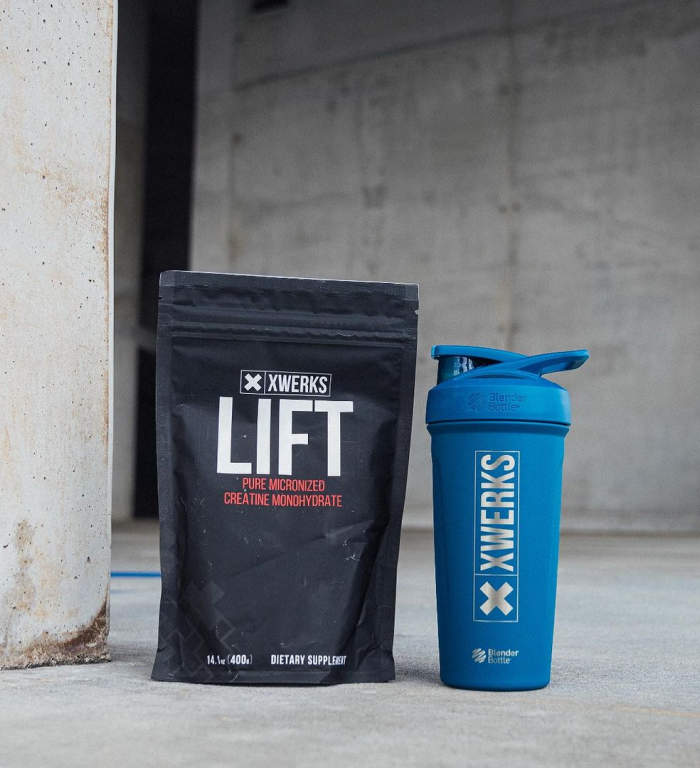
For golfers serious about training, creatine is one of the most impactful supplements available. XWERKS Lift provides 5g pure creatine monohydrate per serving — the standard daily dose at established research-supported levels.
Age-related muscle preservation
Critical after 50Adults lose 3-8% of muscle mass per decade after age 30, accelerating after 50. The EWGSOP2 consensus on sarcopenia identifies age-related muscle loss as a primary determinant of physical function decline. For golfers, this directly compromises swing speed, rotational power, walking endurance, recovery between rounds.
Creatine combined with resistance training is one of the best research-backed interventions for slowing sarcopenia. Multiple studies on older adults show creatine + resistance training produces meaningfully more muscle and strength preservation than training alone. The mechanism: same as in younger adults (more training stimulus, supported MPS) but particularly valuable in the aging context where muscle preservation is the central challenge.
For golfers over 50: creatine is among the highest-priority supplements. The cost-benefit ratio is excellent and the research support is strong. See our best creatine for easy digestion for older-adult-specific considerations and myostatin inhibitors for the broader research on muscle preservation interventions.
Cognitive benefits during fatigue
Modest but relevantSome research supports cognitive benefits of creatine supplementation, particularly under conditions of fatigue, sleep deprivation, or cognitive load. The mechanism: brain tissue uses creatine similarly to muscle; supplementation supports neural ATP regeneration. The Avgerinos systematic review documents modest cognitive benefits, particularly in stressed populations.
For golfers, this matters most in:
• Tournament play (multi-day fatigue)
• Long rounds in heat (cognitive load)
• Travel and time-zone changes (sleep deprivation effects)
• Older golfers (cognitive support generally)
The effect size is modest — creatine isn't a cognitive enhancer in the nootropic sense. But for golfers managing cumulative fatigue across tournament weeks, the combined muscle + modest cognitive support is meaningful. Combined with quality sleep practices (see our sleep hacking guide), creatine supports the cognitive consistency that matters for tournament performance.
Recovery between sessions and rounds
Modest recovery supportCreatine supports recovery between training sessions and (modestly) between rounds. The mechanism includes faster glycogen replenishment when combined with carbs, supported MPS, and reduced muscle damage markers in some research.
For golfers: this matters most during tournament weeks and golf trips with back-to-back rounds. Creatine is part of the broader recovery framework (protein, carbs, hydration, sleep), not a standalone recovery solution. See our best carbs after workout guide for the carb component of recovery.
The simple protocol
The creatine protocol is genuinely one of the simplest in supplement science. Antonio et al.'s common questions and misconceptions paper provides comprehensive answers to most practical creatine questions:
Standard daily protocol:
• 3-5g creatine monohydrate daily
• Take any time of day
• Take with or without food (doesn't matter much)
• Consistency matters more than precise timing
• Reaches muscle saturation in 3-4 weeks
• Maintain indefinitely (no cycling required)
Optional loading protocol:
• 20g daily for 5-7 days (split into 4 doses of 5g)
• Followed by 3-5g daily maintenance
• Reaches saturation in ~1 week instead of 3-4 weeks
• Some users experience GI distress at loading doses; reduce if needed
• Optional — not necessary for the long-term outcomes
Form selection:
• Creatine monohydrate: Standard, most-researched, most cost-effective. The default choice for everyone.
• Micronized creatine monohydrate: Same compound, finer particle size. May reduce GI distress in sensitive users. Modestly more expensive.
• Creatine HCL, ethyl ester, nitrate, etc.: Marketed as "better absorption" forms. Research support for superiority over monohydrate is weak. Substantially more expensive without proportional benefit.
• Creatine gummies: Convenient form. XWERKS Build provides 1g creatine per gummy in a convenient format. 3-5 gummies daily for therapeutic dose.
What about cycling on/off?
Not necessary. Older recommendations to cycle creatine were based on weak reasoning; current research supports continuous daily use indefinitely. Your body doesn't "adapt" or "down-regulate" in ways that require cycling.
What if you forget for a few days?
Not a problem. Muscle creatine stores deplete slowly (weeks). Missing a day or two doesn't meaningfully reduce levels. Just resume regular intake.
Hydration considerations
The water weight reality
Real but not problematicCreatine pulls water into muscle cells, producing 2-4 lbs of intracellular water weight at saturation. This isn't "bloat" in any negative sense — it's hydrated muscle tissue, which is metabolically active and supports performance. The weight gain is normal and expected.
For golfers concerned about scale weight: the 2-4 lbs is muscle-water, not fat. Body composition (and physical appearance) typically improves modestly with creatine due to enhanced training capacity. Don't be alarmed by the initial scale increase; it reflects healthy muscle hydration.
Total hydration matters
Drink water, especially in heatCreatine's intracellular water demand makes overall hydration somewhat more important. For golfers in hot climates (Florida summer, Arizona, Texas) or playing long rounds in heat: maintain aggressive hydration practices regardless of creatine status. Creatine doesn't "cause" cramping or dehydration in adequately hydrated users, but it underlines the importance of consistent water intake.
Older golfer specifics
Multiple research lines support creatine as one of the most-impactful interventions for older adult golfers:
1. Sarcopenia is the central challenge. Age-related muscle loss directly compromises golf performance — rotational power, swing speed, grip strength, walking endurance. The Forbes et al. meta-analysis shows creatine + resistance training produces meaningfully better muscle preservation than training alone in older adults.
2. Anabolic resistance is overcome partially. Older adults have reduced muscle protein synthesis response to a given protein dose. Creatine's MPS-supporting effects help compensate, working synergistically with adequate protein intake.
3. Cognitive support matters. Some research supports cognitive benefits of creatine in older adults beyond what younger adults experience. The combined muscle + cognitive support is particularly valuable.
4. Bone density support. Limited research suggests creatine combined with resistance training may support bone density better than training alone. Relevant for older adults concerned about bone health and fall risk.
5. Recovery improves. Older adults recover slower from training and physical activity. Creatine modestly improves recovery, supporting consistency in training.
6. Cost-benefit is excellent. Roughly $10-25/month for quality creatine. Cost-benefit ratio is excellent compared to many other supplements marketed to older adults.
Practical recommendation for older golfers:
• Start with daily 3-5g creatine monohydrate (no loading needed)
• Combine with adequate protein (1.8-2.0g/kg daily)
• Combine with resistance training 2-3x weekly
• Maintain consistently for 6+ months to see full benefits
• Among the most-impactful supplements available for this age group
For broader hormonal context affecting older men's training capacity, see how to increase testosterone and the ultimate guide to naturally raising testosterone.
What to skip in creatine marketing
• "Golf-specific" creatine products: Same compound (creatine monohydrate) marketed at premium prices. The "golf" branding rarely reflects formulation differences.
• Exotic creatine forms (HCL, ethyl ester, nitrate, tri-creatine malate): Marketed as "better absorption" with weak research support. Substantially more expensive without proportional benefit. Monohydrate is the standard for good reasons.
• "Buffered creatine" (Kre-Alkalyn): Marketed as solving "acid breakdown" problems that don't actually exist. Research doesn't support superiority over monohydrate.
• "Creatine + nitric oxide" combo products at premium prices: The combination doesn't produce meaningfully better outcomes than separate products.
• Creatine "complexes" with proprietary blends: Often modest creatine doses combined with cheaper fillers and unsupported "performance enhancers." Read labels; verify creatine content.
• Loading panic if you forgot a few days: Missing days doesn't require restarting loading. Muscle creatine stores deplete slowly. Just resume daily intake.
• Cycling on/off creatine: Not necessary. Continuous daily intake is the established protocol. The body doesn't down-regulate in ways requiring cycling.
• Creatine timing obsession: Pre-workout, post-workout, with juice for insulin spike, etc. — all roughly equivalent in long-term outcomes. Take it consistently; precise timing produces minimal additional benefit.
• "Direct on-course performance" claims: Creatine doesn't dramatically improve specific golf skills (putting, short game, course management). It supports physical capacity through training; the direct on-course effects are modest and indirect.
• Avoiding creatine due to kidney concerns (without kidney disease): The "creatine damages kidneys" framing applies to people with pre-existing kidney disease, not healthy adults. Multiple long-term studies show creatine is safe for healthy adults at standard doses.
Common questions about creatine for golf
"Will creatine improve my swing speed?"
Indirectly — through supporting the off-course training that builds rotational power and overall muscular capacity. Creatine itself doesn't directly increase swing speed; it supports the gym work that builds the physical foundation for faster swing speed.
"Should I take creatine on golf days?"
Yes — daily creatine works through chronic muscle saturation, not acute pre-event use. Take your normal daily dose on golf days. The 4-5 hour duration of a round and the precise nature of golf don't substantially benefit from acute creatine spike.
"Is creatine safe for older golfers?"
Yes for healthy adults. Multiple studies on older adults show creatine is safe and beneficial. People with kidney disease should consult their physician. Otherwise, creatine is one of the most-researched and safest supplements available for older adults.
"Will creatine make me bloated?"
Creatine produces 2-4 lbs of intracellular water weight (not subcutaneous bloat). This isn't visible bloat — it's hydrated muscle tissue. Some users experience modest GI distress during loading; reducing dose or switching to micronized monohydrate typically resolves this.
"Should I cycle off creatine periodically?"
No. Continuous daily intake is the established protocol with no documented downside. The body doesn't develop tolerance or down-regulate in ways requiring cycling. Just take it daily indefinitely.
"Do I need to load creatine?"
No — loading is optional. Loading reaches muscle saturation in ~1 week vs ~3-4 weeks with daily 3-5g. The long-term outcomes are equivalent. Loading produces faster initial benefits but isn't necessary. Most people skip loading and just start daily 3-5g.
"What's the difference between creatine monohydrate and HCL?"
Monohydrate is the standard form with strongest research support and lowest cost. HCL is marketed as "better absorption" but research support for superiority is weak. Monohydrate produces equivalent long-term outcomes at substantially lower cost.
"Are creatine gummies as effective as powder?"
If they provide adequate creatine dose: yes. XWERKS Build provides 1g per gummy; 3-5 gummies daily delivers the standard therapeutic dose. The form (powder vs. gummy) matters less than reaching daily target.
The Bottom Line
Creatine is one of the most-researched and most-effective supplements available — but its benefits for golf are largely indirect. It doesn't directly improve putting touch, short game, or course management. It supports the off-course training that builds rotational power, grip strength, and overall swing capacity.
Where creatine genuinely helps golfers: off-course strength training (more reps, more volume, faster recovery), age-related muscle preservation (sarcopenia in golfers over 50), modest cognitive support during fatigue, recovery between training sessions and back-to-back rounds.
The simple protocol: 3-5g creatine monohydrate daily, every day, any time of day. Loading optional (20g daily for 5-7 days reaches saturation faster but isn't necessary). Maintain indefinitely; no cycling required.
Form selection: creatine monohydrate is the standard — most-researched, most cost-effective. Exotic forms (HCL, ethyl ester, nitrate) don't produce meaningfully better results despite premium pricing. Gummies work if dose is adequate.
Older golfers (50+): creatine is among the highest-priority supplements. Combined with resistance training and adequate protein, supports muscle preservation that maintains golf performance across decades. Cost-benefit ratio is excellent.
Hydration: creatine produces 2-4 lbs muscle water weight (not subcutaneous bloat). Maintain aggressive hydration practices, especially in hot climates. Creatine doesn't cause cramping in adequately hydrated users.
Skip: "golf-specific" creatine products at premium prices, exotic forms (HCL, ethyl ester, nitrate) without research support, creatine "complexes" with proprietary blends, cycling on/off, timing obsession, claims that creatine directly improves specific golf skills.
The honest framing: creatine isn't a golf-specific supplement; it's a foundational training-supporting supplement that golfers benefit from like any other active adult — with particular value for older golfers preserving the physical capacity that drives swing performance. Boring, simple, effective.
Dig deeper: supplements for golfers · protein for golfers · pre-workout for golf · best creatine for easy digestion · myostatin inhibitors · best carbs after workout · carbs vs protein for muscle building · naturally raise testosterone · hack your sleep
Foundational Creatine Support
For golfers serious about off-course training and long-term performance: XWERKS Lift provides 5g pure creatine monohydrate per serving — standard research-supported dose, no fillers, no proprietary blends. Take daily for muscle saturation that supports gym work, swing capacity, and (especially for golfers over 50) age-related muscle preservation. Or try XWERKS Build creatine gummies for convenient travel-friendly format.
Shop Lift