Protein Powder Myths Debunked: What the Research Actually Shows
Protein powder has been mainstream for decades and the misinformation around it has been building just as long. Some myths scare people away from using it. Others convince people to use it incorrectly. Here are the most persistent ones, corrected with actual research.
Myth 1: "Protein powder will damage your kidneys"
This is the most persistent protein myth in existence and it is not supported by the evidence in healthy individuals. The concern traces back to an observation that people with existing kidney disease are often placed on protein-restricted diets to slow disease progression. This medical recommendation for sick kidneys was extrapolated — incorrectly — into a claim that high protein intake damages healthy kidneys.
A 2018 meta-analysis by Devries et al. published in the Journal of Nutrition examined the totality of evidence on protein intake and renal function in healthy adults and concluded that higher protein intake does not adversely affect kidney function. The ISSN's 2017 position stand on protein and exercise states clearly: "There is no evidence that a high protein intake per se has adverse effects on kidney function in healthy, exercising individuals." A 2016 study by Antonio et al. followed resistance-trained men consuming 2.5-3.3 g/kg/day of protein (more than double the RDA) for one year and found no adverse changes in blood lipids, liver function, or kidney function markers.
Does protein powder specifically cause kidney damage? No. Protein powder is protein. Your kidneys don't know whether the amino acids came from a chicken breast or a scoop of whey isolate. The processing is different. The amino acid profile reaching your bloodstream is functionally the same.
Myth 2: "You need to drink your protein within 30 minutes after training or it's wasted"
The "anabolic window" was fitness gospel for years — the idea that muscle protein synthesis (MPS) could only be maximized by consuming protein within a narrow 30-60 minute window post-exercise. Miss the window, and your training was supposedly compromised.
A landmark 2013 meta-analysis by Schoenfeld et al. examined the evidence for protein timing and concluded that the total daily protein intake is far more important than the precise timing of consumption. While there's a modest benefit to having protein somewhere in the 2-3 hour window around your training session, the urgency of the "30-minute window" has been significantly overstated. The anabolic response to resistance training is elevated for at least 24 hours post-exercise — not 30 minutes.
In practical terms: if your last meal was 2-3 hours before training, having a protein shake within an hour after is reasonable. If you ate a high-protein meal 60-90 minutes before your session, your post-workout shake can wait until you get home or until your next meal. The key is hitting 1.6-2.2 g/kg of protein across the entire day, distributed across 3-5 meals/snacks. Obsessing about a 30-minute cutoff is unnecessary stress.
Myth 3: "Protein powder will make women bulky"
This one persists despite being physiologically impossible for most women. Building significant visible muscle mass requires years of consistent progressive overload, a caloric surplus, adequate testosterone, and favorable genetics. Women produce approximately 15-20 times less testosterone than men — the primary anabolic hormone driving muscle hypertrophy.
Protein powder doesn't change your hormonal profile. It provides amino acids — the building blocks your muscles need for repair and adaptation. Women who consume adequate protein while resistance training typically experience increased lean mass (muscle tone and definition) and reduced body fat percentage — the "toned" look that most people are actually pursuing. That's body recomposition, and it's the opposite of getting bulky.
The female bodybuilders who do develop significant muscle size do so through years of dedicated training, precise nutrition, and often pharmacological assistance. A scoop of whey protein after your workout will not produce that outcome. Not even close.
Myth 4: "You can only absorb 20-30 grams of protein per meal"
This myth comes from a misunderstanding of muscle protein synthesis research. Studies have shown that MPS peaks at around 20-40g of protein per meal (depending on the source and individual body size), and that consuming more doesn't further increase the MPS response. This led to the widespread claim that "your body can't absorb more than 30g at once."
But absorption and MPS stimulation are two different things. Your body absorbs virtually all the protein you eat — it just doesn't all go to muscle building. The amino acids beyond the MPS saturation point are used for other essential functions: enzyme production, immune cell synthesis, hormone production, neurotransmitter creation, and energy. They're not "wasted." They're used for things your body needs.
A 2023 study by Trommelen et al. published in Cell Reports Medicine demonstrated that consuming 100g of protein in a single meal resulted in continued amino acid utilization over a prolonged period — the body didn't stop absorbing or using the protein after 30g. It just shifted the utilization pathway beyond acute muscle protein synthesis.
For practical purposes, distributing protein across 3-5 meals (20-40g per meal) is slightly more effective for maximizing MPS specifically, but eating a larger protein serving in a single meal is not wasteful. Your body handles it fine.
Myth 5: "Protein powder is full of chemicals and is 'processed food'"
All food is processed to some degree. Olive oil is processed (pressing and filtering). Flour is processed (milling). Cheese is processed (culturing and aging). The word "processed" has been weaponized into a vague scare term that obscures the actual question: what's in the product and how was it made?
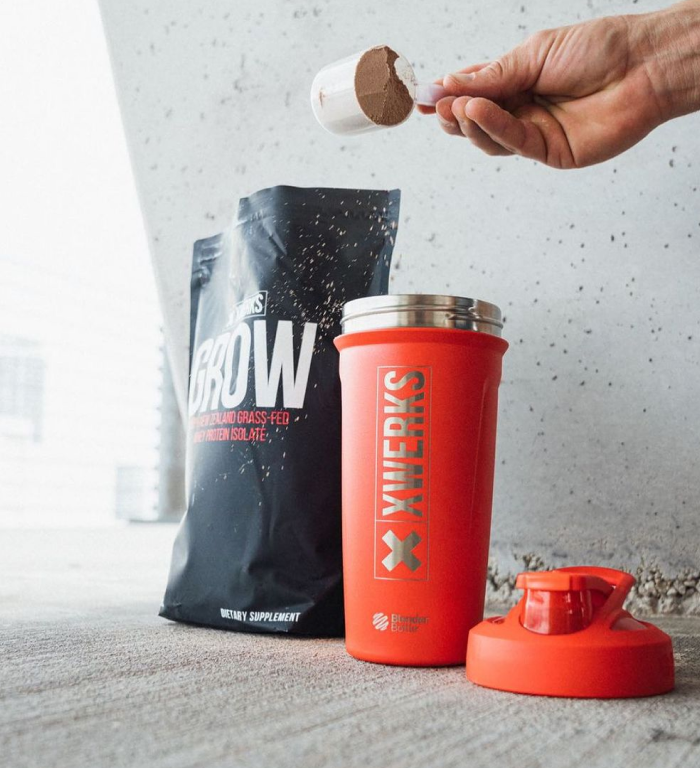
A quality whey protein isolate is produced by filtering whey (a natural byproduct of cheese production) to remove lactose, fat, and carbohydrates while retaining the protein. Cold micro-filtration — the method used for XWERKS Grow — uses physical ceramic membrane filters at low temperatures. No chemical reagents, no acid treatment, no bleaching.
The result is a powder that is: whey protein isolate (from grass-fed NZ cows), natural flavoring, stevia (a plant-based sweetener), and sunflower lecithin (a natural emulsifier for mixability). Four ingredients. That's fewer ingredients than most yogurts, bread, or salad dressings.
Not all protein powders are this clean. Many budget products contain artificial sweeteners (sucralose, acesulfame K), thickening gums (xanthan, guar, carrageenan), maltodextrin filler, artificial colors, and soy lecithin. Reading the label matters. But the category of "protein powder" isn't inherently problematic — the formulation of the specific product you choose determines the answer.
Myth 6: "Protein powder causes bloating and digestive problems"
This one is technically true — but only for certain forms of protein powder. The distinction is important.
Whey protein concentrate contains 3-5 grams of lactose per serving. For the approximately 65% of adults who have some degree of lactose malabsorption, this is enough to cause bloating, gas, and cramping. Add in the artificial sweeteners, gums, and fillers common in cheap protein powders, and you've stacked multiple GI irritants into one shake.
The fix isn't avoiding protein powder — it's choosing the right form. Whey protein isolate contains less than 0.5g of lactose per serving — well below the symptom threshold for most lactose-sensitive adults. A clean formulation without artificial sweeteners, gums, or fillers eliminates the other common triggers.
Myth 7: "You should only use protein powder if you're trying to build muscle"
Protein does far more than build muscle. It's required for enzyme production, hormone synthesis, immune function, tissue repair, neurotransmitter production, and virtually every metabolic process in the body. Adequate protein intake is associated with improved satiety (feeling full and staying full, which helps with weight management), better bone density in older adults, faster recovery from injury and illness, and improved body composition even without resistance training.
Protein powder is a convenient way to increase protein intake. It's useful for athletes building muscle, people losing weight (protein preserves muscle during a caloric deficit and increases satiety), older adults fighting age-related muscle loss (sarcopenia), people recovering from surgery or illness, busy professionals who struggle to prepare protein-rich meals, and anyone whose diet falls short of the 1.2-1.6 g/kg/day minimum recommended for active adults.
Myth 8: "All protein powders are basically the same"
This is like saying all cars are the same because they all have four wheels. The differences between protein products are significant and affect digestibility, nutritional value, taste, and health impact.
Concentrate vs. isolate: Concentrate is 70-80% protein with 3-5g lactose. Isolate is 90-95% protein with less than 0.5g lactose. Different products for different needs.
Processing method: Cold micro-filtration preserves bioactive protein fractions (immunoglobulins, lactoferrin, GMP). Ion exchange uses chemical reagents that destroy them. Hydrolysis breaks them down further.
Sourcing: Grass-fed whey from countries with strict dairy regulations (New Zealand, Ireland) vs. conventional grain-fed operations using hormones and antibiotics. The raw material quality directly affects the final product.
Additives: Some products have 4 ingredients. Others have 20+ including artificial sweeteners, thickeners, fillers, and "proprietary blends" that hide the actual amounts of each ingredient. The label tells you everything — if you read it.
The Bottom Line
Protein powder is one of the most studied, safest, and most effective nutritional supplements available. It doesn't damage your kidneys, doesn't make women bulky, doesn't require obsessive timing, and isn't "full of chemicals" when you choose a quality product with a clean label.
Most of the myths exist because people treat "protein powder" as a single monolithic category, when in reality the differences between a cold-processed grass-fed whey isolate with 4 ingredients and a budget concentrate loaded with artificial sweeteners and proprietary blends are enormous.
Choose a quality isolate. Hit your daily protein target. Train consistently. That's the formula — no myths required.
Four Ingredients. Zero Myths.
XWERKS Grow — 100% New Zealand grass-fed whey protein isolate. Cold micro-filtered. Naturally sweetened. 25g protein per scoop. The cleanest protein available.
SHOP GROW →Further Reading
Whey Protein for Sensitive Stomachs — Why isolate solves digestive issues and what to look for on the label.
Whey Protein for Weight Loss — How protein supports fat loss, appetite control, and muscle preservation.
Whey Isolate vs. Hydrolyzed — Why "pre-digested" protein isn't worth the premium for healthy adults.
What Is Clear Protein Powder? — How acidified whey compares to traditional isolate.
The Problem with Proprietary Blends — Why every dose should be on the label.
The Ultimate Whey Protein Guide — Everything about whey protein in one resource.
References
1. Devries MC, et al. Changes in kidney function do not differ between healthy adults consuming higher- compared with lower- or normal-protein diets. J Nutr. 2018;148(11):1760-1775.
2. Jäger R, et al. International Society of Sports Nutrition position stand: protein and exercise. JISSN. 2017;14:20.
3. Antonio J, et al. A high protein diet has no harmful effects: a one-year crossover study in resistance-trained males. J Nutr Metab. 2016;2016:9104792.
4. Schoenfeld BJ, et al. The effect of protein timing on muscle strength and hypertrophy: a meta-analysis. JISSN. 2013;10:53.
5. Morton RW, et al. A systematic review, meta-analysis and meta-regression of the effect of protein supplementation on resistance training-induced gains. Br J Sports Med. 2018;52:376-384.
6. Trommelen J, et al. The anabolic response to protein ingestion during recovery from exercise has no upper limit in magnitude and duration in vivo in humans. Cell Rep Med. 2023;4(12):101324.
7. Hoffman JR, Falvo MJ. Protein — which is best? J Sports Sci Med. 2004;3(3):118-130.