

Does Creatine Make You Bloated? What the Science Actually Says
TL;DR
- Creatine causes a small amount of water retention inside your muscle cells — not the subcutaneous, puffy "bloat" most people picture. It makes muscles look fuller, not softer.
- The visible bloating people complain about almost always comes from a high-dose loading phase (20g/day), which can cause temporary GI discomfort and water-weight gain of 1–3 lbs in the first week.
- The fix is simple: skip loading and take 3–5g per day. You'll reach full muscle saturation in ~3–4 weeks with little to no bloating.
- Micronized creatine monohydrate dissolves better and is gentler on the stomach than cheap, gritty creatine — reducing the GI side effects that get mislabeled as "bloat."
- Bottom line: creatine doesn't make you fat or puffy. Any water it adds is intramuscular, performance-enhancing, and easily managed with a low daily dose.
"Does creatine make you bloated?" is one of the most common reasons people hesitate to start the most-researched, most-effective supplement in sports nutrition. The fear is understandable — but it's mostly based on a misunderstanding of where creatine actually puts water, combined with the outdated advice to "load" with 20 grams a day. Here's what creatine really does to water balance, why the bloat reputation is overblown, and exactly how to take it so you get all the performance benefits with little or no bloating.

What "bloating" actually means — and where creatine puts water
When people say "bloated," they usually mean one of two different things: a soft, puffy look from water sitting under the skin (subcutaneous), or an uncomfortable, distended stomach from GI water and gas. Understanding the difference matters, because creatine's main effect is neither of those.
Creatine draws water into your muscle cells (intracellular water). This is the entire point — it's part of how creatine works. More water and creatine inside the muscle supports the ATP-PCr energy system that powers short, explosive efforts, and it makes muscles look fuller and more defined, not softer. Intramuscular water is a feature, not a side effect.
So why do some people genuinely feel bloated?
Real, visible bloating and stomach discomfort do happen for some people — but the cause is almost always one of two things, both easily avoided.
1. The loading phase (the main culprit)
Old-school creatine advice says to "load" with 20g per day (split into 4 doses) for the first week to saturate muscles quickly. That large dose is what causes most reported bloating: rapid water-weight gain plus GI discomfort from a lot of creatine hitting your gut at once. The loading phase works — but it's optional, and it's the source of the bloat reputation.
2. Low-quality, non-micronized creatine
Cheap creatine with large, gritty particles dissolves poorly and can sit in the stomach, causing GI distress that feels like bloating. Micronized creatine — ground into much finer particles — dissolves cleanly and is markedly gentler on the stomach. The form matters more than people expect.
How to take creatine without bloating
Skip the loading phase
Take a steady 3–5g per day from the start. You'll reach the same full muscle saturation as a loading protocol — it just takes about 3–4 weeks instead of one. Research confirms the end result is identical; loading only changes how fast you get there. For the vast majority of people, the slightly slower ramp is well worth avoiding the water-weight spike and GI discomfort.
Choose micronized monohydrate
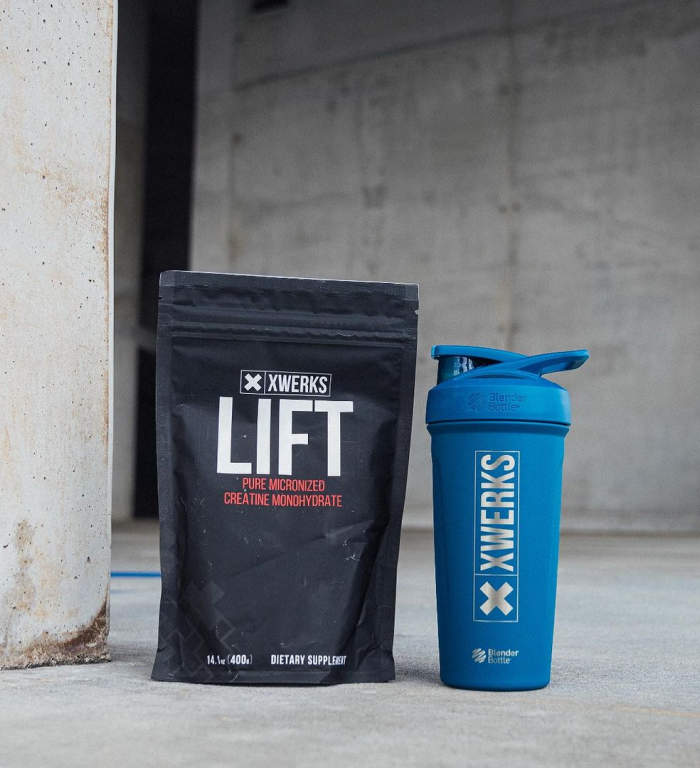
Creatine monohydrate is the most-researched, most-effective, and best-value form — you don't need exotic "buffered" or "HCl" versions that charge a premium for no proven advantage. Just choose a micronized monohydrate so it mixes cleanly and sits easier in the stomach. XWERKS Lift is 5g of micronized monohydrate per scoop, dosed exactly for the no-load approach.
Take it with enough water
Dissolve creatine fully in 8–10 oz of water (or your shake) and drink it down. Taking it dry, or in too little liquid, increases the odds of stomach discomfort. Staying well-hydrated overall also helps your body distribute the intracellular water creatine pulls in.
Be consistent, not perfectly timed
Creatine works by saturating your muscles over time — so the daily habit matters far more than the exact time of day. Pick a time you'll remember (with a meal or your post-workout shake) and stick to it. There's no "bloat-optimal" timing; consistency is the whole game.
Will the water weight go away?
The small amount of intramuscular water creatine adds stays as long as you keep taking it — because it's part of how the supplement works. It's not progressive; you don't keep gaining water indefinitely. You reach a new saturated baseline (typically 1–3 lbs over a few weeks) and stay there. If you stop taking creatine, that water gradually leaves over a few weeks. For nearly everyone, the strength, power, and muscle-fullness benefits vastly outweigh a couple pounds of performance-enhancing muscle water.
The Bottom Line
Creatine doesn't make you fat or puffy. Its main water effect is intracellular — water drawn into muscle cells, which makes muscles look fuller and powers performance. That's a benefit, not bloat.
The visible bloating people complain about comes from the 20g/day loading phase and from cheap, non-micronized creatine sitting in the stomach. Both are easily avoided.
The low-bloat protocol: skip loading, take 3–5g of micronized monohydrate daily with plenty of water, and be consistent. You'll hit full saturation in 3–4 weeks with little to no bloating — and get every performance benefit creatine offers.
Further Reading
References
1. Kreider RB, et al. International Society of Sports Nutrition position stand: safety and efficacy of creatine supplementation in exercise, sport, and medicine. J Int Soc Sports Nutr. 2017;14:18.
2. Hultman E, et al. Muscle creatine loading in men. J Appl Physiol. 1996;81(1):232-237.
3. Powers ME, et al. Creatine supplementation increases total body water without altering fluid distribution. J Athl Train. 2003;38(1):44-50.
4. Antonio J, et al. Common questions and misconceptions about creatine supplementation. J Int Soc Sports Nutr. 2021;18:13.