TL;DR
- Hyrox prep workouts should replicate the race's specific demand: alternating 1km running with functional strength stations under accumulating fatigue. Generic CrossFit WODs and pure running plans both miss the point.
- The four workout types every Hyrox athlete needs: compromised running (running under residual fatigue), station simulators (single-station capacity work), mini-Hyrox sessions (3-4 station race rehearsals), and full race simulations (every 2-3 weeks in race prep).
- Specific weak-station builders matter: sled push and pull capacity is built differently than wall ball capacity, which is built differently than burpee broad jump capacity. Train your worst stations more than your best.
- Programming framework: 2 running-focused sessions, 2 strength sessions, 1-2 hybrid Hyrox-specific sessions per week. Reduce as race approaches; full simulations replace volume in final 4 weeks.
- Skip: pure CrossFit metcons (rep schemes don't match Hyrox), only running (you'll bonk on stations), maximum-effort workouts every session (recovery is a limiter), trying to PR every workout in race prep block.
Hyrox training fails when athletes treat the event like a CrossFit competition or a road race. It's neither. The race demands a hybrid capacity that requires hybrid prep — specifically, workouts that replicate the unique compounding fatigue of running 1km, then doing a station, then running 1km again, eight times. Most CrossFit WODs are too short and too rep-heavy. Most running plans don't address what happens to your pace after sled-pushing for 50 meters. The workouts that actually prepare you for Hyrox are the ones that train compromised running (running with residual fatigue from heavy work), single-station capacity (the ability to maintain output on a specific station to completion), mini-race rehearsals (3-4 station blocks at race pace), and full race simulations (the only way to test pacing and nutrition in advance). This guide breaks down the four workout types every Hyrox athlete needs, station-specific capacity builders, sample weekly programming, sample workouts you can run tomorrow, and the common mistakes that wreck race-day performance. The supplement and recovery framework is covered separately in the Supplement Guide for Hyrox Athletes; this post focuses entirely on the training side.
Why generic workouts fail for Hyrox
Hyrox punishes athletes whose training doesn't match the event's specific demands. The three most common training mismatches:
1. Pure CrossFit programming. CrossFit metcons typically run 8-20 minutes at maximum intensity with diverse modalities. Hyrox is a 60-120 minute paced effort with eight specific stations. CrossFit conditioning builds anaerobic capacity but doesn't build the steady-state aerobic capacity Hyrox demands, and the rep schemes don't match. Strong CrossFitters often blow up around station 5 because they paced like a 12-minute AMRAP.
2. Pure running plans. Marathon and half-marathon training builds aerobic engine but doesn't prepare you for sled push at minute 25 or wall balls at minute 50. Pure runners typically struggle on stations 2 (sled push), 3 (sled pull), and 8 (wall balls) because they lack the muscular strength-endurance these stations demand.
3. Random WODs and bodybuilding splits. No specific aerobic capacity, no station practice, no pacing experience. The athletes most surprised by Hyrox fatigue are usually the ones whose training had no structured progression toward race demands.
The fix: Hyrox-specific workouts that train compromised running, single-station capacity, mini-race rehearsals, and full race simulations. Generic fitness builds a base; Hyrox-specific work builds the race.
The four workout types every Hyrox athlete needs
Type 1: Compromised running
Running under residual fatigueThe single biggest skill in Hyrox is running well after just doing heavy work. Compromised running workouts pair a strength element with running so you practice exactly that.
Sample compromised running workout:
• 1km run at goal Hyrox pace
• 50m heavy sled push (~1.5× bodyweight)
• 1km run at goal Hyrox pace
• 50m heavy sled pull
• 1km run at goal Hyrox pace
• 50m farmer's carry (heavy)
• 1km run at goal Hyrox pace
The runs should feel sustainable in isolation but become progressively harder as accumulated leg fatigue compounds. Track your run splits — the gap between your fresh 1km pace and your 4th 1km pace tells you exactly where to focus training.
Type 2: Station simulators
Capacity for one specific stationEach Hyrox station has a specific time/rep target. Station simulators build the ability to complete a single station to its full prescribed work without breaks. You can't practice pacing in a race rehearsal if you can't even complete the station unbroken.
Sample station simulator (wall balls):
• 100 wall balls (men: 9kg / 20lb to 10ft target; women: 6kg / 14lb)
• Goal: complete unbroken under 4:30
• Then 200m run easy
• Repeat 3-5 rounds depending on capacity
Sample station simulator (rowing):
• 1000m row at goal race pace
• 200m walk recovery
• Repeat 4-6 times
• Goal: hold consistent split across all rounds
The point is repeatability — not max effort. You're training the capacity to repeat the station effort under fatigue, not testing one-shot output.
Type 3: Mini-Hyrox blocks
3-4 stations at race paceMini-Hyrox sessions train pacing, transitions, and cumulative fatigue without requiring a full 60-90 minute session. Pick 3-4 consecutive stations and run them at race pace.
Sample mini-Hyrox (stations 1-4):
• 1km run at goal race pace
• 1000m SkiErg at goal race pace
• 1km run
• 50m sled push at race weight
• 1km run
• 50m sled pull at race weight
• 1km run
• 80m burpee broad jumps
Sample mini-Hyrox (stations 5-8):
• 1km run at goal race pace
• 1000m row
• 1km run
• 200m farmer's carry (men: 24kg/hand; women: 16kg/hand)
• 1km run
• 100m sandbag lunges (men: 20kg; women: 10kg)
• 1km run
• 100 wall balls
Practice both halves separately before doing full simulations. The first half teaches early-race pacing discipline; the second half teaches finishing under accumulated fatigue.
Type 4: Full race simulations
Every 2-3 weeks in race prep blockThe only way to test full race pacing, nutrition, hydration, gear, and mental strategy is to run the full event in training. Full simulations should be 2-3 in your final 8-week race prep block; not weekly (too much recovery cost), not zero (you race blind).
Full race simulation:
• Complete the full Hyrox event sequence at goal race pace
• Use exact race-day nutrition, pre-workout, and hydration protocol
• Wear the gear and shoes you plan to race in
• Track each station time and run split
• Allow 5-7 days recovery before the next hard session
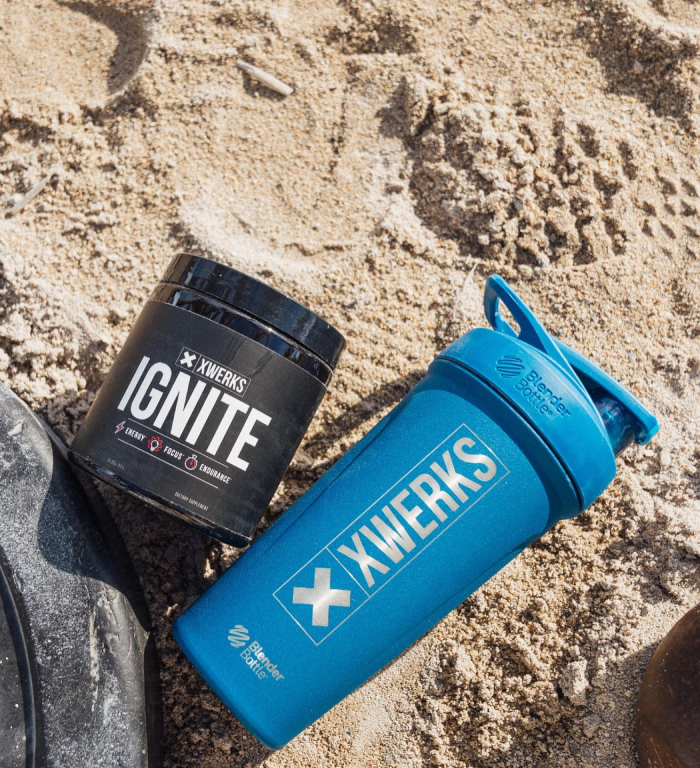
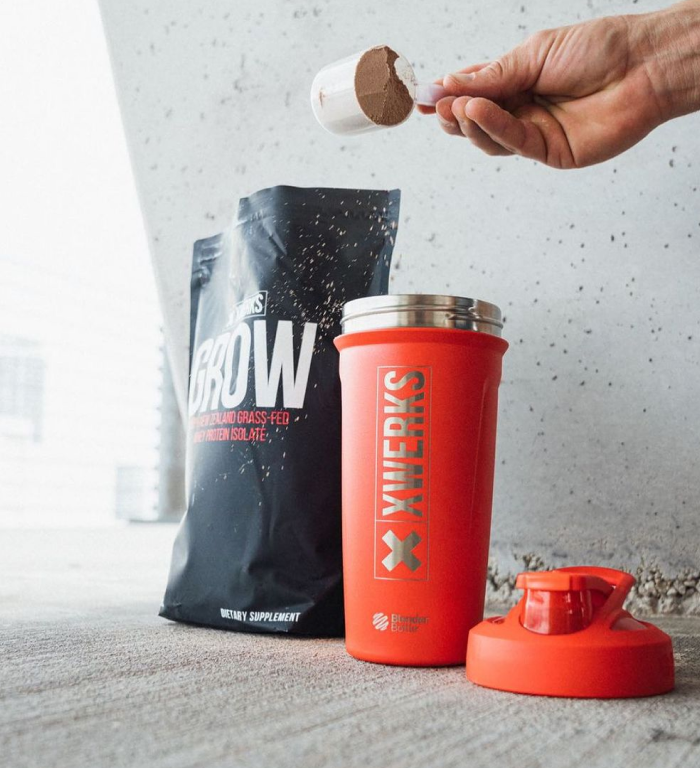
The first simulation establishes baseline. The second tests adjustments. The third (if used) confirms race-week protocol. Use Ignite 30 minutes before, sip Motion during transitions, and refuel with Grow within 60 minutes after — the same protocol you'll use on race day.
Station-by-station capacity workouts
SkiErg (1000m)
Aerobic-anaerobic mix, mostly upper bodyCapacity workout: 6 × 500m SkiErg at faster than race pace, 90 sec rest. Build to 4 × 1000m at race pace, 60 sec rest.
Common mistake: Pulling too hard with arms. The SkiErg uses legs and core for the pull-down. Conserve shoulder fatigue for later stations.
Sled push (50m)
Strength-endurance, leg driveCapacity workout: 6 × 25m sled push at race weight, walk-back rest. Build to 4 × 50m at race weight + 10kg, walk-back rest.
Common mistake: Standing too upright. Get your shoulders low, drive through the legs, push for distance per step rather than rapid choppy steps. Practice the start — the first 5 meters set the rest of the push.
Sled pull (50m)
Posterior chain, grip enduranceCapacity workout: 5 × 25m sled pull at race weight, hand-over-hand technique, 90 sec rest. Build to 4 × 50m at race weight, walk-back rest.
Common mistake: Pulling with arms. The pull is a hip-hinge and posterior chain movement. Stay low, pull with the back and hips, keep the rope tight.
Burpee broad jumps (80m)
Full body, anaerobic, often the breakerCapacity workout: 4 × 40m burpee broad jumps unbroken, 2 min rest. Build to 3 × 80m, 90 sec rest.
Common mistake: Jumping too aggressively early. The broad jump distance per rep matters less than maintaining a sustainable cadence. Find a rhythm — down, jump, down, jump — and protect it. Athletes who blast the first 30m often crawl the last 30m.
Rowing (1000m)
Aerobic-anaerobic, full bodyCapacity workout: 5 × 500m row at faster than race pace, 90 sec rest. Build to 4 × 1000m at race pace, 60 sec rest.
Common mistake: Bad pacing. The first 200m feels easy and tempts overpacing. Set your damper around 5-7, find your race split in the first 100m, and hold it. Final 200m can rise.
Farmer's carry (200m)
Grip, posture, oblique enduranceCapacity workout: 4 × 100m farmer's carry at race weight, walk-back rest. Build to 3 × 200m unbroken at race weight.
Common mistake: Choosing a carry rhythm too slow. Long strides, fast turnover, slight forward lean, eyes up. The grip is the limiter — train it specifically with heavier farmer's carries (60-80% of race weight overload) for shorter distances in capacity work.
Sandbag lunges (100m)
Quad endurance, balance under loadCapacity workout: 5 × 50m sandbag lunges at race weight, 60 sec rest. Build to 3 × 100m unbroken at race weight.
Common mistake: Stride too long. Take shorter, controlled steps so the back knee just brushes the ground without crashing. Sandbag position matters — high on the shoulders, not slipping forward to the chest. Practice pickup and shouldering separately.
Wall balls (75-100 reps)
Quad-shoulder endurance, the closerCapacity workout: 5 × 30 wall balls unbroken, 90 sec rest. Build to 3 × 50 unbroken, 2 min rest. Final progression: 100 wall balls in two sets (50/50, 60/40, etc.).
Common mistake: Death-gripping the ball. Use legs to drive the ball, hands to guide and catch. Find a breathing rhythm — exhale on the throw, inhale on the catch — and never hold breath. The athletes who finish strong here are the ones who paced the entire race so wall balls are still a 4-5 minute station, not a 10-minute crawl.
Sample weekly programming
Build aerobic engine and general strength. Hyrox-specific work is minimal.
• Mon: Strength session (compound lifts: squat, deadlift, press, row)
• Tue: Easy aerobic run 45-60 min (zone 2)
• Wed: Conditioning session (intervals, mixed modalities)
• Thu: Strength session
• Fri: Tempo run 30-45 min OR threshold intervals
• Sat: Long run 60-90 min (zone 2)
• Sun: Rest or easy active recovery
Build phase (8-12 weeks out)
Introduce compromised running and station-specific capacity work.
• Mon: Compromised running session
• Tue: Easy aerobic run 45-60 min
• Wed: Station capacity workout (rotate through stations)
• Thu: Strength session (lower volume than base phase)
• Fri: Threshold intervals or tempo run
• Sat: Mini-Hyrox block (4 stations)
• Sun: Rest
Race prep phase (4-8 weeks out)
Maximum Hyrox-specific work. Reduce volume in final 2 weeks.
• Mon: Compromised running
• Tue: Recovery run 30-40 min easy
• Wed: Station capacity (focus on weakest stations)
• Thu: Strength session (maintenance only)
• Fri: Tempo run or short intervals
• Sat: Mini-Hyrox block OR full simulation (every 2-3 weeks)
• Sun: Rest
Race week: Drop volume by 40-50%. Last hard session 5-6 days out. Two short race-pace efforts (20-30 min total) in the final 4 days. Focus on sleep, hydration, and final nutrition rehearsal. See the Supplement Guide for Hyrox Athletes for the race-week supplementation framework.
Three sample workouts you can run tomorrow
Workout A: "Hyrox Quarter" (compromised running + 2 stations)
~25 minutes, intermediateFor time:
• 1km run at goal Hyrox pace
• 1000m SkiErg at race pace
• 1km run
• 50m sled push at race weight
• 1km run
This rehearses stations 1-2 plus the runs between, in roughly 25-30 minutes. A great mid-week introduction to compromised running with strength elements.
Workout B: "The Closer" (race finish simulation)
~25 minutes, advancedStart in a fatigued state — either after a 30-minute run or following another conditioning session.
For time:
• 1km run at goal race pace
• 100m sandbag lunges at race weight
• 1km run
• 100 wall balls
This trains the final 25-30 minutes of Hyrox — the part where most athletes blow up. The pre-fatigue replicates accumulated race fatigue. Incredible mental and physical training.
Workout C: "Compromised Mile" (running capacity under load)
~30 minutes, all levelsSix rounds:
• 800m run at goal Hyrox pace
• 30m heavy farmer's carry (heavier than race weight)
• 30 sec rest
The short walk-back recovery between rounds builds the ability to start running again under accumulated fatigue. Track each 800m split — the gap between your first split and your last split is your fatigue resistance metric.
Common mistakes in Hyrox prep
• Maximum effort every workout. Hyrox is paced. Training every workout to failure builds neither aerobic capacity nor pacing discipline. 70-80% of training should be at moderate intensity.
• Too many full simulations. Full Hyrox simulations cost 5-7 days of recovery. Two or three full simulations across an 8-week race prep block is plenty. Mini-Hyrox blocks deliver most of the same training stimulus at far lower recovery cost.
• Ignoring weak stations. Athletes naturally avoid their worst stations. Train them more, not less. Spend 60% of station-specific work on your weakest 2-3 stations.
• Only doing strength OR only doing running. The hybrid is the point. Even if your background is one-sided, the training has to be both.
• Generic CrossFit programming. Random metcons don't replicate Hyrox demands. Pick programming with structured Hyrox-specific progression.
• Skipping pacing practice. The biggest race-day mistake is going too hard early. Practice running 1km at goal Hyrox pace — not faster — dozens of times before the race.
• Race-week new things. Race week is for confirming what works, not testing new gear, new pre-workouts, or new pacing strategies. Everything should be rehearsed weeks in advance.
• Ignoring recovery. Hybrid training has high recovery cost. Sleep, protein, carbs, and rest days are training. Skipping recovery limits adaptation more than skipping a session.
How fueling and supplementation pair with the training
Hyrox training is high-volume hybrid work that taxes both energy systems and creates substantial muscle damage. The supplementation framework supports the training, not replaces it:
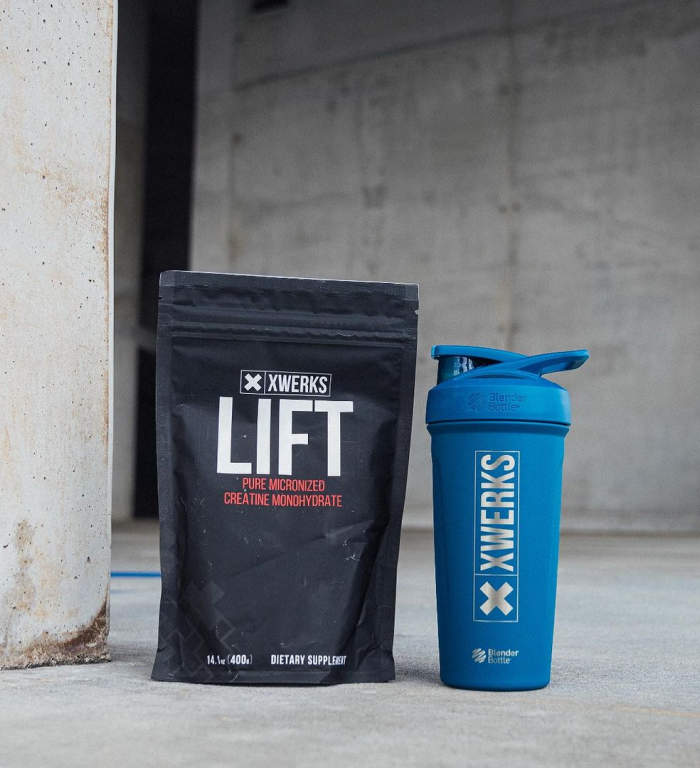
• Daily creatine (5g of Lift) supports power output on station work and accelerates between-session recovery
• Daily protein (1.6-2.2g/kg, with Grow covering post-session needs) for muscle repair under high training volume
• Pre-workout (Ignite, 30 min before key sessions) for focus and sustained output through long compromised running and mini-Hyrox blocks
• Intra-workout carbs (Motion) for sessions over 60-75 minutes — mini-Hyrox blocks and full simulations specifically
• Beta-alanine loading (3-6g daily, started 6-8 weeks before race) for lactate buffering on stations
The full supplementation framework is in our Supplement Guide for Hyrox Athletes and the race-day pre-workout breakdown is in Pre-Workout for Hyrox.
Common questions about Hyrox prep workouts
"How many hours per week do I need to train for Hyrox?"
For competitive performance: 6-10 hours weekly across 5-6 sessions. For finishing healthy: 4-6 hours across 4 sessions. Quality and specificity matter more than total volume — 5 well-designed Hyrox-specific sessions beat 8 random workouts.
"Can I prep for Hyrox in 8 weeks?"
If you have a fitness base (some running ability and basic strength): yes, 8 weeks is enough for a respectable first Hyrox. From zero base: extend to 12-16 weeks minimum. The first race is usually about completion; later races are where times drop substantially.
"What's the right balance of running vs strength?"
For most athletes: roughly 40% running, 30% strength, 30% Hyrox-specific hybrid work. Adjust based on background. Pure runners shift toward more strength; pure lifters shift toward more running. Hybrid sessions count as both.
"How often should I do full Hyrox simulations?"
2-3 times in the final 8 weeks before race day. Not weekly — the recovery cost is too high. Mini-Hyrox blocks (3-4 stations) twice weekly capture most of the training benefit at much lower recovery cost.
"Should I race CrossFit competitions or other hybrid races during prep?"
Generally no during the final 4 weeks of Hyrox prep — the recovery cost is significant. Earlier in the prep block, occasional events can serve as fitness tests, but treat them as training not as A-races.
"What about doubles training? When does that start?"
For doubles competitors: introduce partner-specific workouts (rep relays, station handoffs) in the final 6-8 weeks. Practice transitions and communication — the time saved (or lost) in handoffs adds up over 8 stations.
Fuel the work
Hyrox prep is high-volume hybrid training. The supplement stack that supports it: Ignite for sustained pre-workout focus, Motion for intra-session fueling on long days, Grow for daily protein, Lift for creatine. The full Hyrox supplement collection is at Supplements for Hyrox.
Shop the Hyrox StackThe Bottom Line
Hyrox prep workouts should replicate the race's specific demand: alternating 1km running with functional strength stations under accumulating fatigue. Generic CrossFit WODs and pure running plans both miss the point.
The four workout types every Hyrox athlete needs: compromised running (running with residual fatigue), station simulators (single-station capacity), mini-Hyrox blocks (3-4 stations at race pace), and full race simulations (every 2-3 weeks in race prep).
Train weak stations more than strong ones. Sled push capacity is built differently than wall ball capacity, which is built differently than burpee broad jump capacity. Spend 60% of station-specific work on your worst 2-3 stations.
Programming framework: 2 running-focused sessions, 2 strength sessions, 1-2 hybrid Hyrox-specific sessions per week. Reduce volume in final 2-3 weeks; full simulations replace volume in final 4 weeks.
Skip: pure CrossFit metcons (rep schemes don't match Hyrox), only running (you'll bonk on stations), maximum-effort workouts every session (recovery is the limiter), trying to PR every workout in race prep.
Pair the training with the fueling. Daily creatine, daily protein, pre-workout for key sessions, intra-workout carbs for sessions over 75 minutes. Training only works if you can recover from it.
Dig deeper: Supplement Guide for Hyrox Athletes · Pre-Workout for Hyrox · Cluster Dextrin: The Carb That Changed Sports Nutrition · Anaerobic vs Aerobic Exercise · Pre-Workout for CrossFit · Muscle Recovery Supplements · Supplements for Hyrox Collection
Plan your HYROX race weekend
Choose your next event in our October–December 2026 HYROX race calendar. The city guides cover venue arrival, hotel areas, local activities, official results and event-specific XWERKS first-order offers.