What Is Bulking? Lean Bulking vs. Dirty Bulking Explained
TL;DR
- Bulking is a deliberate caloric surplus combined with resistance training to maximize muscle growth, with some fat gain accepted as a cost.
- Lean bulking: 200-400 calorie daily surplus, focused on whole foods, minimizes fat gain. Slower but sustainable. Preferred approach for most people.
- Dirty bulking: Aggressive surplus (500-1,000+ calories), unrestricted food choices including junk food. Faster weight gain but most of it is fat. Rarely worth it.
- Muscle gain has a biological ceiling — roughly 1-2 lbs of muscle per month for intermediates. Eating beyond the ceiling just adds fat, not muscle.
Bulking is a phase in bodybuilding and strength training where you deliberately eat in a caloric surplus (consuming more calories than you burn) while doing progressive resistance training to maximize muscle growth. The surplus provides the extra energy and raw materials (protein, carbs, fats) your body needs to build new muscle tissue. Some fat gain is accepted as a cost of building muscle. The two main approaches are lean bulking (moderate surplus, whole foods, slow and sustainable) and dirty bulking (aggressive surplus, anything goes, fast weight gain with more fat). For nearly everyone, lean bulking is the better choice — muscle gain has a biological ceiling, and eating beyond that ceiling just adds fat.
Why bulk at all?
The case for bulking rests on one biological fact: building muscle requires surplus energy and raw materials. Your body won't efficiently synthesize new muscle tissue if you're in a caloric deficit. It can happen (newbies gain some muscle while losing fat, and people with significant excess body fat can do "recomposition"), but in general, optimal muscle gain requires eating slightly more than you burn.
This creates a tradeoff:
If you eat at maintenance: You'll maintain weight and recover from workouts, but muscle gain will be slow or minimal for intermediate-and-above trainees.
If you eat in a deficit: You'll lose weight, possibly lose some fat, but muscle gain will be heavily impaired. This is the "cutting" phase — used to reveal muscle, not build it.
If you eat in a surplus: You'll gain weight. Some of it will be muscle (if you're training hard), some will be fat. The question is the ratio — and that depends on how aggressive the surplus is.
Bulking is the period of deliberate surplus. Most natural lifters alternate bulking phases (3-6 months of gaining) with cutting phases (6-12 weeks of fat loss) to build muscle over time while managing body composition.
How much surplus do you actually need?
This is where most people go wrong. The math on muscle gain is less dramatic than bro-science suggests. Realistic natural muscle gain rates:
Beginner (first 6-12 months of serious training): 1-2 lbs of muscle per month
Intermediate (1-3 years): 0.5-1 lb of muscle per month
Advanced (3+ years): 0.25-0.5 lb of muscle per month
Each pound of muscle represents about 2,500-3,500 extra calories above maintenance. Divided across 30 days, that's only 80-120 extra calories per day to fuel 1 lb of muscle gain per month — even less if you're past the beginner stage.
This means a surplus of 200-400 calories per day is more than enough for most trainees. Eating 1,000+ extra calories per day doesn't let you build muscle faster — it just adds fat alongside any muscle gain. Your body has a ceiling on how much new tissue it can synthesize, and calories beyond that ceiling are stored as fat.
Lean Bulking: The Preferred Approach
What is lean bulking?
Lean bulking is a bulking approach with a modest caloric surplus (typically 200-400 calories above maintenance) and a focus on whole-food nutrition. The goal is to maximize the muscle-to-fat ratio of new weight gained, even if it means gaining weight more slowly.
The lean bulking approach
Caloric surplus: 200-400 calories above maintenance. For a 180 lb intermediate trainee with a 2,800 cal maintenance, that's 3,000-3,200 cal per day.
Macro targets: Protein 1.6-2.2g/kg body weight (130-180g for a 180 lb person). Fats 20-30% of calories. Carbs fill the remainder (typically 40-50% of calories).
Food choices: Primarily whole foods. Lean meats, eggs, dairy, whole grains, fruits, vegetables, healthy fats. Some flexibility for occasional treats, but the base diet is clean.
Weight gain rate: 0.5-1 lb per month for intermediate trainees. 1-2 lbs per month for beginners.
Duration: 3-6 months typically, followed by a maintenance phase or mini-cut if body fat has crept up noticeably.
Advantages of lean bulking
Minimal fat gain. The slow rate of weight gain means most of what you add is muscle, keeping body fat percentage relatively stable.
Shorter cutting phases needed. Because you don't accumulate much fat during the bulk, the subsequent cut can be short (4-8 weeks) rather than prolonged.
Better body composition year-round. You stay relatively lean throughout the bulking phase, which is psychologically more sustainable and keeps you looking good in the mirror.
Better insulin sensitivity and overall health. Whole-food choices support metabolic health, energy levels, and performance.
More sustainable long-term. You can lean bulk almost indefinitely (with occasional maintenance phases) without dramatic body composition changes.
Disadvantages of lean bulking
Slow progress. Watching the scale crawl up at 0.5-1 lb per month can feel discouraging, especially for people who want to see fast changes.
Requires discipline. You have to track calories, weigh foods, and be deliberate about choices. Can't just "eat whatever you want."
Lower training fuel for some. A modest surplus may not provide enough energy for high-volume training programs, particularly for advanced lifters.
Dirty Bulking: What It Is and Why It's Usually a Bad Idea
What is dirty bulking?
Dirty bulking is an aggressive bulking approach with a large caloric surplus (typically 500-1,000+ calories above maintenance) and unrestricted food choices — including fast food, processed snacks, sugary drinks, and anything else that hits caloric targets. The philosophy is "eat big to get big," prioritizing total caloric intake over food quality.
The dirty bulking approach
Caloric surplus: 500-1,000+ calories above maintenance. Some extreme dirty bulkers eat 5,000-6,000+ calories per day regardless of their maintenance needs.
Macro targets: Protein targets are sometimes maintained, but often neglected in favor of hitting calorie totals. Carbs and fats are whatever ends up on the plate.
Food choices: Unrestricted. Pizza, burgers, ice cream, fried food, soda, pastries — whatever is calorie-dense and easy to eat in large quantities. Whole food is not a priority.
Weight gain rate: 2-5+ lbs per month, most of which is fat.
Why people choose dirty bulking
Convenience. You don't have to track macros carefully or plan meals. Just eat a lot.
Easier to hit caloric targets. Highly processed foods are calorie-dense, making it easier for hardgainers to hit aggressive surplus numbers without feeling stuffed.
Faster weight gain on the scale. Watching the scale jump up feels satisfying, even if most of the weight is fat and water.
Cultural nostalgia. Dirty bulking has a long history in bodybuilding culture from the 1970s-90s, before nutrition science clarified the downsides.
Why dirty bulking is usually a bad idea
Most of the weight is fat. Since muscle gain has a biological ceiling, eating 1,000+ calories above that ceiling means the extra is stored as fat. Dirty bulkers often gain 20+ lbs over a bulk but only 4-6 lbs of that is actual muscle.
Longer, more miserable cuts. After a dirty bulk, you need an extended (12-16+ week) cut to lose all the accumulated fat. This means spending half of every year in a caloric deficit — not a fun way to live.
Poor energy and performance. Highly processed junk food diets produce worse sleep, worse energy, more joint inflammation, and often worse training performance than whole-food bulks.
Metabolic health costs. Insulin sensitivity, cholesterol profile, and inflammatory markers often worsen during dirty bulks, creating health risks beyond just aesthetics.
Body image issues. Spending 6+ months looking soft and feeling sluggish takes a psychological toll, especially if you're not competing or preparing for something specific.
Sample day of eating for lean bulking (180 lb trainee, ~3,200 calories)
Breakfast (700 cal): 4 whole eggs + 2 slices whole grain toast + 1 banana + 1 tbsp peanut butter + black coffee. ~40g protein, 70g carbs, 25g fat.
Mid-morning shake (550 cal): 1 scoop XWERKS Grow + whole milk + oats + berries + almond butter. ~40g protein, 65g carbs, 18g fat.
Lunch (800 cal): 8 oz chicken breast + 1.5 cups rice + mixed vegetables + olive oil dressing. ~50g protein, 85g carbs, 25g fat.
Pre-workout (150 cal): 1 apple + small handful of nuts.
Post-workout shake (300 cal): 1 scoop Grow + XWERKS Motion + water. ~30g protein, 25g carbs fast.
Dinner (700 cal): 8 oz salmon or steak + sweet potato + large salad with olive oil + vegetables. ~45g protein, 50g carbs, 30g fat.
Daily totals: ~3,200 calories, ~205g protein, 295g carbs, 100g fat. Solid lean bulk for a 180 lb intermediate trainee.
How long should a bulk last?
Lean bulk duration: 3-6 months is typical. Long enough to see meaningful muscle gain but short enough that body fat doesn't creep up too much.
Signs it's time to cut: Body fat has visibly increased (abs are less defined, face looks rounder, waist has expanded). Training performance is declining. Bloodwork shows negative trends. Psychological fatigue of constant eating.
Transition strategy: End a bulk with a short maintenance phase (2-4 weeks) to stabilize weight before cutting. This reduces the metabolic "shock" of going from surplus to deficit and helps preserve muscle during the cut.
Longer cycles: Some experienced lifters do extended "maingaining" (maintenance-focused) or "perma-bulking" (long slow bulks) with occasional mini-cuts. Both can work for advanced trainees who have already built their base.
The Bottom Line
Bulking is a deliberate caloric surplus combined with resistance training to maximize muscle growth. Some fat gain is accepted as a cost of building muscle.
Lean bulking (200-400 cal surplus, whole foods) is the preferred approach for nearly everyone. It maximizes the muscle-to-fat ratio of new weight gained and is sustainable long-term.
Dirty bulking (500-1,000+ cal surplus, anything goes) produces faster scale weight gain but most of it is fat. The subsequent cut is longer and more miserable. Rarely worth it.
Muscle gain has a biological ceiling. ~1-2 lbs per month for beginners, 0.5-1 lb per month for intermediates. Eating beyond that ceiling just adds fat. Smart bulking provides just enough surplus to maximize muscle gain without unnecessary fat accumulation.
Hit Your Bulking Protein Targets
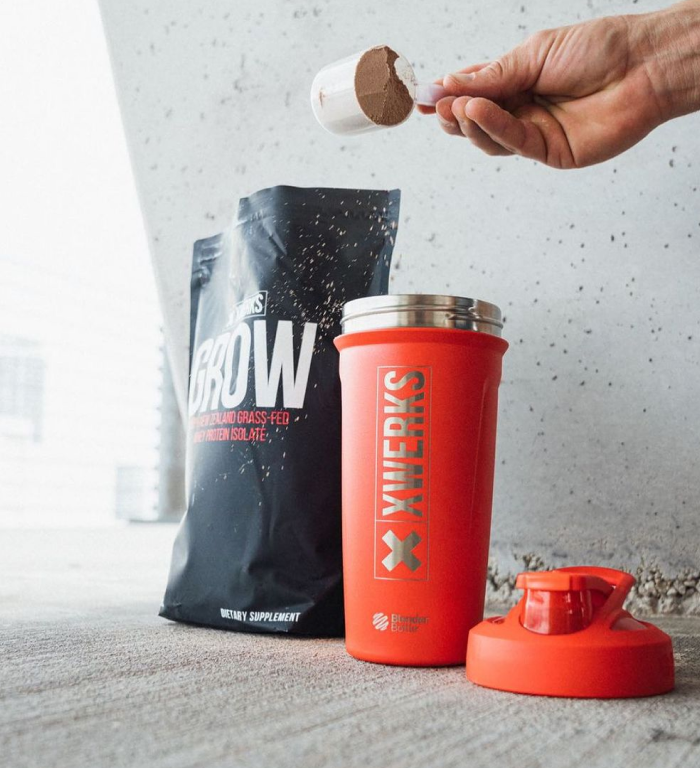
XWERKS Grow — 25g of NZ grass-fed whey isolate per scoop. The easiest way to hit 180-200g of daily protein during a bulk without cooking another chicken breast.
SHOP GROW →Further Reading
Protein Powder for Weight Gain
How Long Does It Take to Gain Muscle
References
1. Helms ER, et al. Evidence-based recommendations for natural bodybuilding contest preparation: nutrition and supplementation. J Int Soc Sports Nutr. 2014;11:20.
2. Iraki J, et al. Nutrition recommendations for bodybuilders in the off-season: a narrative review. Sports. 2019;7(7):154.
3. Schoenfeld BJ, et al. Dose-response relationship between weekly resistance training volume and increases in muscle mass. J Sports Sci. 2017;35(11):1073-1082.
4. Morton RW, et al. A systematic review, meta-analysis and meta-regression of protein supplementation on resistance training-induced gains in muscle mass and strength. Br J Sports Med. 2018;52(6):376-384.
5. Garthe I, et al. Effect of two different weight-loss rates on body composition and strength and power-related performance in elite athletes. Int J Sport Nutr Exerc Metab. 2011;21(2):97-104.