Protein Powder for Weight Gain: The Practical Guide
TL;DR
- Protein powder supports weight gain by making it easier to hit a caloric surplus — but you still need the surplus itself. Protein alone doesn't create mass gain.
- Target a 300-500 calorie daily surplus for lean mass gain, higher for aggressive bulking. Most of the gain should come from a moderate surplus, not an extreme one.
- Use whey protein (like XWERKS Grow) as the foundation of high-calorie weight gainer shakes — add oats, whole milk, banana, nut butter, olive oil for easy 700-1,200 calorie meals.
- Avoid commercial "mass gainers" — most are just cheap whey protein + maltodextrin + sugar at 2-3x the cost of a DIY shake.
Protein powder alone doesn't cause weight gain — a caloric surplus does. But protein powder is one of the most practical tools for actually hitting that surplus, especially for people who struggle to eat enough whole food. The best approach is building high-calorie weight gainer shakes around quality whey protein (like XWERKS Grow) + oats + whole milk + banana + nut butter — producing 700-1,200 calorie meals that are easier to consume than equivalent amounts of solid food. Commercial "mass gainers" are usually just whey powder + maltodextrin + sugar at a huge markup; DIY is cheaper and healthier.
Can protein powder alone cause weight gain?
No — and this is a crucial misunderstanding that trips up a lot of people. Weight gain is driven by caloric surplus, meaning you consume more calories than your body burns. A scoop of whey protein (25g) is only ~110 calories. Adding one scoop of whey to an otherwise unchanged diet might contribute to weight gain if you were already close to your surplus threshold, but it's a small addition.
The real power of protein powder for weight gain isn't the calories in the powder itself — it's that protein powder is a building block for high-calorie shakes. A shake with 1 scoop of whey + whole milk + oats + banana + peanut butter can easily hit 700-1,000+ calories in 20 seconds of drinking. That's the equivalent of a full meal in liquid form, which is a game-changer for anyone who struggles to eat enough solid food.
For most hardgainers (people who find it difficult to gain weight), the challenge isn't lack of appetite for protein — it's that eating 3,500+ calories of solid food every day is exhausting. Shakes solve that problem.
How much of a surplus do you actually need?
The math on muscle gain is less dramatic than most people think. Research shows that natural trainees can realistically gain roughly:
Beginner (first year of lifting): 20-25 lbs of muscle in a year (2 lbs/month)
Intermediate (1-3 years): 10-12 lbs of muscle per year (1 lb/month)
Advanced (3+ years): 3-5 lbs of muscle per year
Each pound of muscle represents roughly 2,500-3,500 extra calories on top of normal maintenance. Divided by 30 days, that's about 100-300 extra calories per day for intermediate trainees gaining 1 lb of muscle per month.
This is why a moderate surplus works better than an aggressive one. Eating 1,000+ extra calories per day doesn't let you build muscle faster — it just adds fat alongside any muscle gain. Your body has a ceiling on how much new muscle it can build in a given period, and surplus calories beyond that ceiling become fat.
Why weight gainer shakes work so well
There are three reasons weight gainer shakes are effective for hardgainers:
1. Liquid calories bypass appetite regulation. Your body is less effective at recognizing satiety from liquid calories compared to solid food. This is a problem for weight loss (liquid calories can sabotage a deficit) but a benefit for weight gain — you can drink 800 calories without feeling uncomfortably full the way you would after eating 800 calories of chicken and rice.
2. Speed of consumption. Eating a 1,000-calorie solid meal takes 20-30 minutes. Drinking a 1,000-calorie shake takes 3-5 minutes. If you're trying to hit 4,000+ calories per day, the time saved matters.
3. Nutritional density. A well-built weight gainer shake can include more nutrients (protein, fat, carbs, micronutrients from fruit and milk) in less volume than an equivalent solid meal. For someone with low appetite or a small stomach, this is critical.
DIY weight gainer shake recipes
Forget commercial mass gainers — DIY is better, cheaper, and more flexible. Build your shakes around XWERKS Grow as the protein foundation and customize the calories:
The 700-Calorie Lean Gainer
• 1 scoop XWERKS Grow (25g protein, ~110 cal)
• 1 cup whole milk (~150 cal, 8g protein)
• 1 banana (~100 cal)
• 1/2 cup rolled oats (~150 cal)
• 2 tbsp peanut butter (~190 cal)
Total: ~700 calories, 45g protein, 75g carbs, 25g fat. Good for lean bulk or adding 1-2 per day to a moderate-calorie base diet.
The 1,000-Calorie Moderate Gainer
• 1 scoop XWERKS Grow (25g protein, ~110 cal)
• 1.5 cups whole milk (~225 cal)
• 1 banana + 1 cup frozen berries (~180 cal)
• 1/2 cup rolled oats (~150 cal)
• 3 tbsp peanut butter (~285 cal)
• 1 tbsp honey (~65 cal)
Total: ~1,015 calories, 50g protein, 115g carbs, 40g fat. One of these per day on top of a normal diet easily produces a solid bulking surplus.
The 1,500-Calorie Hardgainer Bomb
• 2 scoops XWERKS Grow (50g protein, ~220 cal)
• 2 cups whole milk (~300 cal)
• 1 banana + 1 cup frozen berries (~180 cal)
• 1 cup rolled oats (~300 cal)
• 3 tbsp peanut butter (~285 cal)
• 1 tbsp olive oil or MCT oil (~120 cal)
• 1 tbsp honey (~65 cal)
Total: ~1,470 calories, 80g protein, 160g carbs, 55g fat. This is a meal, not a snack. For extreme hardgainers who can't eat enough solid food, one of these per day on top of 3 regular meals can push you into aggressive surplus territory.
Commercial mass gainers vs. DIY
Most commercial "mass gainers" are a rip-off. Here's the breakdown:
Typical commercial mass gainer serving: ~1,200-1,500 calories, 50g protein, 250g carbs (mostly maltodextrin and added sugar), 5-10g fat. Cost: $3-5 per serving.
Issues with commercial mass gainers:
1. Low protein-to-calorie ratio. Most mass gainers are carb-dominant, with protein making up only 15-20% of calories. This makes it easier to hit a surplus but worse for actually building muscle.
2. Refined carb sources. Maltodextrin and added sugar dominate the carb content. These spike blood sugar, provide minimal satiety, and have no nutritional value beyond calories. Whole-food carbs (oats, banana, sweet potato) are vastly superior.
3. Minimal healthy fats. Most mass gainers contain almost no fat, missing out on one of the easiest ways to add calories (fat = 9 cal/gram vs. 4 for carbs/protein).
4. Expensive. At $3-5 per serving, a bag lasts maybe 12-15 servings. A DIY weight gainer shake costs under $2 per serving and provides better nutrition.
5. Digestive issues. The combination of high maltodextrin, artificial sweeteners, and fillers often causes bloating, gas, and gut distress.
The DIY approach wins on every metric except convenience — and a blender takes 60 seconds.
Protein targets for weight gain
Even when bulking, you still need to hit your daily protein target: 1.6-2.2g per kg body weight (0.73-1.0g per lb). For a 170 lb guy trying to bulk to 200 lb, that's 125-170g of protein per day. This doesn't increase dramatically during bulking — protein needs are about the same whether you're bulking or maintaining.
What changes during bulking is total calorie intake. The extra calories come primarily from carbs and fats, not extra protein. Eating 300g of protein per day during a bulk doesn't build more muscle than eating 180g — it just displaces other macros and costs more money.
Training for weight gain
Weight gain without resistance training just means getting fatter. For muscle gain specifically, you need:
Progressive overload resistance training. 3-5 sessions per week focused on compound movements (squats, deadlifts, presses, rows, pulls). Track your workouts and aim to progressively add weight, reps, or sets over time.
Adequate volume. 10-20 working sets per muscle group per week is the research-backed sweet spot for muscle growth in most trainees.
Sufficient recovery. Muscle grows during recovery, not during the workout itself. 7-9 hours of sleep per night and rest days between hard sessions are non-negotiable.
Training + caloric surplus + adequate protein = muscle gain. Missing any one of these produces suboptimal results.
The Bottom Line
Protein powder alone doesn't cause weight gain. You need a caloric surplus — 200-500 calories above maintenance for lean bulking, more for aggressive gain.
The real value of protein powder for weight gain is building high-calorie shakes. Whey + whole milk + oats + banana + nut butter = 700-1,200 calorie meals that are easier to consume than equivalent solid food.
Skip commercial mass gainers. Most are just whey + maltodextrin + sugar at a huge markup. DIY is cheaper, more nutritious, and more flexible.
Still hit protein targets (1.6-2.2g/kg) and train hard with progressive overload. Protein powder is a tool, not a substitute for programming and effort.
The Foundation of Every Great Weight Gainer Shake
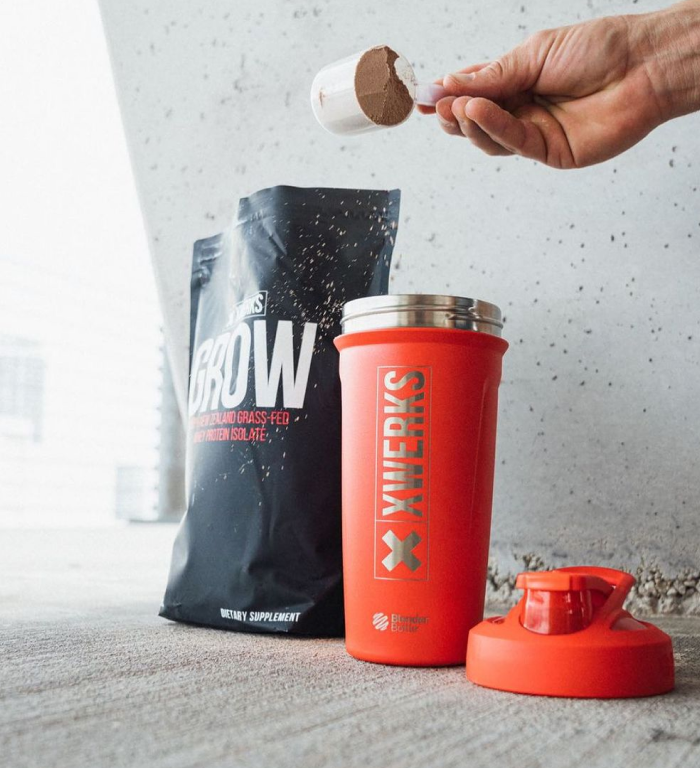
XWERKS Grow — 25g of grass-fed New Zealand whey isolate per scoop. Clean foundation for building high-calorie shakes without the digestive issues of commercial mass gainers.
SHOP GROW →Further Reading
What Is Bulking? (Lean vs. Dirty)
How Long Does It Take to Gain Muscle
References
1. Aragon AA, Schoenfeld BJ. Nutrient timing revisited: is there a post-exercise anabolic window? J Int Soc Sports Nutr. 2013;10:5.
2. Helms ER, et al. Evidence-based recommendations for natural bodybuilding contest preparation. J Int Soc Sports Nutr. 2014;11:20.
3. Morton RW, et al. A systematic review, meta-analysis and meta-regression of protein supplementation on resistance training-induced gains in muscle mass and strength. Br J Sports Med. 2018;52(6):376-384.
4. Schoenfeld BJ, et al. Dose-response relationship between weekly resistance training volume and increases in muscle mass. J Sports Sci. 2017;35(11):1073-1082.