How Long Does It Take to Gain Muscle? Realistic Expectations
TL;DR
- Beginners can gain 1-2 lbs of muscle per month in their first year of serious training. Intermediates: 0.5-1 lb/month. Advanced: 0.25-0.5 lb/month.
- Visible changes typically appear in 4-8 weeks of consistent training. Significant physique changes take 6-12 months minimum.
- Natural lifters have a biological ceiling — most men can gain 20-25 lbs of muscle in their first year, ~40 lbs total over 3-5 years of serious training.
- The rate depends on training age, genetics, programming, nutrition, sleep, and age. You can't accelerate muscle growth beyond the biological ceiling — but you can easily slow it down with any one of those factors.
Muscle gain is slower than most people expect. A beginner (first year of serious training) can realistically gain 1-2 lbs of muscle per month, or 20-25 lbs in the first year. Intermediates (1-3 years trained) gain 0.5-1 lb per month. Advanced lifters (3+ years) gain only 0.25-0.5 lb per month. Visible changes typically appear in 4-8 weeks of consistent training. A major physique transformation takes 6-12 months minimum, and building a truly impressive natural physique takes 3-5+ years. You can't accelerate past your biological ceiling — but you can easily slow down your progress with poor programming, inadequate protein, bad sleep, or insufficient calories.
The realistic muscle gain rates
Based on decades of research and observation in natural trainees, muscle gain follows a predictable pattern: fastest in your first year, then diminishing each subsequent year as you approach your genetic ceiling.
| Training Status | Monthly Gain | Annual Gain |
|---|---|---|
| Beginner (Year 1) | 1-2 lbs | 15-25 lbs |
| Intermediate (Year 2-3) | 0.5-1 lb | 6-12 lbs |
| Advanced (Year 4-5) | 0.25-0.5 lb | 3-6 lbs |
| Highly Advanced (Year 6+) | 0.1-0.25 lb | 1-3 lbs |
These numbers are for natural trainees doing everything reasonably right: progressive overload training, adequate protein, sufficient calories, decent sleep. Enhanced lifters (those using anabolic steroids) can bypass the biological ceiling and gain muscle at rates that aren't achievable naturally.
Women generally gain muscle at roughly 50-70% of the rate of men, due to lower testosterone levels. So a beginner woman might gain 10-15 lbs of muscle in her first year rather than 20-25. The pattern of diminishing returns over time is the same.
When will you actually see changes?
Visible progress follows a rough timeline in consistent trainees:
Weeks 1-2: Nothing visible, but changes are happening
You may feel sore and see a slight "pump" after workouts, but no real visual change yet. Most early progress is neurological — your nervous system is learning to recruit muscle fibers more efficiently. This is why strength can increase 10-20% in the first few weeks without any visible size change.
Weeks 3-4: First subjective changes
Clothes may start fitting slightly differently. You'll notice improved muscle "tone" (actually just modest increases in muscle fiber size combined with reduced subcutaneous fat). The scale may not change yet — or it may go up slightly if you're eating in a surplus.
Weeks 4-8: First visible changes
This is when most consistent trainees see real, photograph-able changes. Shoulders may look slightly wider, arms slightly larger, chest fuller. Friends and family may start commenting. The change isn't dramatic, but it's real and visible to careful observation.
Weeks 8-16 (months 2-4): Clear progress
By this point, progress is obvious in photos taken at the same angle and lighting. You can see muscle definition emerging, particularly if combined with some fat loss. This is often the most motivating phase of training — results are undeniable and momentum builds.
Months 4-12: Major transformation phase
After 6-12 months of consistent training, most beginners look noticeably different. Adding 15-25 lbs of muscle in the first year produces dramatic physique changes — this is where the "transformation" photos come from that fitness influencers love to post. Expect clothes to fit differently, strength to have roughly doubled on most lifts, and confidence to increase significantly.
Years 2-5: The grind years
Progress slows dramatically. You're past the newbie-gains phase, and each additional pound of muscle requires more effort than the one before. This is where most people plateau or quit because progress isn't dramatic enough to feel rewarding. Stick with it — this is when real physiques are built.
Years 5+: Approaching the ceiling
For most natural trainees, you're within 80-90% of your maximum possible muscle mass. Gains become increasingly slow and hard-earned. Advanced trainees often shift focus from "building more muscle" to "refining proportions, improving weak points, and maintaining what they've built."
What's the maximum muscle you can gain naturally?
The ceiling for natural muscle gain is genetically determined but predictable. Researchers like Casey Butt have developed equations that estimate maximum natural muscle mass based on body frame size (height, wrist/ankle circumference). These are rough guidelines:
For an average-framed man at ~10-12% body fat: Roughly 40-45 lbs of lean mass above starting untrained weight is achievable. This represents approximately 25-30 lbs of actual muscle tissue over 3-5 years of serious training.
For an average-framed woman at ~18-22% body fat: Roughly 15-20 lbs of lean mass above starting untrained weight. Still a significant and transformative amount.
Individual variation is large — some people have favorable genetics and can exceed these averages; others will fall below them. Frame size matters: a naturally wide-framed individual has more "room" to carry muscle than a smaller-framed person. This isn't fair but it's biology.
The practical implication: if you're natural and someone is claiming to have gained 50+ lbs of muscle in 1-2 years, they're either measuring wrong, lying, or enhanced. Realistic expectations prevent frustration and disappointment.
Factors that determine how fast you gain muscle
Training age (biggest factor)
The longer you've been training, the slower progress becomes. This is the single biggest determinant of gain rate. Beginners gain dramatically faster than advanced lifters because they're further from their ceiling.
Genetics
Frame size, muscle belly length, fiber type distribution, insertion points, hormonal profile, and myostatin levels all affect muscle-building potential. You can't change genetics — but within your genetic range, effort and smart training determine where you land.
Programming
Training volume, intensity, frequency, exercise selection, and progression model all affect outcomes. Research by Schoenfeld and others suggests 10-20 working sets per muscle group per week is the sweet spot for hypertrophy in most trainees. Bad programming (too much or too little volume, no progressive overload, random exercise selection) can cut gains in half or more.
Nutrition
Protein: 1.6-2.2g per kg body weight daily (~0.73-1g per lb). Morton et al. 2018 confirmed diminishing returns above 1.6g/kg for most people. Calories: Moderate surplus (200-400 cal above maintenance) for optimal muscle gain with minimal fat gain. Extreme surplus doesn't build more muscle, just more fat.
Sleep
7-9 hours per night. Growth hormone peaks during deep sleep. Sleep deprivation impairs recovery, reduces testosterone, and slows muscle gain significantly. Chronically getting 5-6 hours can cut your gains by 30-50%.
Age
Muscle-building capacity declines gradually with age, particularly after 40-50, due to reduced testosterone, anabolic resistance, and reduced training recovery. A 25-year-old and a 50-year-old following identical programs will see different results. But age is not an excuse — trainees over 50 can still build significant muscle, just more slowly.
Stress and life factors
Chronic life stress elevates cortisol, which impairs muscle-building. Job stress, relationship stress, financial stress, and travel all eat into your recovery capacity. Managing these isn't optional for optimal gains.
Why it feels slower than it actually is
Even at optimal rates, muscle gain feels slow because of several psychological factors:
The mirror illusion. You see yourself every day, so gradual changes are invisible. Progress is only obvious in before/after photos taken weeks or months apart.
Goal inflation. As you gain muscle, your standards rise. What once looked impressive becomes "just okay," and you keep chasing a moving target.
Social media distortion. Influencers, bodybuilders, and enhanced lifters create unrealistic reference points. Comparing yourself to these people is demoralizing and unproductive.
The training vs. results lag. You feel the training (soreness, fatigue, effort) immediately, but results only materialize over weeks and months. This creates a perception that you're working hard without progress — even when you're making normal gains.
Bathroom scale chaos. Daily weight fluctuates 2-5 lbs based on water, glycogen, food intake, and hormones. Focusing on daily scale changes hides the underlying slow trend.
How to measure progress accurately
Since muscle gain is slow and easily missed, use multiple measurement methods:
Photos. Front, side, and back photos taken in the same lighting, pose, and time of day. Monthly intervals. Compare 6-month and 12-month photos for the real picture.
Tape measurements. Chest, waist, hips, arms, thighs, calves. Monthly. Looking at multiple sites catches growth that scale weight might miss.
Scale weight. Daily weighing averaged over a week. Weekly averages reveal trends that daily weights hide. Expect 0.5-1 lb per month of weight gain if bulking at a moderate surplus (most of which should be muscle, some water, minimal fat).
Strength progression. Log every workout. Track working sets and weights. Strength is highly correlated with muscle gain in natural trainees — if your squat is going from 225 to 315 lbs, you're almost certainly adding muscle, even if the scale doesn't show it dramatically.
Clothing fit. How your shirts fit around the shoulders, chest, and arms is a surprisingly reliable real-world indicator of muscle gain.
Body composition measurements. DEXA scans, BodPod, or InBody measurements every 3-6 months provide more accurate fat/muscle tracking. Skinfold calipers work too if you're consistent.
The Bottom Line
Beginners gain 1-2 lbs of muscle per month in their first year of serious training (15-25 lbs total). Intermediates gain 0.5-1 lb per month. Advanced lifters: 0.25-0.5 lb per month.
Visible changes in 4-8 weeks of consistent training. Clear physique transformation in 6-12 months. A truly impressive natural physique takes 3-5+ years.
You can't accelerate past the biological ceiling — but you can easily slow yourself down with bad programming, inadequate protein, poor sleep, or insufficient calories. Most of what determines your rate is execution, not genetics.
Measure progress across multiple methods: monthly photos, tape measurements, weekly weight averages, strength logs, and clothing fit. Ignore daily scale fluctuations and social media comparisons. Consistency over years builds physiques.
Hit Your Protein Target — The #1 Nutritional Factor for Muscle Gain
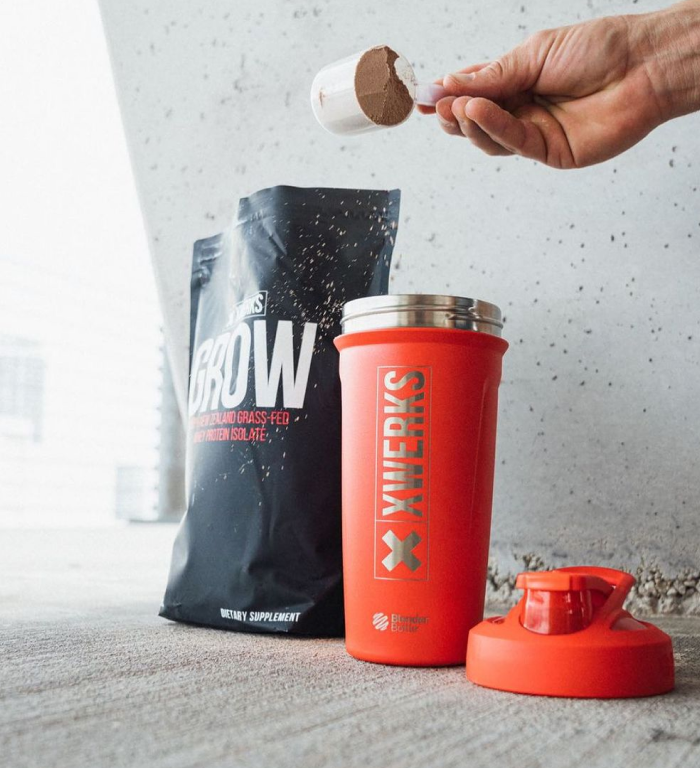
XWERKS Grow — 25g of NZ grass-fed whey isolate per scoop. The easiest way to hit 1.6-2.2g/kg of daily protein without cooking 6 chicken breasts a day.
SHOP GROW →Further Reading
What Is Bulking? (Lean vs. Dirty)
Protein Powder for Weight Gain
How Much Protein Can Your Body Absorb
References
1. Morton RW, et al. A systematic review, meta-analysis and meta-regression of the effect of protein supplementation on resistance training-induced gains in muscle mass and strength. Br J Sports Med. 2018;52(6):376-384.
2. Schoenfeld BJ, et al. Dose-response relationship between weekly resistance training volume and increases in muscle mass. J Sports Sci. 2017;35(11):1073-1082.
3. Helms ER, et al. Evidence-based recommendations for natural bodybuilding contest preparation. J Int Soc Sports Nutr. 2014;11:20.
4. Iraki J, et al. Nutrition recommendations for bodybuilders in the off-season. Sports. 2019;7(7):154.
5. Phillips SM, et al. A critical examination of dietary protein requirements, benefits, and excesses in athletes. Int J Sport Nutr Exerc Metab. 2007;17:S58-76.