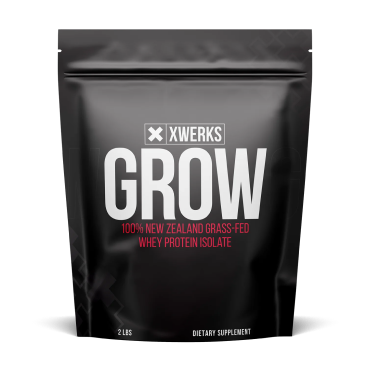
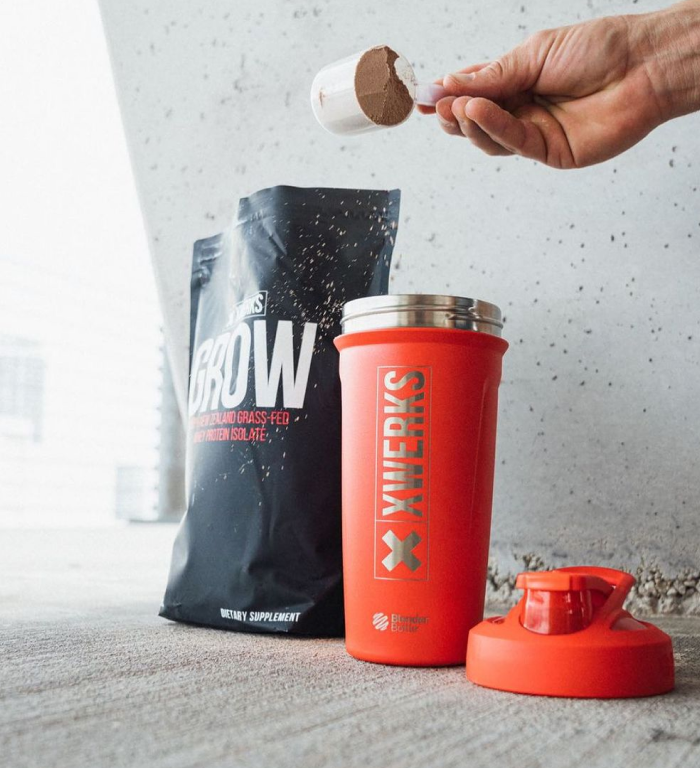
Xwerks Grow - 100% New Zealand grass-fed whey protein isolate.
Our protein is sourced from naturally raised grass-fed cows that naturally graze on the countryside of New Zealand, one of the strictest countries in the world when it comes to dairy quality. Meaning no hormones, antibiotics or pesticides that can be passed on to you.
Whey isolate means our whey is "isolated" through micro filtration to almost totally pure protein at25g of protein and over 6g of BCAA's per servingwith no lactose, carbs or fats (Peanut Butter contains 23g of Protein, 2g fat and 2g carbs). Our unique protein formula contains only whey protein isolate and is not blended with lesser quality whey.
Grow is naturally sweetened and flavored making it truly the cleanest protein available.
Made from grass-fed, pasture raised cows in New Zealand
100% whey protein isolate
Cold pressed, non ion-exchange filtering
No artificial sweetners, flavors or coloring
Soy and Gluten free
Processed acid and bleach free
Amazing rich flavor with no aftertaste
Raw whey is rich in protein substances, called native micro fractions. These include; alpha lactalbumin, beta-lactoglobulin, glycomacropeptide, immunoglobulins, serum albumin, lactoferrin, lactoperoxidase.
Our micro filtration process helps preserve these important biological nutrients while removing unwanted fats and carbohydrates (such as lactose).
This means our whey has the following benefits and more:
Muscle growth and repair
Strengthens and boosts the immune system
Anti-oxidant properties
Easily digestible, no bloat
Fantastic flavor
No clumping
FAQ
WHAT CAN I EXPECT FROM USING GROW
Increased muscle repair and recovery
No bloated feel
Great flavor with no after taste
Instant mixing with no clumping
HOW MANY SERVINGS IS GROW One bag contains 30 servings.
WHAT IS THE DIFFERENCE BETWEEN YOUR PROTEIN AND OTHERS We have a couple blog posts that may help answer that:
IS GROW DAIRY FREE No, but it does not contain lactose due to our microfiltration process.
DOES GROW CONTAIN SUGAR No, it is naturally sweetened with Stevia.
DOES GROW CONTAIN PEANUTS Only Peanut Butter PR contains peanuts.
WHAT IS GROW FLAVORED WITH Cocoa bean for Chocolate Cream, vanilla bean for Vanilla Victory and peanut butter powder and cocoa bean for Peanut Butter PR.
HOW MUCH IS SHIPPING $5, or free for orders over $75
IS GROW KETO FRIENDLY Yes it is, our low carb formula is perfect for anyone following the keto diet
Between 7 and 28 days depending on whether you load. With a loading phase (20g/day for 5-7 days), your muscles reach full creatine saturation within one week. Without loading (5g/day from day one), it takes approximately 3-4 weeks to reach the same saturation level. Both approaches produce the same endpoint — loading just gets you there faster.
Why creatine doesn't work instantly
Creatine is not a stimulant. It doesn't give you a burst of energy 30 minutes after you take it like caffeine does. Instead, creatine works by gradually increasing the phosphocreatine (PCr) stores in your muscles over days and weeks. Once those stores are fully saturated — approximately 20-40% above baseline — you have a larger energy reserve available for high-intensity efforts: more ATP regeneration between sets, more power on explosive lifts, and less fatigue during repeated sprints.
Without supplementation, your muscles' creatine stores are only about 60-80% full. Supplementing closes that gap. But closing it takes time because your muscles can only absorb and store a finite amount of creatine per day. That's why the timeline depends on how much you take daily.
Path 1: With a loading phase (full saturation in ~7 days)
A creatine loading phase involves taking approximately 20g per day (split into 4 doses of 5g) for 5-7 days, then dropping to a 5g/day maintenance dose. Research confirms this approach increases intramuscular creatine content by 20-40% within that first week — you reach full saturation fast.
Days 1-7: During loading, your muscles rapidly absorb and store creatine. By the end of the first week, your phosphocreatine reserves are at maximum capacity. Some people notice subtle improvements in training volume (more reps, less fatigue between sets) during this period. You'll likely gain 1-3 lbs of water weight as creatine pulls water into muscle cells — this is intracellular hydration, not bloating, and it supports muscle function.
Weeks 2-4: With stores fully saturated, you're now operating at enhanced capacity. Training volume improvements become more noticeable — an extra rep here, a slightly heavier set there. These incremental gains in workout quality compound into measurable strength improvements over weeks.
Weeks 4-12+: This is where creatine's real value emerges. The consistent increase in training volume translates to greater progressive overload, which drives measurably more lean mass gain and body composition improvement compared to training without creatine. Meta-analyses show approximately 1-1.4 kg more lean mass and 5-15% greater strength improvements over 8-12 weeks versus placebo.
Loading phase trade-offs: The main downsides of loading are mild GI discomfort (cramping, bloating) in some people from consuming 20g of creatine per day, and the rapid 1-3 lb water weight gain in the first week. Both are temporary. If either bothers you, skip loading — you'll reach the same saturation in 3-4 weeks at 5g/day with no GI issues and a more gradual water weight change.
Path 2: Without loading (full saturation in ~28 days)
If you skip the loading phase and start at 5g per day from day one, your muscles accumulate creatine more gradually. Research shows it takes approximately 3-4 weeks (28 days) to reach the same saturation level achieved in 7 days with loading.
Weeks 1-2: Creatine stores are building but haven't reached full saturation yet. You probably won't notice much difference in the gym during this period. This is the patience phase — the creatine is working at the cellular level, but the effects aren't perceptible yet.
Weeks 3-4: Stores approach full saturation. Many people report their first noticeable improvements around this point — slightly more endurance on high-rep sets, a bit more pop on explosive movements, marginally better recovery between sessions.
Weeks 4-12+: From this point forward, the trajectory is identical to the loading pathway. Full saturation means full benefits. The long-term outcomes — strength, lean mass, body composition, and performance — are the same regardless of whether you loaded or not.
What "working" actually looks like
Creatine's effects are real but subtle on a day-to-day basis. You're not going to feel a dramatic shift the way you feel caffeine or a pre-workout. What you'll notice instead is a pattern of small improvements that compound over time.
More reps at the same weight. Where you used to fail at 8 reps on bench press, you get 9 or 10. This happens because your muscles have more phosphocreatine available to regenerate ATP between contractions.
Better recovery between sets. Your 2-minute rest between heavy sets feels more productive. You come back to the bar feeling readier than usual. This is phosphocreatine resynthesis happening faster.
Slightly better performance on explosive efforts. Sprints, jumps, and power cleans feel a fraction sharper. Not dramatically — but measurably, over enough reps and sessions.
Over weeks and months: Those extra reps and slightly heavier sessions add up to more total training volume, more progressive overload, and ultimately more muscle and strength than the same program without creatine. The effect is cumulative — creatine is a long-game supplement, not a single-session booster.
What affects how fast creatine works?
Your starting creatine stores. If you eat a lot of red meat and fish (which provide dietary creatine), your stores may already be 70-80% full. If you're vegan or vegetarian, your stores may be only 60-70% full — meaning supplementation has a larger gap to fill and may produce a more noticeable effect.
Your body weight and muscle mass. Larger individuals with more muscle tissue have more total creatine storage capacity. Some researchers recommend a body-weight-adjusted loading dose of 0.3 g/kg/day (so a 90kg/200lb person would load at ~27g/day rather than the standard 20g).
Your training. Creatine without training still increases muscle creatine stores, but the performance and body composition benefits require resistance training to manifest. The supplement enhances your training — it doesn't replace it.
Consistency. This is the most important factor. Missing days means your stores begin depleting. Creatine works through sustained saturation, not occasional doses. Timing doesn't matter — but daily consistency absolutely does.
Do you need to cycle creatine?
No. There is no evidence that cycling creatine (taking it for a period, then stopping, then restarting) provides any advantage over continuous daily use. The ISSN's position stand confirms that long-term creatine supplementation (up to 30g/day for 5 years) is safe in healthy individuals. When you stop taking creatine, your muscle stores return to baseline over approximately 4-6 weeks. You don't gain anything by cycling — you just spend 4-6 weeks with sub-optimal stores.
What if creatine doesn't seem to be working?
Approximately 20-30% of people are classified as "creatine non-responders" — individuals whose muscle creatine stores are already near maximum capacity from dietary intake and endogenous synthesis. If you eat a meat-heavy diet and have naturally high creatine levels, supplementation has less room to add. This doesn't mean creatine is "not working" — it means you didn't have the deficit that supplementation addresses.
Other reasons creatine may seem ineffective: you're not training with sufficient intensity (creatine enhances high-intensity work, not easy cardio), you're not taking it consistently (daily, without gaps), or your expectations are miscalibrated (creatine adds 5-15% improvement, not 50%).
The Timeline Summary
With loading (20g/day x 7 days): Full muscle saturation in ~7 days. Noticeable training improvements within 1-2 weeks. Measurable strength and lean mass gains by week 4-8.
Without loading (5g/day): Full saturation in ~28 days. Noticeable improvements around week 3-4. Same long-term outcomes as loading.
The real payoff: Creatine's biggest value comes from months of consistent use. The extra reps and training volume compound into significantly more strength and muscle over 8-12+ weeks. It's a long-game supplement — take it daily, train hard, and let it accumulate.
Start Today. Results in 1-4 Weeks.
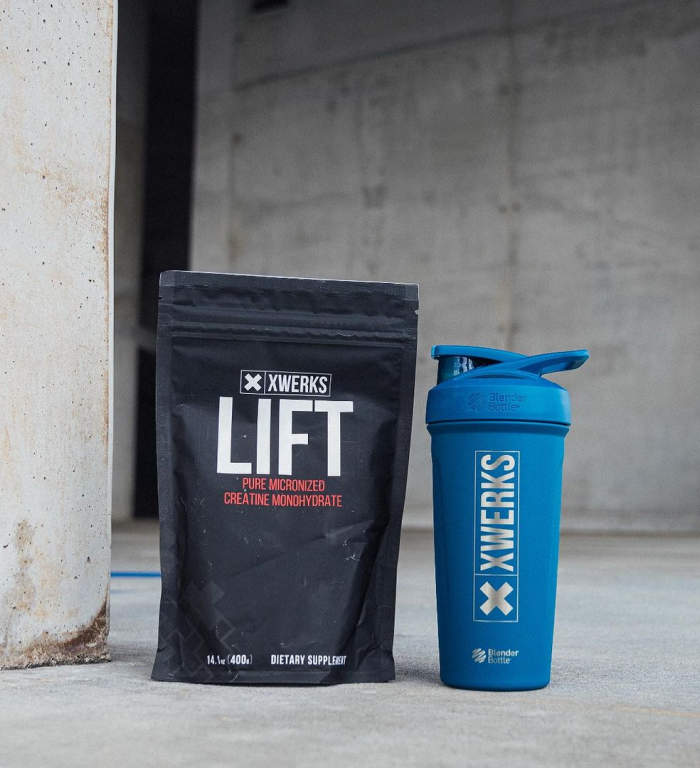
XWERKS Lift — pure micronized creatine monohydrate. 5g per scoop, 80 servings, unflavored. The most researched supplement in sports nutrition, at $0.50/day.
1. Kreider RB, et al. International Society of Sports Nutrition position stand: safety and efficacy of creatine supplementation. JISSN. 2017;14:18.
2. Hultman E, et al. Muscle creatine loading in men. J Appl Physiol. 1996;81(1):232-237.
3. Antonio J, et al. Common questions and misconceptions about creatine supplementation. JISSN. 2021;18(1):1-16.
4. Desai I, et al. The effect of creatine supplementation on resistance training-based changes to body composition. J Strength Cond Res. 2024;38(10):1813-1821.
5. Branch JD. Effect of creatine supplementation on body composition and performance: a meta-analysis. Int J Sport Nutr Exerc Metab. 2003;13(2):198-226.
Unlock Exclusive Offers and Fitness Tips!
Subscribe to the XWERKS newsletter to stay in the loop with the latest product releases, exclusive offers, and expert fitness tips that will elevate your performance to new heights!