Testosterone Replacement Therapy: Side Effects You Should Know
TRT (testosterone replacement therapy) is a legitimate medical treatment for clinically diagnosed hypogonadism. It can restore energy, libido, muscle mass, and quality of life when testosterone is genuinely low. But it's not risk-free, and the side effects are significant enough that anyone considering TRT should understand them fully — and exhaust natural optimization strategies first.
This article is informational, not medical advice. TRT is a medical treatment that requires diagnosis, prescription, and monitoring by a qualified physician. If you're experiencing symptoms of low testosterone, get blood work done and consult with an endocrinologist or urologist. Don't self-treat.
What TRT is
TRT involves administering exogenous testosterone — typically via injection (testosterone cypionate or enanthate), transdermal gel, or skin patch — to raise serum testosterone levels in men with clinically low levels (generally below 300 ng/dL on two separate morning blood draws with accompanying symptoms). The 2018 Endocrine Society guideline recommends TRT only when both symptoms and confirmed low levels are present.
The documented side effects
Erythrocytosis (elevated red blood cell count). This is the most common side effect of TRT. Testosterone stimulates erythropoietin production, increasing red blood cell production. When hematocrit (the percentage of blood volume occupied by red blood cells) rises above 54%, the risk of blood clots, stroke, and cardiovascular events increases significantly. Monitoring hematocrit every 3-6 months is standard practice for men on TRT. If levels rise too high, the treatment may need to be paused, the dose adjusted, or therapeutic phlebotomy (blood donation) performed.
Suppression of natural testosterone production. When you introduce exogenous testosterone, your body's hypothalamic-pituitary-gonadal (HPG) axis recognizes that testosterone is already present and reduces its own signaling. LH and FSH production decline, and your testes reduce or cease endogenous testosterone production. This effect is reliable and often significant — your natural production essentially shuts down as long as you're receiving exogenous testosterone. If you stop TRT, it can take months for natural production to recover, and in some cases, full recovery may not occur.
Fertility impact. The LH/FSH suppression from TRT also suppresses sperm production (spermatogenesis). Many men on TRT experience significantly reduced sperm count or complete azoospermia (zero sperm). For men who want to have children, TRT in its standard form is essentially a male contraceptive. This is often poorly communicated to patients before starting treatment. Alternative approaches like clomiphene citrate or HCG may preserve fertility while addressing low testosterone, but these require medical supervision.
Cardiovascular considerations. The cardiovascular safety of TRT has been extensively debated. The large TRAVERSE trial (2023) found that testosterone gel was non-inferior to placebo for major adverse cardiovascular events (MACE) in men with cardiovascular risk factors — meaning it didn't significantly increase heart attack or stroke risk in this population. However, the trial did observe higher rates of atrial fibrillation, acute kidney injury, and pulmonary embolism in the testosterone group as safety signals. The cardiovascular picture is not fully resolved, and shared decision-making between patient and physician remains important.
Testicular atrophy. When your testes stop receiving the LH signal to produce testosterone, they shrink. This is a cosmetic and sometimes psychological concern for some men, and it's a direct consequence of HPG axis suppression. HCG can be used alongside TRT to maintain testicular size and function, but it adds complexity and cost.
Acne and skin changes. Elevated testosterone (and elevated DHT from testosterone conversion) can increase sebum production, leading to acne — particularly on the back and shoulders. This is more common in the early months of treatment and tends to stabilize.
Sleep apnea. TRT may worsen or unmask obstructive sleep apnea. Men with existing sleep apnea or risk factors (obesity, large neck circumference) should be screened and monitored.
Estrogen elevation. Some exogenous testosterone is converted to estrogen via aromatase, particularly in men with higher body fat. This can cause gynecomastia (breast tissue development), water retention, and mood changes. Aromatase inhibitors are sometimes prescribed alongside TRT, though their long-term use carries its own risks.
Mood and behavioral changes. While TRT often improves mood in genuinely hypogonadal men, supraphysiologic levels can cause irritability, aggression, and mood swings. Proper dosing and monitoring are essential to keep levels in the physiological range.
It's a long-term commitment. Once you start TRT and your natural production shuts down, stopping isn't straightforward. Recovery of endogenous production can take months (with post-cycle therapy) and is not guaranteed. Many men who start TRT are on it indefinitely. This requires ongoing monitoring (blood work every 3-6 months), ongoing prescriptions, and ongoing costs.
When TRT makes sense
TRT is appropriate for men with clinically confirmed hypogonadism — total testosterone consistently below 300 ng/dL on morning blood draws, accompanied by symptoms (fatigue, reduced libido, erectile dysfunction, muscle loss, depression, cognitive decline). For these men, the benefits of restoring physiological testosterone often outweigh the risks, particularly when monitored by a qualified physician.
TRT is less appropriate — and the risk-benefit calculation shifts — when used by men with "low-normal" testosterone (300-500 ng/dL), men without clinical symptoms, younger men who may want children, or men seeking supraphysiologic levels for performance enhancement. In these cases, the side effects and long-term commitment may not be justified, especially when natural optimization strategies remain unexplored.
What to try before TRT
For men with suboptimal but not clinically low testosterone, or men who want to optimize before committing to exogenous therapy, the modifiable lifestyle factors are significant:
Body composition. Excess body fat is the single largest modifiable driver of low testosterone. Adipose tissue contains aromatase, which converts testosterone to estrogen. Losing fat — even modest amounts — can meaningfully increase testosterone. This should be priority one.
Resistance training. Compound resistance exercises directly stimulate testosterone production and maintain the muscle mass that supports healthy hormonal function.
Sleep. Testosterone production peaks during deep sleep. Chronic sleep restriction (under 6 hours) is associated with significantly lower testosterone — one study found a week of 5-hour sleep reduced testosterone by 10-15%.
Stress management. Chronic cortisol elevation directly suppresses the HPG axis. Ashwagandha (KSM-66) has clinical evidence for cortisol reduction and indirect testosterone support.
Micronutrient optimization. Zinc deficiency reliably reduces testosterone; supplementation in deficient men reliably restores it. Vitamin D deficiency (42% of American adults) is associated with lower testosterone. Boron has been shown to increase free testosterone and reduce SHBG.
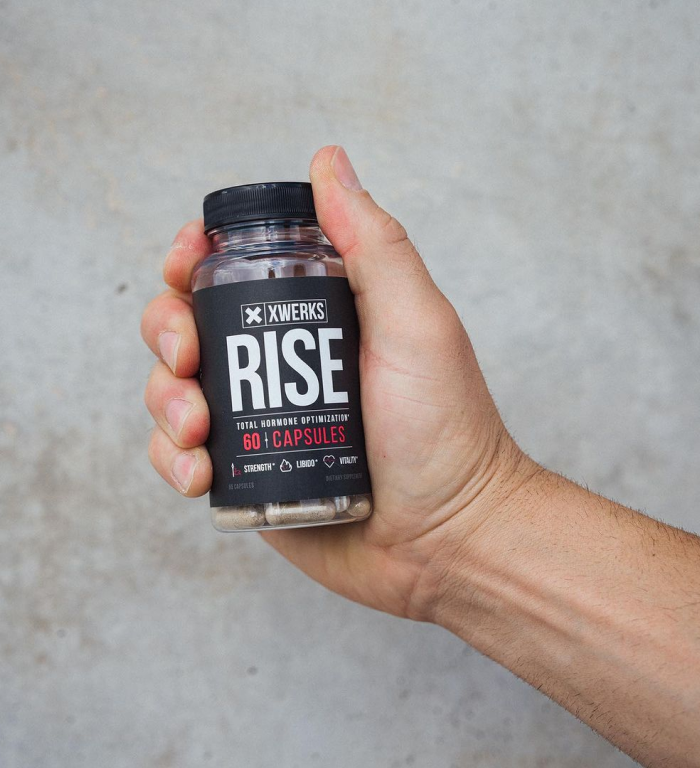
Targeted supplementation. Tongkat Ali has the strongest clinical evidence of any herbal testosterone-support compound — a 2022 meta-analysis of 9 RCTs confirmed significant testosterone improvement. XWERKS Rise combines Tongkat Ali (400mg) with Zinc (15mg), Boron (6mg), Shilajit (250mg), and BioPerine (10mg) to address multiple testosterone-support pathways without the side effects, fertility risks, or long-term commitment of TRT.
The honest positioning: Rise is not a TRT replacement. For men with genuine hypogonadism (total T consistently below 300 ng/dL), medical treatment is likely necessary and Rise alone may not be sufficient. But for the much larger population of men with suboptimal testosterone (300-500+ ng/dL), age-related decline, or lifestyle-driven suppression, the natural optimization pathway — body composition, training, sleep, stress management, and targeted supplementation — should be fully explored before committing to a lifetime of exogenous testosterone with its accompanying side effects, monitoring requirements, and fertility implications.
The Bottom Line
TRT is an effective medical treatment for clinically diagnosed hypogonadism, but it carries significant side effects: HPG axis suppression (your natural production shuts down), fertility impairment, erythrocytosis requiring monitoring, testicular atrophy, potential cardiovascular signals, and a long-term or lifetime commitment.
For men with suboptimal but not clinically low testosterone, the natural optimization pathway — body composition, resistance training, sleep, stress management, zinc, vitamin D, Tongkat Ali, and ashwagandha — is worth exhausting before committing to exogenous therapy. These strategies have no fertility risk, no HPG suppression, no monitoring requirements, and address the root causes of decline rather than overriding them.
Explore the Natural Path First
XWERKS Rise — 400mg Tongkat Ali, 15mg Zinc, 6mg Boron, 250mg Shilajit, 10mg BioPerine. Multi-pathway testosterone support without the side effects, fertility risks, or lifetime commitment of TRT.
SHOP RISE →
Further Reading
Tongkat Ali FAQ — The most evidence-backed natural testosterone-support ingredient.
Tongkat Ali and SHBG — How freeing bound testosterone works.
Cortisol vs. Testosterone — The stress-hormone connection.
Low Testosterone: What Are the Symptoms? — How to recognize the signs.
Testosterone-Killing Foods — Dietary patterns that affect hormonal health.
References
1. Bhasin S, et al. Testosterone therapy in men with hypogonadism: an Endocrine Society clinical practice guideline. J Clin Endocrinol Metab. 2018;103(5):1715-1744.
2. Lincoff AM, et al. Cardiovascular safety of testosterone-replacement therapy (TRAVERSE). N Engl J Med. 2023;389:107-117.
3. Leisegang K, et al. Eurycoma longifolia improves serum total testosterone: a systematic review and meta-analysis. Medicina. 2022;58(8):1047.
4. Ohlander SJ, et al. Erythrocytosis following testosterone therapy. Sex Med Rev. 2018;6(1):77-85.
5. Rastrelli G, et al. Testosterone replacement therapy for sexual symptoms. Sex Med Rev. 2019;7(3):464-475.
6. Leproult R, Van Cauter E. Effect of 1 week of sleep restriction on testosterone levels in young healthy men. JAMA. 2011;305(21):2173-2174.