Frequently Asked Questions About Tongkat Ali
Tongkat Ali (Eurycoma longifolia) is the most researched natural testosterone-support ingredient available. A 2022 systematic review and meta-analysis of randomized controlled trials confirmed that it significantly improves serum total testosterone in men. Here's what you need to know — answered honestly, with citations.
What is Tongkat Ali?
Tongkat Ali — also called Eurycoma longifolia, longjack, or Malaysian ginseng — is a flowering plant native to Southeast Asia, primarily Malaysia, Indonesia, Thailand, and Vietnam. The root has been used in traditional medicine for centuries as a general health tonic, energy booster, and treatment for age-related decline in male vitality.
The root contains bioactive compounds called quassinoids (primarily eurycomanone), along with alkaloids, sesterterpenoids, and flavonoids. Eurycomanone is considered the primary active compound responsible for Tongkat Ali's hormonal effects and is used as the standardization marker in clinical-grade extracts.
Modern research has moved beyond traditional claims. There are now multiple randomized controlled trials, systematic reviews, and at least one meta-analysis examining Tongkat Ali's effects on testosterone, cortisol, body composition, fertility, mood, and physical performance. The evidence is strongest for testosterone support in men with suboptimal levels and for cortisol reduction under stress.
Does Tongkat Ali actually increase testosterone?
Yes — with caveats. A 2022 systematic review and meta-analysis published in Medicina (PMC9415500) examined nine randomized controlled trials and found that Tongkat Ali supplementation significantly increased serum total testosterone in men (SMD = 1.352, p = 0.001). The effect was observed in both healthy volunteers and men with clinically low testosterone (hypogonadism).
The proposed mechanisms include stimulating luteinizing hormone (LH) production (which signals the testes to produce testosterone), reducing sex hormone-binding globulin (SHBG) to increase free testosterone availability, and inhibiting aromatase activity (the enzyme that converts testosterone to estrogen). George & Henkel (2014) detailed these pathways in their PMC review.
Important context: The most consistent testosterone improvements have been observed in men who started with suboptimal or clinically low levels. Healthy young men with already-normal testosterone may see smaller or no measurable changes. A 4-week study by Antonio et al. in exercise-trained men and women found no significant changes in salivary free testosterone, cortisol, body composition, or mood — suggesting that short durations and/or already-optimized hormonal profiles may not respond as strongly. Duration and baseline status matter.
The strongest results came from the Tambi et al. (2012) trial in men with late-onset hypogonadism, where 200mg/day of standardized extract for one month brought testosterone back into normal range in 90.8% of participants. The Chinnappan et al. (2021) multicenter RCT found dose-dependent increases in total testosterone at 100mg and 200mg/day over 12 weeks in men aged 50-70 with testosterone below 300 ng/dL.
What dose should I take?
The clinically studied dose range is 200-400mg per day of a standardized water-soluble extract (standardized to 0.8-2% eurycomanone content). Most positive clinical trials used 200mg/day or 400mg/day.
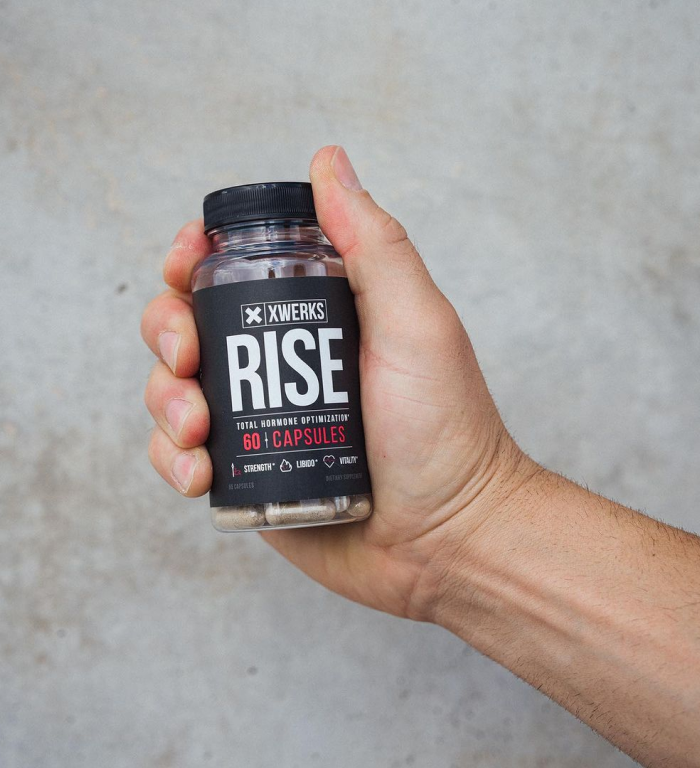
XWERKS Rise contains 400mg of Tongkat Ali per serving — the upper end of the clinically studied range. This is combined with 250mg Shilajit, 15mg Zinc, 6mg Boron, and 10mg BioPerine (black pepper extract for absorption enhancement).
Take it in the morning or early afternoon — some users report restlessness or difficulty sleeping if taken late in the day. Take it with food for improved absorption. Consistency matters: most clinical trials showing positive results ran for 4-12 weeks.
Does Tongkat Ali reduce cortisol and stress?
Yes. The Talbott et al. (2013) study is the key reference here. Moderately stressed adults who took 200mg/day of Tongkat Ali for 4 weeks showed significant reductions in cortisol (-16%), tension (-11%), anger (-12%), and confusion (-15%), along with improvements in the cortisol-to-testosterone ratio. This is relevant because chronic elevated cortisol directly suppresses testosterone production — so reducing cortisol is itself a mechanism for supporting healthy testosterone levels.
This adaptogenic quality — the ability to help the body maintain hormonal balance under stress — is one of the reasons Tongkat Ali pairs well with ashwagandha, another adaptogen with strong cortisol-lowering evidence. If you're dealing with chronic stress from work, training, sleep disruption, or life in general, the cortisol-testosterone relationship is worth understanding.
Does it help with physical performance and body composition?
The evidence here is more mixed than for testosterone. Henkel et al. (2014) found that Tongkat Ali supplementation improved muscle strength and lean body mass in a cohort that included both athletes and seniors. A 6-month RCT by Leitao et al. found that Tongkat Ali combined with concurrent training significantly improved erectile function and increased testosterone in men with androgen deficiency of aging males (ADAM) — with the combination group showing the best results.
However, the Antonio et al. (2024) study found that 4 weeks of Tongkat Ali supplementation in exercise-trained males and females produced no differences in body composition, handgrip strength, mood, sleep, cortisol, or free testosterone compared to placebo. The most likely explanation: the participants were already healthy, exercise-trained, and hormonally optimized — they didn't have the room for improvement that older or stressed populations do.
Does Tongkat Ali support male fertility?
Multiple studies have examined Tongkat Ali's effects on fertility parameters. Tambi et al. (2011) found significant improvements in sperm concentration, motility, and morphology in men with idiopathic infertility, along with increased pregnancy rates among partners. The proposed mechanism involves both the testosterone increase and direct effects on Leydig and Sertoli cell function in the testes.
This is one of the more consistent findings in the Tongkat Ali literature — improvements in semen quality appear across multiple studies, even in those where testosterone changes were modest.
Does Tongkat Ali work for women?
There's limited but emerging research. Women produce testosterone at much lower levels than men (roughly 5-10% of male levels), and testosterone plays important roles in female energy, libido, bone health, and muscle maintenance. A pilot study by Henkel et al. (2014) included both male and female seniors and found improvements in physical function across both sexes.
However, most clinical trials have been conducted exclusively in men, and dose optimization for women has not been established. Women interested in Tongkat Ali should start at the lower end of the dose range (100-200mg/day) and consult a healthcare provider, particularly if they have hormone-sensitive conditions.
Is Tongkat Ali safe? What are the side effects?
Clinical studies lasting up to 12 weeks have generally reported good tolerability with minimal side effects (Rehman et al., 2016). The safety profile at recommended doses (200-400mg/day of standardized extract) appears favorable.
Potential side effects — typically mild and dose-dependent — include restlessness or irritability, insomnia (especially with late-day dosing), mild GI discomfort, and increased body temperature. These usually resolve with dose adjustment.
Long-term safety data beyond 12 weeks is limited. Some practitioners recommend cycling (5 days on / 2 days off, or 8 weeks on / 2 weeks off) to maintain effectiveness and reduce the chance of tolerance, though this is based more on clinical practice than controlled studies.
How is Tongkat Ali different from Fadogia Agrestis?
This is one of the most common questions since Andrew Huberman's podcast popularized the Tongkat Ali + Fadogia stack. The short answer: Tongkat Ali has far more clinical evidence and a much stronger safety profile. Read our full comparison of Tongkat Ali vs. Fadogia Agrestis — but the key difference is that Tongkat Ali has multiple RCTs in humans while Fadogia's evidence is limited primarily to animal studies, some of which showed dose-dependent testicular toxicity in rats.
This is why XWERKS Rise uses Tongkat Ali (400mg) as its primary ingredient rather than Fadogia: the evidence base is deeper, the safety profile is better established, and the clinical dosing is more clearly defined.
What should I look for when buying Tongkat Ali?
The supplement market is full of Tongkat Ali products with wildly different quality, standardization, and transparency. Here's what matters:
Standardized extract, not raw powder. Look for products using a standardized water-soluble root extract with a defined eurycomanone content (typically 0.8-2%). Raw root powder is cheap but contains inconsistent levels of active compounds.
Extract ratio. Common ratios are 100:1 or 200:1, meaning 100-200 grams of raw root concentrated into 1 gram of extract. Higher ratios aren't necessarily better — what matters is the eurycomanone content of the final extract.
Third-party testing. Tongkat Ali is one of the most adulterated supplement ingredients in the world. Low-quality products have been found contaminated with lead, mercury, and even undeclared pharmaceutical compounds. Choose products tested by independent labs for purity, potency, and heavy metal contamination.
Complementary ingredients. Tongkat Ali works through hormonal pathways that benefit from cofactors. Zinc is a direct precursor for testosterone synthesis. Boron has been shown to increase free testosterone and reduce SHBG in clinical studies. Shilajit provides fulvic acid, which research suggests supports mitochondrial energy production and may have synergistic effects with Tongkat Ali on testosterone. BioPerine (piperine) enhances the bioavailability of many supplemental compounds.
How long does Tongkat Ali take to work?
Most clinical trials showing positive results ran for 4-12 weeks. Talbott's cortisol/stress study showed improvements in 4 weeks. Tambi's testosterone study in hypogonadal men showed results within 1 month. Chinnappan's multicenter trial ran for 12 weeks. The general expectation: initial effects on energy, stress, and mood may be noticeable within 2-4 weeks; testosterone-related effects on strength, body composition, and libido typically require 4-8 weeks of consistent use.
Tongkat Ali is not a fast-acting stimulant. It works through gradual hormonal optimization, not acute pharmacological effects. Think of it as resetting your baseline rather than providing a temporary spike.
Can I take Tongkat Ali with other supplements?
Tongkat Ali pairs well with several evidence-based supplements. Ashwagandha (KSM-66) complements Tongkat Ali's testosterone support with additional cortisol reduction and anxiolytic effects. Creatine monohydrate supports the downstream effects of healthy testosterone — strength, lean mass, and training capacity. Whey protein isolate provides the amino acid building blocks that testosterone-driven muscle protein synthesis requires.
Exercise caution combining Tongkat Ali with other testosterone-boosting supplements (DHEA, tribulus, high-dose fenugreek) without professional guidance. Do not combine with TRT or other prescription hormone therapies without your doctor's approval.
The Bottom Line
Tongkat Ali is the most evidence-backed natural testosterone-support ingredient available, with a 2022 meta-analysis confirming significant testosterone improvement across multiple RCTs. It also has consistent evidence for cortisol reduction, fertility support, and stress management.
It works best for men with suboptimal testosterone, elevated cortisol, or age-related hormonal decline. Healthy young men with already-normal hormone levels may see more modest effects. The clinically studied dose is 200-400mg/day of standardized extract, taken consistently for at least 4-8 weeks.
XWERKS Rise delivers 400mg of Tongkat Ali alongside Shilajit, Zinc, Boron, and BioPerine — the full complement of cofactors that support the hormonal pathways Tongkat Ali activates. No proprietary blends. Every dose on the label.
Tongkat Ali + Shilajit + Zinc + Boron + BioPerine
XWERKS Rise — the complete testosterone support formula. Every ingredient at a clinically relevant dose. Every dose on the label.
SHOP RISE →Further Reading
History and Uses of Tongkat Ali — The traditional roots and modern science behind this Southeast Asian herb.
Tongkat Ali vs. Fadogia Agrestis — Why the evidence and safety profiles are not even close.
Cortisol vs. Testosterone — How chronic stress suppresses testosterone and what to do about it.
References
1. Leisegang K, et al. Eurycoma longifolia (Jack) improves serum total testosterone in men: a systematic review and meta-analysis of clinical trials. Medicina. 2022;58(8):1047. PMC9415500.
2. Tambi MI, Imran MK, Henkel RR. Standardised water-soluble extract of Eurycoma longifolia, Tongkat Ali, as testosterone booster for managing men with late-onset hypogonadism? Andrologia. 2012;44:226-230.
3. Chinnappan SM, et al. Effect of Eurycoma longifolia standardised aqueous root extract on testosterone levels and quality of life in ageing male subjects. Food Nutr Res. 2021;65:5647.
4. George A, Henkel R. Phytoandrogenic properties of Eurycoma longifolia as natural alternative to testosterone replacement therapy. Andrologia. 2014;46(7):708-721. PMC4429628.
5. Talbott SM, et al. Effect of Tongkat Ali on stress hormones and psychological mood state in moderately stressed subjects. J Int Soc Sports Nutr. 2013;10:28.
6. Henkel RR, et al. Tongkat Ali as a potential herbal supplement for physically active male and female seniors. Phytother Res. 2014;28:544-550.
7. Tambi MI, Imran MK. Eurycoma longifolia Jack in managing idiopathic male infertility. Asian J Androl. 2011;12(3):376-380.
8. Leitao AE, et al. A 6-month, double-blind, placebo-controlled, randomized trial to evaluate the effect of Eurycoma longifolia and concurrent training on erectile function and testosterone levels in ADAM. Maturitas. 2021;145:78-85.
9. Antonio J, et al. The effects of Tongkat Ali supplementation in exercise-trained males and females. JISSN. 2024.
10. Rehman SU, et al. Review on a traditional herbal medicine, Eurycoma longifolia Jack (Tongkat Ali): its traditional uses, chemistry, evidence-based pharmacology and toxicology. Molecules. 2016;21(3):331. PMC4854082.