







Does Ashwagandha Increase Testosterone?
Yes — but indirectly. Ashwagandha has strong clinical evidence for reducing cortisol, which removes one of the primary brakes on testosterone production. It also has direct evidence for increasing testosterone in stressed and exercising men, though the mechanism is primarily cortisol-mediated rather than direct hormonal stimulation like Tongkat Ali.
How ashwagandha affects testosterone
Ashwagandha's testosterone-supporting effects operate through a different pathway than most people assume. It doesn't directly stimulate LH or the Leydig cells the way Tongkat Ali does. Instead, ashwagandha's primary mechanism is cortisol reduction — and cortisol directly suppresses the HPG axis that produces testosterone.
When cortisol is chronically elevated (from stress, sleep deprivation, overtraining, or lifestyle factors), the HPA axis suppresses LH secretion, reducing testosterone production. Ashwagandha's withanolides modulate the HPA axis, reducing cortisol output. With cortisol lowered, the HPG axis is "released" from suppression and testosterone production can normalize.
Think of it this way: ashwagandha doesn't push the gas pedal on testosterone — it releases the brake.
What the research shows
Cortisol reduction. A 2012 RCT by Chandrasekhar et al. found that 300mg of high-concentration ashwagandha root extract twice daily for 60 days reduced serum cortisol by 27.9% compared to placebo in chronically stressed adults. This is one of the most robust cortisol reduction results for any natural compound.
Testosterone increase in stressed men. The same study observed a significant increase in serum testosterone in the ashwagandha group vs. placebo. The testosterone increase was interpreted as a consequence of cortisol reduction — with the stress brake removed, the HPG axis normalized production.
Testosterone with resistance training. Wankhede et al. (2015) studied 57 young men undergoing an 8-week resistance training program. The group taking 300mg of standardized ashwagandha root extract twice daily showed significantly greater increases in testosterone, greater muscle strength (bench press, leg extension), greater muscle size, and greater reduction in exercise-induced muscle damage compared to placebo. This is the study most commonly cited for ashwagandha's direct testosterone benefit in exercising men.
Fertility and reproductive hormones. Ahmad et al. (2010) found that ashwagandha supplementation in infertile men improved semen quality and increased testosterone, LH, and FSH levels while reducing oxidative stress markers. This suggests that ashwagandha may support reproductive hormones through both stress reduction and antioxidant mechanisms.
Systematic reviews. A 2022 systematic review and meta-analysis of ashwagandha supplementation in males found statistically significant improvements in testosterone levels across pooled studies, with effect sizes most pronounced in stressed populations and exercising men.
What's in XWERKS Ashwa
XWERKS Ashwa contains 1,500mg of ashwagandha (Withania somnifera) root per serving — derived from a high-potency 30:1 root extract standardized to 3% withanolides. The 30:1 extraction means 30 parts of raw ashwagandha root are concentrated into 1 part of extract, delivering a potent dose of the bioactive withanolides that drive ashwagandha's adaptogenic and cortisol-modulating effects.
Withanolides are the active compounds in ashwagandha responsible for its hormonal and stress-reducing benefits. Standardization to 3% withanolides ensures consistent potency from batch to batch — important for any adaptogenic supplement, since wild-grown root varies significantly in active compound content.
How ashwagandha and Tongkat Ali complement each other
Ashwagandha and Tongkat Ali are often stacked because they work through different mechanisms:
Ashwagandha (Ashwa): Primarily reduces cortisol → releases the brake on HPG axis → indirect testosterone support. Also provides antioxidant protection, stress resilience, and improved sleep quality.
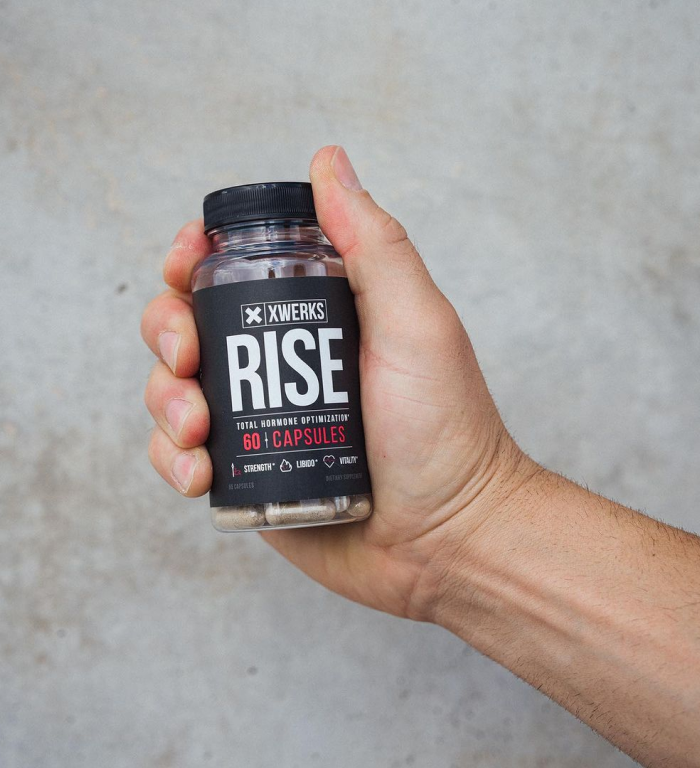
Tongkat Ali (Rise): Directly stimulates LH → increases Leydig cell testosterone production. Also reduces SHBG (increasing free testosterone) and has weak aromatase inhibition.
Together, they address both sides of the hormonal equation: ashwagandha removes the cortisol-driven suppression while Tongkat Ali actively stimulates production and availability. This is why Rise and Ashwa are designed to work together.
Dosage and timing
Clinical studies have used ashwagandha doses ranging from 300mg to 600mg of high-concentration root extract per day. XWERKS Ashwa provides 1,500mg of root from a 30:1 standardized extract, delivering withanolides at a clinically meaningful dose. Effects on cortisol typically appear within 2-4 weeks. Testosterone improvements may take 4-8 weeks of consistent daily use. Ashwagandha can be taken morning or evening — timing is flexible, consistency is essential.
The Bottom Line
Ashwagandha increases testosterone primarily by reducing cortisol — releasing the stress-driven brake on the HPG axis. The effect is strongest in stressed, exercising, or sleep-deprived men. The cortisol reduction evidence is robust (27.9% reduction in one RCT). The testosterone evidence is positive, particularly when combined with resistance training (Wankhede 2015).
For direct testosterone production stimulation, Tongkat Ali has stronger evidence. For cortisol reduction and stress management, ashwagandha is the clear leader. Together, they address both sides of the hormonal equation — which is why stacking Rise + Ashwa covers more ground than either supplement alone.
Both Sides of the Equation
XWERKS Ashwa (1,500mg ashwagandha root from a 30:1 standardized extract) for cortisol reduction. XWERKS Rise (400mg Tongkat Ali + Zinc + Boron) for direct testosterone support. Stack both for comprehensive hormonal optimization.
SHOP ASHWA → SHOP RISE →Further Reading
Cortisol vs. Testosterone — The inverse relationship explained in depth.
Tongkat Ali FAQ — The direct testosterone stimulation pathway.
Low Testosterone in Young Males — The modifiable lifestyle factors behind hormonal decline.
References
1. Chandrasekhar K, et al. A prospective, randomized double-blind, placebo-controlled study of safety and efficacy of a high-concentration full-spectrum extract of ashwagandha root. Indian J Psychol Med. 2012;34(3):255-262.
2. Wankhede S, et al. Examining the effect of Withania somnifera supplementation on muscle strength and recovery. JISSN. 2015;12:43.
3. Ahmad MK, et al. Withania somnifera improves semen quality by regulating reproductive hormone levels and oxidative stress. Fertil Steril. 2010;94(3):989-996.
4. Lopresti AL, et al. A randomized, double-blind, placebo-controlled, crossover study examining the hormonal and vitality effects of ashwagandha in aging, overweight males. Am J Mens Health. 2019;13(2):1557988319835985.