Creatine for Pickleball Players: Why It Works and How to Use It
TL;DR
- Pickleball is a repeated-sprint sport with short explosive efforts and constant direction changes — exactly the pattern where creatine produces the most performance benefit.
- Creatine supports pickleball performance through three mechanisms: explosive first-step power, recovery between points, and muscle preservation (critical for the 50+ demographic that dominates the sport).
- Standard dose: 5g daily of creatine monohydrate. No loading phase needed. Take consistently — timing doesn't matter.
- Bonus for older pickleball players: creatine supports cognitive function, bone density, and fall prevention — all relevant to maintaining competitive play into the 60s and 70s.
Pickleball has become the fastest-growing sport in America, with a player demographic skewing heavily toward ages 50-70+. The sport's movement pattern — short explosive sprints, rapid direction changes, and repeated high-intensity efforts with 10-20 second recovery periods between points — is almost perfectly suited to where creatine monohydrate produces the most performance benefit. For older pickleball players specifically, creatine provides three stacked benefits: enhanced first-step power and court coverage, better recovery between points (meaning less fatigue in the third game), and critical muscle preservation to combat age-related sarcopenia. Standard dose is 5g daily of creatine monohydrate — no loading phase needed, take consistently. Bonus effects include cognitive function support (useful for strategy and reaction time) and modest bone density benefits (fall prevention becomes increasingly important past 60).
Why pickleball is practically perfect for creatine
Creatine primarily supports the phosphocreatine (PCr) energy system — the body's fast-access energy system for efforts lasting roughly 10-15 seconds. This is the system your body uses for explosive efforts: sprints, jumps, heavy lifts, and rapid movements.
Now think about the movement pattern of competitive pickleball:
Short explosive sprints
Most pickleball points last 5-15 seconds of active play. During that time, players make 3-8 explosive movements — first-step acceleration, lateral shuffles, quick stops and direction changes. This is exactly the duration and intensity profile where the phosphocreatine system is primary.
Rapid direction changes
Pickleball requires constant lateral movement, forward-backward transitions, and rapid acceleration/deceleration. These explosive changes of direction place high demand on phosphocreatine-fueled muscle contractions.
Recovery between points
Pickleball features 10-20 seconds of recovery between points. Phosphocreatine stores are partially regenerated during these rest periods. Higher baseline phosphocreatine stores (from creatine supplementation) mean faster recovery and higher power output on the next point.
Repeated efforts over 60-90 minutes
A typical pickleball session involves 60-90+ minutes of repeated short efforts with incomplete recovery. By the third game, the difference between a player with saturated phosphocreatine stores and one without becomes meaningful — one is still generating explosive power on the tenth point of the game, the other is slowing down.
The three specific benefits for pickleball players
1. Enhanced first-step power and court coverage
Creatine's effects on explosive power are well-documented. Pickleball players taking creatine report improved ability to cover the court — reaching lobs they couldn't before, getting to drop shots faster, covering the kitchen more effectively. The effect is subtle but meaningful, particularly in close points where the first step determines whether you get to the ball.
For players in their 50s, 60s, and 70s facing natural age-related decline in fast-twitch muscle power, creatine partially compensates — helping maintain court coverage that would otherwise decline over years.
2. Better recovery between points and within matches
Higher muscle phosphocreatine stores mean faster recovery between points. Over a 90-minute match with 60+ points played, this adds up. Players report less fatigue in the third game, more consistent power output throughout the session, and faster recovery between consecutive matches in tournaments.
This is arguably the most important practical benefit — the ability to play at your actual skill level in game three rather than declining noticeably as matches progress.
3. Muscle preservation (critical for masters players)
Pickleball players over 50 face the same anabolic resistance as all older adults — their muscles become less responsive to protein intake and training stimulus. Creatine supplementation combined with resistance training (even modest training — 2-3 sessions per week) produces significantly greater muscle preservation than either alone.
Chilibeck et al. 2017 meta-analysis in older adults confirmed creatine + resistance training significantly improved lean mass and strength compared to training alone. For pickleball players, this translates to maintained power output and injury resilience over years of play.
Additional benefits relevant to the 50+ pickleball demographic
Cognitive function and reaction time
Creatine supports cognitive function in older adults — memory, processing speed, and mental fatigue resistance. For pickleball, this translates to better strategic decision-making, pattern recognition, and reaction time during fast exchanges at the kitchen line. Subtle but real.
Bone density
Some research suggests creatine combined with resistance training improves bone density in older adults, beyond training alone. For pickleball players concerned about fall-related fractures (a major risk factor as players age into 70s and 80s), this is a meaningful bonus effect.
Fall prevention through muscle maintenance
Stronger legs, better balance, and maintained reaction time all reduce fall risk — both on and off the court. Creatine's effects on muscle mass and function support this directly.
How to take creatine for pickleball
Dose: 5g daily of creatine monohydrate. Same dose for 50-year-old weekend warriors and 70-year-old competitive players.
Timing: Doesn't matter. Take it whenever is convenient — with breakfast, in your morning coffee, in a post-workout shake, at dinner. What matters is consistency, not timing.
Loading phase: Optional and unnecessary. You can load (20g/day for 5-7 days, split into 4 doses, to saturate muscles faster) or just take 5g daily and reach saturation in 3-4 weeks. Most people skip loading — no meaningful long-term difference.
Form: Creatine monohydrate. The most studied, most effective, most affordable form. Don't waste money on "advanced" creatine forms (HCL, ethyl ester, buffered) — research has consistently shown they're no more effective. XWERKS Lift uses micronized monohydrate for better solubility.
How to take it: Mix 5g (one scoop) in water, coffee, juice, or a smoothie. Micronized creatine dissolves better than regular monohydrate. Take it daily — including non-playing days.
Expect: Benefits appear over 3-4 weeks as muscle creatine stores saturate. The performance effects are noticeable but subtle — don't expect to suddenly hit 30% harder shots. Expect: slightly more pop off the first step, less fatigue in game 3, maintained power output over months and years.
Common concerns addressed
"Will I gain weight?" Creatine causes 1-3 lbs of intracellular water retention as muscles store additional creatine. This is inside muscle cells (not under the skin) and actually improves muscle function and appearance. Not a "bloat" effect.
"Is creatine safe for older adults?" Yes. Creatine has been studied extensively in older populations with excellent safety records. It's safe for healthy kidneys (doesn't cause kidney damage in people with normal kidney function). Talk to your doctor if you have pre-existing kidney disease.
"Will it affect my heart?" No adverse cardiovascular effects have been found in healthy adults. Some research suggests positive effects on cardiovascular markers.
"Can I take it with my medications?" Creatine has minimal drug interactions. If you're on prescription medications, a quick conversation with your doctor or pharmacist is reasonable, but interactions are rare.
"Do I need to 'cycle off' creatine?" No. Continuous daily use is fine and in fact preferred — cycling off causes you to lose the accumulated muscle creatine stores, diminishing benefits.
"What about my stomach?" Some people experience mild GI discomfort if they take large doses (10g+) on an empty stomach. 5g is well-tolerated by almost everyone. Take with food if you're sensitive.
Combining creatine with other pickleball-relevant supplements
Creatine is the foundation, but a complete stack for serious pickleball players includes:
Whey protein (XWERKS Grow): 1.6-2.0g protein per kg body weight daily. Critical for muscle preservation, particularly for players over 50 dealing with anabolic resistance.
Vitamin D3: 2,000-4,000 IU daily. Supports muscle function, bone density, and immune health. Test blood levels; target 40-60 ng/mL.
Omega-3 fish oil: 2-3g EPA+DHA daily. Supports joint health (wrist, elbow, shoulder — all stressed by pickleball), cardiovascular health, and reduces chronic inflammation from repetitive play.
Pre-workout (XWERKS Ignite): For competitive matches or tournaments. 150-200mg caffeine + citrulline malate + tyrosine improves alertness, power output, and reaction time.
Electrolytes for hot outdoor play: Sodium, potassium, magnesium during long sessions or tournaments. Prevents cramping and sustains performance.
Magnesium glycinate: 200-400mg evening. Supports sleep and muscle recovery.
The pickleball supplement stack for different player types
Casual 2-3x/week recreational player
Minimum: 5g creatine daily + adequate protein (whey shake on training days) + vitamin D3. Add omega-3s if you have joint complaints.
Competitive tournament player (50+)
Complete stack: creatine (5g daily) + whey (1-2 scoops daily to hit protein target) + vitamin D3 + omega-3s + magnesium. Pre-workout before tournament matches. Electrolytes during long tournament days.
Senior pickleball player (65+)
All of the above, with extra emphasis on protein (aim for 2.0-2.2g/kg to combat anabolic resistance) and the addition of vitamin K2 (100-200mcg with D3 for bone density). Consider magnesium at a higher dose (400mg) for sleep and muscle recovery support.
The Bottom Line
Pickleball is practically perfect for creatine supplementation. The sport's movement pattern (short explosive efforts with 10-20 second recovery) maps directly to where creatine produces the most performance benefit.
Three benefits for players: enhanced first-step power and court coverage, better recovery between points (less fatigue in game 3), and muscle preservation (critical for the 50+ demographic that dominates the sport).
Standard dose: 5g daily of creatine monohydrate. No loading needed. Take consistently, including non-playing days. Micronized monohydrate dissolves best.
Bonus effects for older players: cognitive function support (useful for strategy and reaction time), bone density support (when combined with resistance training), and fall prevention through muscle maintenance. All relevant for maintaining competitive play into the 60s, 70s, and beyond.
5g of Daily Performance Support
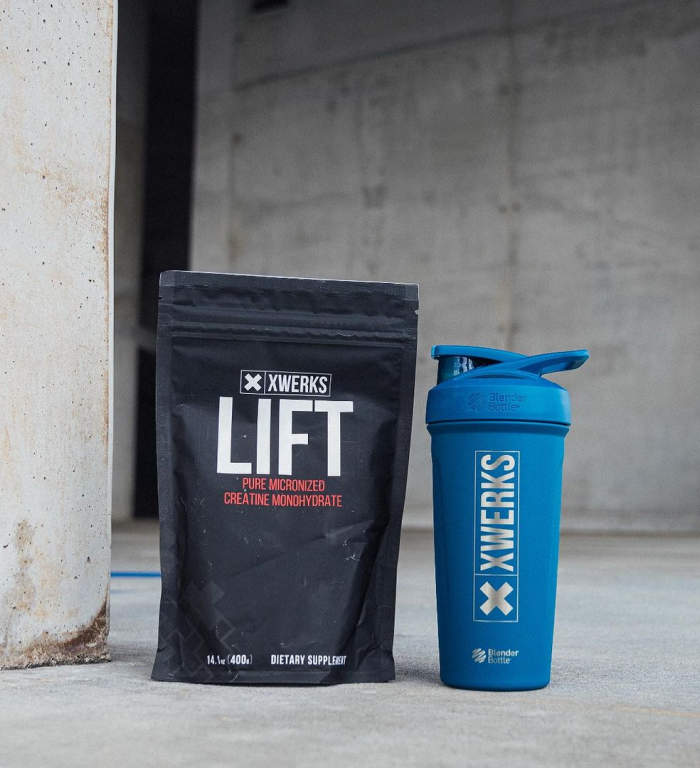
XWERKS Lift — micronized creatine monohydrate, 5g per scoop, 80 servings per bag. The most studied form of creatine at the dose used in research.
SHOP LIFT →Further Reading
Supplements for Muscle Preservation After 50
Best Supplements for Healthy Aging Men
Creatine Neuroprotective Effects
References
1. Chilibeck PD, et al. Effect of creatine supplementation during resistance training on lean tissue mass and muscular strength in older adults: a meta-analysis. Open Access J Sports Med. 2017;8:213-226.
2. Kreider RB, et al. International Society of Sports Nutrition position stand: safety and efficacy of creatine supplementation in exercise, sport, and medicine. J Int Soc Sports Nutr. 2017;14:18.
3. Mujika I, et al. Creatine supplementation and sprint performance in soccer players. Med Sci Sports Exerc. 2000;32(2):518-525.
4. Rawson ES, Volek JS. Effects of creatine supplementation and resistance training on muscle strength and weightlifting performance. J Strength Cond Res. 2003;17(4):822-831.
5. Forbes SC, et al. Effects of creatine supplementation on brain function and health. Nutrients. 2022;14(5):921.