Creatine for Cyclists: The Honest Guide to Power-to-Weight
TL;DR
- Creatine is a nuanced decision for cyclists due to power-to-weight sensitivity. The 1-2 lbs intracellular water retention matters differently for pure climbers vs. sprinters vs. recreational riders.
- For sprinters, crit racers, track cyclists, and gravity MTB: Clear yes. ATP-PCr benefits outweigh water weight.
- For climbers and stage racers: Conditional. Benefits (muscle preservation, cognitive function, sprint power) vs. weight penalty depends on race context.
- For recreational and endurance riders: Yes. Performance benefits plus longevity/cognitive support outweigh the minor weight.
- Dose: 5g daily monohydrate. For weight-sensitive racers, consider 3g daily (lower saturation, smaller water gain).
Cycling has more complexity around creatine than most endurance sports because of power-to-weight sensitivity. Pure climbers chase w/kg religiously; 1-2 lbs of intracellular water retention matters more for a rider climbing Alpe d'Huez than for a Saturday group ride. But creatine's benefits — enhanced sprint and attack power, better interval training quality, muscle preservation during high-volume blocks, cognitive support on long rides — are real and research-backed. The honest answer: most cyclists benefit from 5g creatine daily, with the strongest case for sprinters, crit racers, track cyclists, gravity MTB riders, and recreational/endurance athletes. For GC climbers and stage racers, the decision is more nuanced — some world-tour riders use creatine; others specifically avoid it during climbing-focused blocks. For most cyclists, the performance and longevity benefits outweigh the ~1% body weight increase. Dose: 5g daily, every day, indefinitely. Stick with creatine monohydrate.
The power-to-weight nuance
What 1-2 lbs actually means
A 70kg (155-lb) climber who gains 1.5 lbs from creatine is now 156.5 lbs — a 0.97% body weight increase. For a 20-minute climb producing 300W, the rider's w/kg drops from 4.24 to 4.20 — roughly 1% climbing slowdown in isolation.
But this ignores the benefits side of the equation: creatine supports attack power, final kicks, interval training quality, and recovery between efforts. For races where these matter (criteriums, sprint finishes, MTB races, gravel races with tactical surges), the benefits substantially outweigh the 1% penalty.
The climbing exception
For pure climbing efforts at sustained submaximal power (e.g., steady-state Alpe d'Huez time trial), creatine's benefits are smaller because ATP-PCr contribution is minimal during sustained sub-threshold work. The water weight penalty has no offsetting benefit in that specific context.
For stage races with climbs + sprints + attacks + time trials, the calculus shifts toward using creatine — the benefits apply across multiple race modalities.
Where creatine helps cyclists
Sprint finishes and attacks
Criterium sprints, track cycling, final-kilometer attacks — all ATP-PCr-dependent explosive efforts. Creatine directly enhances peak power production. Research has specifically examined cyclists and shown improved peak power and repeated sprint capacity.
Interval training quality
VO2 max intervals (3-5 minute efforts), sweet spot work, and short-interval sets all benefit from creatine's buffering of ATP regeneration. Higher quality intervals = better training adaptation over weeks.
Muscle preservation during high volume
High-volume training blocks (15-25+ hours/week) can produce muscle loss, particularly in the upper body and core. Creatine supports lean mass preservation even during heavy endurance work.
Gravity and mountain biking
Downhill MTB, enduro, and BMX are ATP-PCr dominant sports with tons of explosive efforts. Creatine is an unambiguous yes for gravity disciplines.
Cognitive function on long rides
Avgerinos 2018 review documented creatine's cognitive benefits. Long rides (4+ hours) create cognitive fatigue that affects pacing decisions, tactical choices, and technical descending. Creatine supports brain function throughout.
Recovery between sessions
Back-to-back hard days, race weekends, multi-day tour formats — creatine supports faster recovery between efforts through muscle glycogen replenishment and reduced training-induced inflammation.
Dosing protocol for cyclists
Standard dose: 5g daily monohydrate
Every day, including rest days. Saturates muscle creatine stores in 3-4 weeks. Take at any consistent time. No need for loading phase.
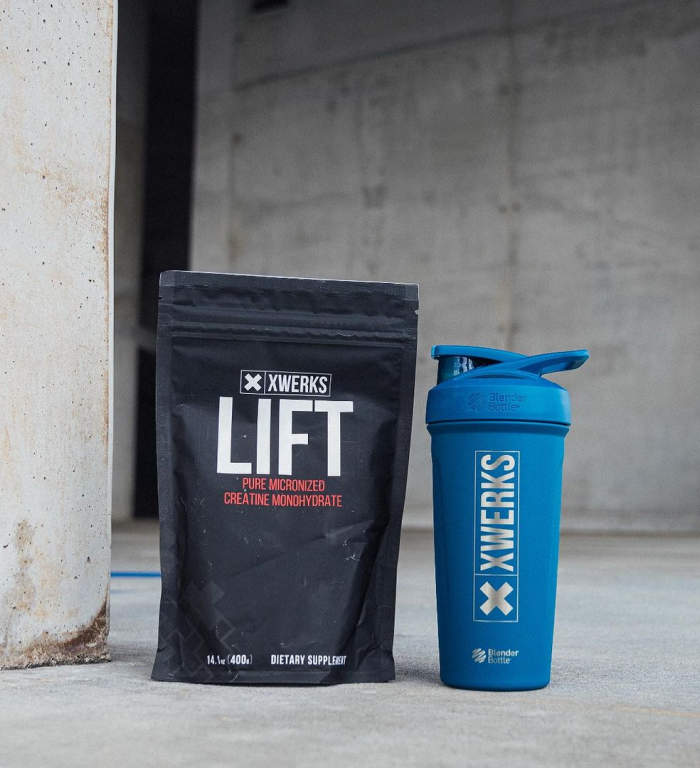
XWERKS Lift provides 5g micronized monohydrate per scoop.
Lower dose option for weight-sensitive riders: 3g daily
If you're a pure climber concerned about water weight, 3g daily produces partial saturation with proportionally less intracellular water retention. Full benefits of 5g aren't fully achieved at 3g, but some benefit remains. This is a reasonable compromise if the 1-2 lb gain genuinely bothers you.
Timing around racing
No need to discontinue before races. Research supports racing on creatine. Some stage racers discontinue 2-3 weeks before major climbing-focused GC races to reduce water weight; this is a reasonable experiment but not research-mandated.
Common cyclist creatine myths
"Creatine makes you bulky"
Creatine doesn't create muscle mass directly. It supports higher training quality, which — combined with resistance training — can produce modest muscle growth. For cyclists doing sport-specific training (mostly riding), creatine doesn't add bulk beyond the 1-2 lbs water.
"It'll hurt my FTP"
FTP is measured relative to weight (w/kg). The same ~1% math applies: your FTP in raw watts may improve slightly with creatine (better training quality), but w/kg may shift by ~1% depending on how weight changes offset the power gains. Real-world: most cyclists don't see their w/kg drop meaningfully on creatine.
"I'll just get more creatine from food"
Getting 5g of creatine from food requires 1+ lbs of fish or 2-3 lbs of meat daily. Not practical for most cyclists, and cooking destroys 20-30% of food creatine.
The Bottom Line
Most cyclists benefit from creatine — sprinters, crit racers, track cyclists, gravity MTB riders, and recreational/endurance cyclists see clear performance benefits. For GC climbers and stage racers, the calculus is more nuanced.
Dose: 5g creatine monohydrate daily, every day. Lower-dose option (3g/day) for very weight-sensitive climbers. Stick with monohydrate; skip marketing-driven alternatives.
The ~1% body weight increase doesn't ruin your power-to-weight. Benefits from enhanced ATP regeneration, training quality, muscle preservation, and cognitive function typically outweigh the small weight penalty.
Creatine Monohydrate for Cyclists
XWERKS Lift — 5g micronized creatine monohydrate per scoop. The most-researched form, mixes instantly, no flavor.
SHOP LIFT →Further Reading
Pre-Workout for Mountain Biking
References
1. Kreider RB, et al. ISSN position stand: safety and efficacy of creatine supplementation. J Int Soc Sports Nutr. 2017;14:18.
2. Chilibeck PD, et al. Effect of creatine supplementation during resistance training on lean tissue mass. Open Access J Sports Med. 2017;8:213-226.
3. Avgerinos KI, et al. Effects of creatine supplementation on cognitive function: systematic review. Exp Gerontol. 2018;108:166-173.