

Protein Powder for Runners: How Much, When, and Why
TL;DR
- Runners need more protein than commonly cited RDA — target 1.6-1.8g per kg body weight daily (higher than standard 0.8g/kg recommendation).
- Whey protein isolate is ideal for runners: fast-digesting, high-leucine, GI-tolerant, low-volume. Goes down easily even after hard efforts when appetite is suppressed.
- Timing: within 60-90 min post-run. For doubles or hard days, target 25-30g protein post-run. Pre-bed protein (20-30g) supports overnight repair during high-mileage blocks.
- Plant-based runners: need more total protein (1.8-2.0g/kg) and should diversify sources — pea + rice blend, soy isolate, or supplementation.
Most runners underestimate their protein needs. The standard RDA of 0.8g per kg body weight is set for sedentary adults — runners training at meaningful volume need 1.6-1.8g per kg daily, and up to 2.0g/kg during high-mileage blocks or when cutting weight. Research on endurance athletes confirms that higher protein intake supports muscle preservation, enhances recovery between sessions, and improves training adaptation. Whey protein isolate is particularly well-suited to runners: it's fast-digesting (fits post-run recovery windows), high in leucine (the amino acid driving muscle protein synthesis), GI-tolerant (important after hard efforts), and low-volume (goes down easily when appetite is suppressed). Target 25-30g of whey protein within 60-90 minutes post-run. For doubles, high-mileage weeks, or runs over 90 minutes, additional protein intake becomes increasingly important. Plant-based runners need slightly higher targets (1.8-2.0g/kg) and should diversify protein sources for complete amino acid profiles.
Why runners need more protein than they think
The old "protein is for lifters" myth
For decades, runners were told protein didn't matter much — that it was a macronutrient for strength athletes. Current research has thoroughly debunked this. Endurance training creates substantial muscle damage, alters amino acid metabolism during exercise, and requires more protein for recovery and adaptation than sedentary baseline.
Running-specific protein demands
• Muscle damage repair: Long runs and interval sessions create micro-tears requiring amino acid availability for repair
• Amino acid oxidation during exercise: During sustained running, some amino acids are oxidized for energy — particularly in glycogen-depleted states
• Mitochondrial adaptation: Endurance training's mitochondrial adaptations require protein synthesis
• Immune function: High training volume suppresses immune function; adequate protein supports immune recovery
Research-backed targets
ACSM, Academy of Nutrition and Dietetics, and Dietitians of Canada joint position statement (Thomas 2016) recommends 1.2-2.0g/kg daily for endurance athletes. Recent research favors the higher end (1.6-2.0g/kg) for actively training runners, particularly during hard training blocks or cutting phases.
Why whey isolate specifically for runners
Fast digestion = post-run recovery window
Whey isolate digests in 1-2 hours, delivering amino acids quickly during the post-run muscle protein synthesis window. Slower proteins (casein, plant-based) have their place but whey isolate excels immediately post-training.
High leucine content
Whey isolate contains roughly 10-12% leucine — the highest concentration of any common protein. Leucine triggers mTOR and muscle protein synthesis. Hitting the "leucine threshold" (~2.5-3g per serving) maximally stimulates recovery.
GI tolerance
After a hard run, GI blood flow is compromised. Heavy foods often don't sit well. A whey isolate shake goes down easily — no solid food required in that uncomfortable first hour post-run.
Low volume
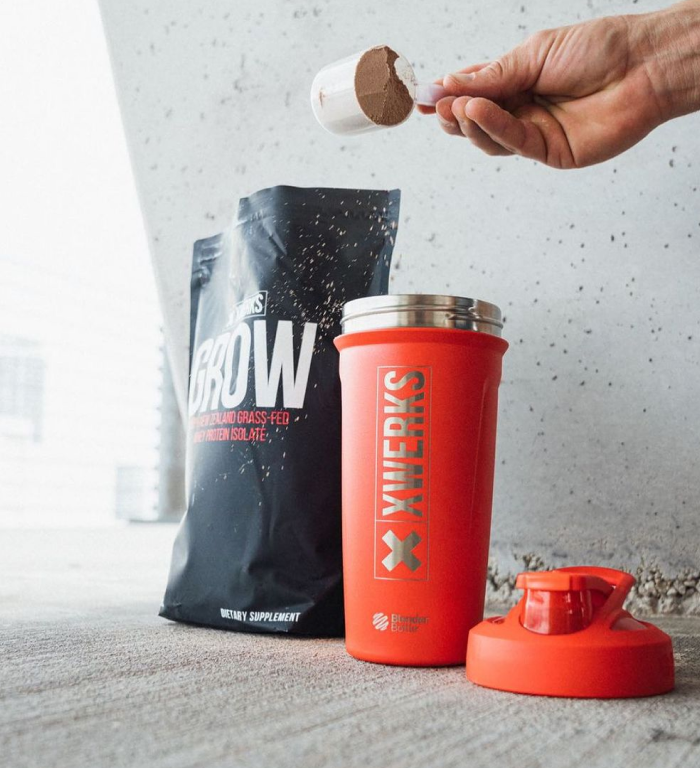
Getting 25-30g of protein from whole food means 4-5 oz of chicken or 5-6 eggs. A scoop of XWERKS Grow provides the same protein in 8 oz of liquid, easier on both appetite and preparation time before or after running.
How much protein runners actually need daily
Daily targets by training load
• Recreational runner (20-30 miles/week): 1.2-1.4g/kg daily
• Training for half/full marathon (35-50 miles/week): 1.4-1.6g/kg
• High-mileage training (50-80 miles/week): 1.6-1.8g/kg
• Elite/ultra volume (80+ miles/week): 1.8-2.0g/kg
• Cutting weight while running: Add 0.2g/kg to above — preserve muscle during deficit
Practical numbers by body weight
For a 150-lb runner (68 kg) training moderately (1.6g/kg target): 110g daily, spread across 4 meals at ~28g each.
For a 180-lb runner (82 kg) at 1.6g/kg: 130g daily, or 32g per meal across 4 meals.
Calculate your exact daily protein target based on body weight and training load: XWERKS Protein Calculator →
Timing protocol for runners
Post-run recovery (0-90 min)
25-30g whey isolate within 60-90 min of run completion. This is the highest-priority timing window for muscle protein synthesis. Pair with carbs (30-60g) for glycogen replenishment.
Between doubles
For runners doing AM + PM sessions, post-AM protein plus a whey-based snack 2-3 hours before PM session supports recovery. Skipping protein between doubles compromises second-session quality.
Pre-bed protein for high volume
During high-mileage blocks, 20-30g protein before bed supports overnight muscle protein synthesis. Some runners prefer slow-digesting casein here; whey also works and is cheaper.
Pre-long-run
Modest protein with carbs 2-3 hours before long runs. Don't overdo it — too much protein pre-run can cause GI issues. Think Greek yogurt + banana, not a full shake.
Plant-based runners
Higher targets
Plant-based runners should aim for 1.8-2.0g/kg daily (slightly higher than omnivores) due to:
• Lower digestibility of plant proteins
• Lower leucine content in most plant sources
• Less complete amino acid profiles per gram
Plant protein options
• Pea + rice blend: Provides complete amino acid profile, higher leucine than either alone
• Soy isolate: Complete amino acid profile, higher leucine than most plant sources
• Hemp, sacha inchi: Options but lower leucine
Whey isolate remains the most-researched protein for muscle protein synthesis response. Plant-based runners who can include whey (or who are lacto-ovo vegetarian) often find it easier to hit protein targets.
The Bottom Line
Runners need 1.6-1.8g protein per kg body weight daily — significantly higher than standard RDA. Higher intake supports muscle preservation, recovery, training adaptation, and immune function.
Whey isolate is ideal for runners — fast-digesting, high-leucine, GI-tolerant, low-volume. 25-30g within 60-90 min post-run hits the muscle protein synthesis window.
Practical strategy: 4 meals/shakes per day at ~30g protein each for most runners. Higher for high-mileage weeks or cutting phases. Plant-based runners should target slightly higher (1.8-2.0g/kg) with diverse sources.
Whey Isolate Built for Runners
XWERKS Grow — 25g of NZ grass-fed whey isolate per scoop. Fast-digesting, GI-tolerant, mixes in 8 oz of water. Chocolate, vanilla, strawberry, peanut butter.
SHOP GROW →Further Reading
Intra-Workout for Trail Running
References
1. Thomas DT, et al. ACSM Joint Position Statement: Nutrition and Athletic Performance. Med Sci Sports Exerc. 2016;48(3):543-568.
2. Morton RW, et al. A systematic review, meta-analysis and meta-regression of the effect of protein supplementation on resistance training-induced gains in muscle mass and strength. Br J Sports Med. 2018;52(6):376-384.
3. Moore DR, et al. Beyond muscle hypertrophy: why dietary protein is important for endurance athletes. Appl Physiol Nutr Metab. 2014;39(9):987-997.