


Clinically Dosed Pre-Workout: The Complete Guide
TL;DR
- A "clinically dosed" pre-workout contains each ingredient at the exact dose used in peer-reviewed research showing performance benefits — not a fraction of the research dose hidden inside a proprietary blend.
- The evidence-backed clinical doses: caffeine 3-6mg/kg, citrulline malate 6-8g, beta-alanine 3.2-6.4g, L-tyrosine 1-2g, creatine 3-5g. Most mainstream pre-workouts deliver 30-60% of these amounts.
- The two red flags: proprietary blends (hides actual doses) and ingredient dumping (12+ ingredients at token amounts rather than fewer ingredients at full doses).
- Clinically dosed pre-workouts typically cost more per serving — for good reason. You're paying for research-backed ingredient amounts rather than marketing-driven ingredient quantities.
"Clinically dosed" is one of the most meaningful yet misunderstood terms in the supplement industry. A clinically dosed pre-workout contains each key ingredient at the exact dose used in peer-reviewed research that demonstrated performance benefits — not a fraction of the research dose hidden inside a proprietary blend, and not a kitchen-sink formula with 15 ingredients at token amounts. The evidence-backed clinical doses are surprisingly specific: caffeine 3-6mg per kg body weight, citrulline malate 6-8g, beta-alanine 3.2-6.4g daily (loaded over weeks), L-tyrosine 1-2g, creatine 3-5g. Most mainstream pre-workouts deliver 30-60% of these amounts at best — enough to feel a stimulant buzz, not enough to produce the full ergogenic effect shown in research. Identifying a true clinically dosed product requires reading the supplement facts panel, rejecting proprietary blends, and evaluating each ingredient against its research-backed dose. The payoff: real performance improvement backed by real science, rather than placebo effect flavored as pre-workout.
What "clinically dosed" actually means
The simple definition
A "clinically dosed" supplement contains each ingredient at the dose shown to produce the measured benefit in controlled research studies. For pre-workout specifically, this means:
• Caffeine at 3-6mg/kg body weight (not 75mg "for flavor")
• Citrulline malate at 6-8g (not 500mg tucked inside a blend)
• Beta-alanine at 3.2g+ (not 800mg for "the tingles")
• L-tyrosine at 1-2g (not 100mg sprinkled on top)
In short: if the label lists an ingredient, it's present at the amount the research actually tested.
What it's NOT
Clinically dosed does not mean:
• "Recommended by clinicians" (meaningless marketing phrase)
• "Clinical strength" (usually just means strong-tasting)
• "Studied in a clinical setting" (every supplement is tested somewhere)
• "Contains research-backed ingredients" (but only at 10% of research dose)
The term has specific meaning when applied to ingredient doses, and very little meaning when used as general marketing language.
Why ingredient dosing matters so much
Pre-workout ingredients have dose-response relationships. Below a threshold dose, benefits are minimal or absent. Above a threshold, additional benefits diminish or reverse. The clinically studied dose isn't arbitrary — it's the dose that actually produces effects in controlled research.
Example: citrulline malate
Research showing ergogenic benefits of citrulline malate consistently uses 6-8g doses. Perez-Guisado and Jakeman 2010 used 8g and found improved muscular endurance (more reps to failure) in trained lifters. Wax et al. 2015 used 8g for similar results.
Many mainstream pre-workouts contain 1-3g of citrulline. At those doses, no research shows meaningful ergogenic effect. The ingredient is listed on the label, creating the impression of inclusion, but the dose is sub-therapeutic. You're paying for marketing, not performance.
Example: beta-alanine
Research demonstrating beta-alanine's ergogenic benefits consistently uses 3.2-6.4g per day, loaded over 4-6 weeks to saturate muscle carnosine. Hobson et al. 2012 meta-analysis confirmed effects at these doses.
Many pre-workouts contain 1.5-2g of beta-alanine. At this dose, you'll feel the characteristic tingling (paresthesia), which creates a sensation of effect. But the actual muscle carnosine saturation — the thing that produces the performance benefit — requires substantially more beta-alanine over weeks.
Example: caffeine
Research on caffeine's ergogenic effects uses 3-6mg per kg body weight as the effective dose range. For a 170-lb athlete, that's 230-460mg.
Some pre-workouts contain 100-150mg. This is enough to feel stimulated — the subjective effect — but at the lower end of the performance-effective range. For serious athletes, higher doses deliver more ergogenic effect; for caffeine-sensitive individuals or late-afternoon training, lower doses may be preferable. Either way, knowing the exact caffeine content matters.
The research-backed clinical doses for pre-workout ingredients
Here's the evidence-backed dose range for each major pre-workout ingredient:
| Ingredient | Clinical Dose | Primary Benefit |
|---|---|---|
| Caffeine | 3-6 mg/kg body weight (~150-500mg) | Endurance, strength, focus, reduced RPE |
| Citrulline Malate | 6-8 g | Muscular endurance, blood flow |
| L-Citrulline (standalone) | 3-6 g | Blood flow, nitric oxide |
| Beta-Alanine | 3.2-6.4 g daily (loaded 4-6 weeks) | Buffering, anaerobic endurance |
| L-Tyrosine | 1-2 g | Focus, cognition under stress |
| Creatine Monohydrate | 3-5 g daily | Power, strength, muscle mass |
| Betaine Anhydrous | 2.5 g | Power output, muscle endurance |
| Taurine | 1-2 g | Endurance, antioxidant |
| Rhodiola Rosea | 200-600 mg (3% rosavins) | Adaptogenic, mental fatigue |
| BCAAs | 5-10 g (if used) | Redundant if protein is adequate |
A product containing all of these at clinical doses would weigh roughly 20-30g per scoop. Most mainstream pre-workouts weigh 7-12g per scoop — which is a mathematical clue that many ingredients must be under-dosed relative to research.
How to read a pre-workout supplement facts panel
Spotting a clinically dosed pre-workout comes down to reading the label correctly.
Step 1: Reject proprietary blends
If the label shows a "proprietary blend" (or "performance blend," "energy matrix," etc.) with a total amount but not individual ingredient amounts, you cannot verify dosing. Even if the first ingredient by weight is large, the subsequent ingredients may each be at 50-100mg — far below clinical doses.
Proprietary blends exist primarily to hide underdosing. A genuinely clinically dosed product has no reason to hide individual ingredient amounts and typically lists each ingredient with its specific mg or g dose.
Step 2: Check the scoop weight
A single scoop of pre-workout containing clinical doses of the primary ergogenic ingredients (caffeine, citrulline, beta-alanine, tyrosine, creatine) weighs 15-25+ grams. Most genuine clinically dosed products have scoops of 15-25g.
If the scoop weighs 7-10g, math says several ingredients must be under-dosed. A ~10g scoop could contain full-dose caffeine and maybe one or two other ingredients at clinical doses, but not a complete clinical stack.
Step 3: Evaluate each ingredient against the clinical dose table
Go through the label ingredient by ingredient and compare to the dose table above. Count how many ingredients are at or above their clinical dose. If 3-5 major ingredients are clinically dosed, the product is meaningfully differentiated. If 0-1 ingredients are clinically dosed, it's a standard "feels like something" pre-workout relying on caffeine.
Step 4: Consider the ingredient count
More ingredients is often worse, not better. A pre-workout with 15+ ingredients in a standard-sized scoop almost certainly has several ingredients at token doses. A focused pre-workout with 6-8 well-dosed ingredients is usually more effective than a kitchen-sink blend.
Common pre-workout red flags
Red flags (avoid)
• Proprietary blends hiding individual doses
• 15+ ingredients in a small scoop
• "Concentrated" formulas with 5-7g scoops
• Exotic stimulants (DMAA, DMHA, yohimbine) at high doses
• Niacin flush as a "feel" feature
• Marketing language without specific dose disclosure
• Too-good-to-be-true pricing (clinical ingredients cost real money)
• "Banned in major leagues" as a marketing boast
Green flags (good signs)
• Individual ingredient doses disclosed in mg/g
• 6-10 focused ingredients at full clinical doses
• Scoop size 15-25g (reflects real ingredient mass)
• Moderate, well-studied stimulants (caffeine)
• Transparent about what's in each scoop
• Specific dose-response research cited
• Reasonable-to-premium pricing
• Established in mainstream sports contexts
What makes XWERKS Ignite clinically dosed
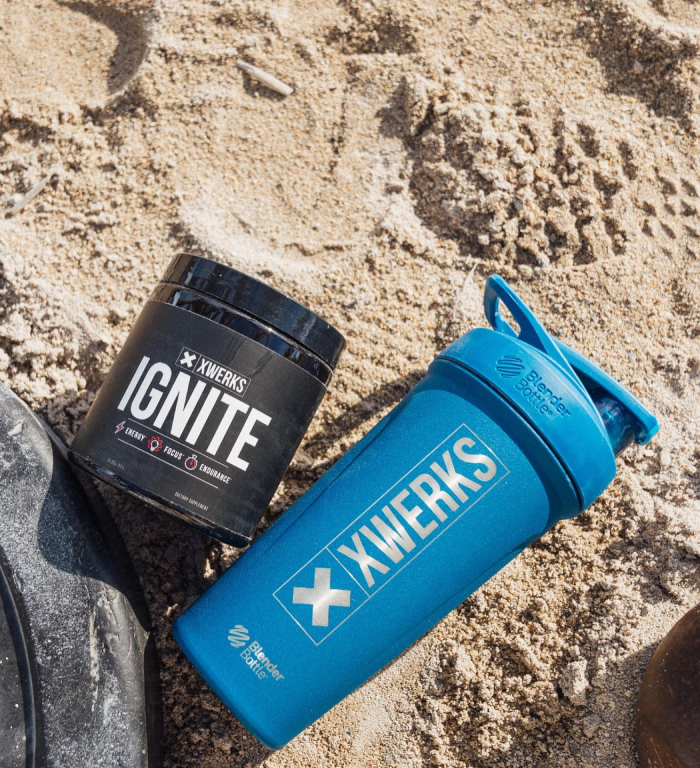
For context, here's how XWERKS Ignite's formulation maps to the clinical dose framework:
Per-serving doses in Ignite
• Caffeine: 150mg — middle of the 3-6mg/kg range for a 70-75kg (155-165 lb) athlete; moderate stimulation appropriate for most training
• Citrulline Malate: 3g — within the research-active range (6g+ is higher-end, 3g is solid lower-effective dose in some studies)
• L-Tyrosine: 2g — at the upper clinical dose for cognitive/focus benefits
• Beta-Alanine: 1.5g — per-serving portion of daily loading; athletes often add standalone beta-alanine to reach 3-6g daily loading
• Rhodiola Rosea: 500mg — within the clinical range for adaptogenic support
• DMAE: 200mg — nootropic support for focus
• BioPerine: 10mg — supports absorption of other ingredients
Design philosophy
Ignite is built for a specific athletic target: moderate, controlled stimulation that supports performance without causing jitters that impair skill work, technical handling, or fine motor control. It's why XWERKS Ignite works well for sports like mountain biking, pickleball, tennis, Hyrox, and motocross where extreme stim would actually hurt performance.
For powerlifting max-attempt days, athletes sometimes add supplemental caffeine (an additional 100-200mg via caffeine tablets) to push into the 250-350mg total caffeine range. For everyday training in most sports, the base 150mg is the right target.
Why clinical doses cost more
Clinical-dose pre-workouts are consistently more expensive per serving than mainstream alternatives. The math explains why:
Raw ingredient cost examples
At commodity pricing, a clinical dose of citrulline malate (8g) costs the manufacturer roughly 4-8x more than a token 1-2g dose. Scale that across multiple ingredients and the cost differential compounds.
A manufacturer can add 500mg of citrulline to the label for pennies of cost. Adding 6-8g of citrulline per serving represents a meaningful input cost that gets passed to the consumer.
The cost comparison
Typical mainstream pre-workout: $0.80-$1.50 per serving
Typical clinical-dose pre-workout: $1.60-$3.00 per serving
The difference (roughly 2x) reflects ingredient cost plus lower margins. You're paying for the actual research-backed doses, not just packaging and marketing.
When clinical dosing matters most vs. least
Matters most: competitive/performance-focused training
If you're training for a specific performance outcome (competition, PRs, body recomposition), the actual ergogenic effect of your pre-workout matters. Getting 40% of the research-backed effect from an under-dosed product is a meaningful performance loss over time.
Matters less: casual general-fitness training
If you're training 2-3x per week for general fitness without specific performance goals, the caffeine hit and workout mood-boost from any pre-workout may be sufficient. The marginal performance difference from clinical dosing is still real, but its practical importance is lower.
Matters most: sports where "feel" is separate from "effect"
For sports requiring skill, technical handling, or fine motor control (racquet sports, motorsports, rock climbing, surgery — seriously, some surgeons track their pre-op caffeine), the quality of the stimulus matters more than the intensity. Moderate, clean stimulation from well-dosed ingredients outperforms mega-stim products that cause jitters and over-arousal.
Matters less: pure maximal-strength single-rep efforts
For one-rep max attempts or pure power events, the combination of stimulation + arousal may be more important than fine-grained dose optimization. Some athletes find mega-stim pre-workouts useful specifically for these contexts, though the trade-off is post-workout recovery and sleep disruption.
Timing and cycling considerations
When to take clinically dosed pre-workout
Timing: 30-45 minutes before training. Caffeine peaks at 45-90 min; citrulline and tyrosine peak around 60-90 min. 30-45 min pre-workout puts most ingredients near peak during training.
Time of day: Avoid within 8 hours of intended sleep. Caffeine's 4-6 hour half-life means afternoon doses disrupt sleep for most people — and poor sleep costs more performance than pre-workout delivers.
Cycling: do you need to cycle off?
Caffeine tolerance builds over 1-2 weeks of daily use, though most ergogenic effects persist despite tolerance (Irwin et al. 2011). You don't need to cycle off to benefit.
That said, periodic deloads (1-2 weeks per quarter of reduced or no pre-workout) can refresh the subjective experience. Some athletes also reduce pre-workout use in the week before a key competition so the full-dose on race day produces a bigger perceived effect.
Beta-alanine consideration
Beta-alanine's benefits come from muscle carnosine saturation, which takes 4-6 weeks of consistent daily supplementation at 3-6g. A pre-workout with 1.5-2g beta-alanine per serving (used 4-5x per week) may slowly saturate over months. For athletes prioritizing beta-alanine benefits, supplementing standalone beta-alanine in addition to pre-workout accelerates loading.
Common questions about clinical dosing
"Does dose really matter that much?"
Yes — ingredient dose-response is well-established in research. Below threshold doses, many ingredients show no measurable benefit. At clinical doses, benefits are consistent across multiple studies. The difference between 1g of citrulline malate and 8g of citrulline malate isn't a minor tweak — it's the difference between placebo and ergogenic.
"Can I stack two pre-workouts to hit clinical doses?"
Possible but risky. Two underdosed pre-workouts often stack to reasonable citrulline or beta-alanine levels but also stack to potentially problematic caffeine levels. Monitor total caffeine carefully (don't exceed 6 mg/kg, or 400-500mg for most athletes), and watch for other ingredient interactions.
"I feel my current pre-workout — doesn't that mean it's working?"
Feeling a pre-workout and benefiting from a pre-workout are related but distinct. Most "feel" comes from caffeine (stimulation), beta-alanine (tingles), and niacin (flush). The ergogenic effect (actual performance improvement) requires clinical doses of the performance ingredients, not just subjective sensations. You can feel strong stimulation from an underdosed product without getting much performance benefit.
"Is clinical dosing just marketing?"
The term can be misused, so check the label rather than the marketing copy. If individual ingredient amounts are disclosed and match research-backed doses, "clinically dosed" is a meaningful descriptor. If individual doses are hidden or clearly sub-therapeutic, it's just marketing.
The Bottom Line
"Clinically dosed" means each ingredient is present at the dose used in research showing performance benefits — not a fraction hidden in a proprietary blend, not a kitchen-sink formula with 15 underdosed ingredients.
The research-backed doses: caffeine 3-6 mg/kg, citrulline malate 6-8g, beta-alanine 3.2-6.4g daily (loaded), L-tyrosine 1-2g, creatine 3-5g. A clinically dosed product has scoop size 15-25g to hold real ingredient mass.
Red flags: proprietary blends, 15+ ingredients in tiny scoops, exotic stimulants marketed as "feel," niacin flush as a feature. Green flags: transparent per-ingredient dosing, 6-10 focused ingredients, moderate well-studied stimulants, reasonable-to-premium pricing.
Clinical dosing costs more for good reason — raw ingredient cost is 2-5x higher at clinical doses. A $1/serving underdosed pre-workout is actually more expensive per unit of effect than a $2/serving clinically dosed product. You're paying for research-backed performance, not packaging and marketing.
A Clinically Dosed Pre-Workout Without the Jitters
XWERKS Ignite — 150mg caffeine, 3g citrulline malate, 2g L-tyrosine, 1.5g beta-alanine, 500mg rhodiola, plus DMAE and BioPerine. Moderate, controlled stimulation that works across skill sports, endurance, and strength training. No proprietary blends, no megadose exotic stimulants, full per-ingredient dose disclosure.
SHOP IGNITE →Further Reading
The Athletic Benefits of Caffeine
Pre-Workout for Mountain Biking
Supplement Guide for Hyrox Athletes
How Long Does Caffeine Take to Wear Off?
References
1. Guest NS, et al. International society of sports nutrition position stand: caffeine and exercise performance. J Int Soc Sports Nutr. 2021;18(1):1.
2. Perez-Guisado J, Jakeman PM. Citrulline malate enhances athletic anaerobic performance and relieves muscle soreness. J Strength Cond Res. 2010;24(5):1215-1222.
3. Wax B, et al. Effects of supplemental citrulline malate ingestion during repeated bouts of lower-body exercise in advanced weightlifters. J Strength Cond Res. 2015;29(3):786-792.
4. Hobson RM, et al. Effects of β-alanine supplementation on exercise performance: a meta-analysis. Amino Acids. 2012;43(1):25-37.
5. Kreider RB, et al. International Society of Sports Nutrition position stand: safety and efficacy of creatine supplementation in exercise, sport, and medicine. J Int Soc Sports Nutr. 2017;14:18.
6. Trexler ET, et al. International society of sports nutrition position stand: Beta-Alanine. J Int Soc Sports Nutr. 2015;12:30.
7. Jagim AR, et al. International society of sports nutrition position stand: energy drinks and energy shots. J Int Soc Sports Nutr. 2023;20(1):2171314.