

TL;DR
- Yes, you can take more creatine than is useful — but serious harm from creatine in healthy adults is extremely rare. The actual risks of overdose are GI distress, diarrhea, and wasted money, not catastrophic health issues.
- The effective daily dose is 3-5g for maintenance. Some research uses up to 20g/day during loading phases. Beyond 20g/day, there's no additional benefit — your muscles can only store so much creatine.
- A single large dose (10g+) often causes stomach upset and diarrhea. Spreading the same daily total across 2-4 smaller doses eliminates this issue.
- Kidney concerns are the most common worry — the research is clear: creatine does not damage kidneys in healthy individuals at any researched dose. Pre-existing kidney disease is a different situation and requires physician guidance.
- Skip: mega-dose "creatine loading" that exceeds 20g/day, assumptions that "more is better" (muscles have a saturation ceiling), and products combining creatine with unrelated compounds at high doses.
"Can you take too much creatine?" is a question driven by two different concerns that deserve different answers. The first is practical: is there a point where more creatine stops helping and starts hurting? The second is medical: is creatine dangerous at high doses? The short answer to both: yes, you can exceed useful doses, and extremely high doses can cause uncomfortable side effects — but the catastrophic health fears driving much of the "too much creatine" search traffic are largely unfounded for healthy individuals. Creatine is one of the most-researched supplements in sports science, with the ISSN Position Stand (Kreider et al. 2017) concluding there are no documented harmful effects in healthy populations at any researched dose. The real "too much creatine" concerns are practical: stomach upset from large single doses, wasted money from over-supplementing, and the rare but legitimate concern for people with pre-existing kidney conditions. This guide covers what the research actually supports on creatine dosing limits, what happens if you take more than recommended, when concerns are legitimate vs. manufactured, and how to optimize your creatine dosing for actual benefit.
How much creatine do you actually need?
Standard maintenance dose: 3-5g daily. This is the dose used in the vast majority of studies showing benefit — enough to maintain full muscle creatine saturation once achieved.
Loading phase (optional): 20g/day for 5-7 days, then drop to 3-5g/day maintenance. Loading achieves muscle saturation in 5-7 days instead of 3-4 weeks at standard dose. Not necessary — your muscles will saturate either way. Loading just accelerates the timeline.
Upper research doses: Some research has examined daily doses up to 25-30g in specific contexts (certain medical conditions, high-muscle-mass athletes). Beyond these doses, there's no additional benefit — muscles have a finite creatine storage capacity, and excess is simply excreted through urine.
The practical answer: 3-5g daily produces essentially all the benefit research supports. Going higher doesn't make your muscles bigger, faster, or stronger. It just produces more expensive urine.
The saturation ceiling — why "more" doesn't help
Muscles can only store so much creatine
Muscle creatine content exists on a continuum. The average unsupplemented adult has muscle creatine stores around 125 mmol/kg of dry muscle. The approximate biological ceiling is about 160 mmol/kg — the maximum amount muscles can hold. Creatine supplementation raises stores from baseline toward this ceiling.
Once you've reached saturation (usually after 3-4 weeks of 3-5g daily, or 5-7 days of 20g loading), additional creatine above maintenance dose doesn't increase muscle stores further. It passes through your body without producing additional muscle effect.
What about people who don't "respond" to creatine?
Some people are "non-responders" — they show smaller performance benefits from creatine than others. This is typically not a dosing issue. Non-responders often have naturally higher baseline muscle creatine (less room to increase) or eat diets high in meat/fish providing substantial dietary creatine. Increasing their supplement dose doesn't convert them to responders because the ceiling is physiological, not dosing-related.
The "more is better" trap
Athletes sometimes reason: "If 5g produces benefits, 10g must produce more benefits; 20g must be even better." This reasoning doesn't work with creatine because of the saturation ceiling. A 20g daily maintenance dose provides the same muscle creatine levels as 5g — once you're saturated, additional creatine is excreted. You're paying 4x more for identical benefit.
What happens if you take too much
GI distress from large single doses
10g+ at once commonly causes stomach upsetThe most common "too much creatine" side effect is GI distress — stomach discomfort, bloating, and sometimes diarrhea from large single doses. This typically occurs with doses over 10g taken at once, particularly on an empty stomach. The fix: spread your daily total across 2-4 smaller doses rather than all at once. During a loading phase, split the 20g into 4 x 5g doses throughout the day instead of one massive dose.
Diarrhea and digestive issues
Typically dose-related and temporaryCreatine can cause osmotic diarrhea when doses exceed absorption capacity — essentially, unabsorbed creatine pulls water into the gut. Again, the fix is spreading doses or reducing single-dose size. Creatine HCl is sometimes marketed as solving this issue (claiming lower doses needed for same effect), but research doesn't strongly support its superiority over monohydrate. If GI issues occur with monohydrate, try: smaller doses more frequently, taking with food, or different brands/formulations.
Water weight (not actual "weight gain")
1-2 lbs intracellular water, not fat gainCreatine draws water into muscle cells — this is part of how it works. At normal doses this produces 1-2 lbs of scale increase over the first 2-3 weeks. Higher doses don't produce significantly more water weight because of the saturation ceiling. This isn't "too much creatine" — it's normal, intramuscular water, not body fat.
Financial waste
The real cost of over-supplementingA 5g dose of creatine monohydrate costs about $0.10-0.30 depending on brand. Taking 20g daily indefinitely instead of 5g means spending 4x more on creatine for identical results. Over a year, the difference is $100-300 in wasted supplements. The "too much" here is financial rather than physiological — but it adds up.
The kidney question — addressing the biggest concern
The persistent concern that creatine damages kidneys comes from a simple misunderstanding: creatine supplementation raises blood creatinine levels. Creatinine is a breakdown product of creatine and is also used as a marker for kidney function — elevated creatinine on a blood test can indicate kidney problems.
Here's the key: creatine supplementation raises creatinine because you're taking more creatine, not because your kidneys are damaged. It's like eating more meat raising your blood urea levels — the marker goes up from dietary intake, not from kidney dysfunction.
The research is extensive and clear:
• The ISSN Position Stand (Kreider 2017) — the most comprehensive safety review — concluded "there is no compelling scientific evidence that the short- or long-term use of creatine monohydrate (up to 30g/day for 5 years) has any detrimental effects on otherwise healthy individuals."
• Long-term studies up to 5 years of continuous use in athletes show no kidney function deterioration.
• Studies specifically in older adults (where kidney function declines with age) show creatine is safe and beneficial.
• Research including stress on kidneys (athletes in heavy training, older adults) shows no problematic changes.
The one honest caveat: if you already have kidney disease, consult your physician before starting any supplement — creatine included. This isn't because creatine is harmful to healthy kidneys; it's because people with existing kidney dysfunction need individualized medical guidance for all aspects of nutrition and supplementation.
When "too much creatine" concerns are legitimate
Pre-existing kidney disease
Physician consultation requiredPeople with chronic kidney disease, significantly reduced kidney function, or on dialysis need individualized medical guidance before starting creatine. This isn't because creatine is harmful to diseased kidneys — some research actually suggests creatine may be beneficial in certain kidney conditions — but because the risk/benefit calculation is complex and requires physician oversight. If you have known kidney disease, discuss any supplement with your nephrologist.
Medications that affect kidney function
Consult physician if taking relevant medicationsSome medications (certain NSAIDs at high doses, some blood pressure medications, certain antibiotics, cyclosporine) can affect kidney function. If you're on long-term prescription medication, discuss adding creatine with your physician — not because of creatine-specific risks, but because supplementation should be considered in the context of your full medication regimen.
Severe dehydration or heat stroke history
Hydration becomes more criticalCreatine draws water into muscle cells, which can slightly increase hydration needs. For most people this is negligible. For athletes training in extreme heat with history of severe dehydration or heat illness, pay particular attention to hydration — though this is good advice for hot-weather training regardless of creatine use. See our hot weather training supplementation guide.
Rare specific conditions
Individual medical evaluation requiredCertain rare genetic conditions affect creatine metabolism and require medical guidance. Creatine transporter deficiency and similar conditions are typically diagnosed in childhood; if you have unusual medical history relevant to creatine metabolism, discuss with your physician.
Signs you might be overdoing it
Practical indicators of taking too much
• Persistent GI discomfort: Stomach upset, bloating, or diarrhea that didn't resolve after the first week. Reduce dose or split across more servings.
• You're taking 10g+ daily as "maintenance": Unnecessary beyond the loading phase. Drop to 3-5g daily.
• You're stacking multiple creatine products: Pre-workout with creatine + separate creatine supplement + "recovery" product with creatine. Usually adds up to more than 5g daily from overlapping sources. Consolidate to one primary creatine source.
• You've been loading for more than 7 days: The purpose of loading is rapid saturation. After 5-7 days of 20g daily, drop to maintenance dose. Continuing loading doses indefinitely wastes money.
• You're taking creatine in multi-gram doses in a single sitting: 10g+ at once increases GI risk. Split the same total across 2-4 smaller doses.
Optimal dosing practical guide
Standard protocol (most people)
5g once daily · any consistent timeTake 5g of creatine monohydrate with any convenient beverage (water, protein shake, coffee, post-workout drink) at any consistent daily time. Saturation takes 3-4 weeks; benefits continue as long as supplementation continues. No cycling necessary.
Loading protocol (if you want faster results)
20g/day split into 4x5g doses for 5-7 daysTake 5g four times per day (morning, lunch, afternoon, evening) for 5-7 days. Achieves muscle saturation in under a week. Then drop to 5g daily maintenance. GI tolerance is better with split doses than single mega-doses.
For larger athletes (200+ lbs)
5-10g daily maintenanceSome research suggests larger athletes may benefit from slightly higher maintenance doses (5-10g) rather than 3-5g, because total muscle creatine storage capacity scales with muscle mass. Still not useful to exceed 10g maintenance once saturated.
For smaller individuals (under 130 lbs)
3g daily often sufficientSmaller people with less total muscle mass often saturate at lower doses. 3g daily is frequently adequate. No need to match the doses athletic magazines recommend for 200+ lb bodybuilders.
Combining creatine with other supplements
Creatine stacks well with most supplements
• Whey protein: Common combination post-workout; no interference
• Pre-workout: Fine to take together; just track total creatine (pre-workout may include 3g creatine; add supplemental creatine as needed)
• Caffeine: Older research suggested caffeine might reduce creatine effects — follow-up research largely refuted this. Coffee + creatine is fine.
• Electrolytes and hydration products: No issues; often taken together
• Beta-alanine: Different mechanism; can combine for complementary effects (particularly for repeated-sprint sports)
• Other amino acids (BCAAs, EAAs): No interference
The main thing to track: total creatine from all sources. Multiple products each containing creatine can add up to more than intended.
Duration and cycling
Cycling creatine is not necessary
Creatine doesn't produce tolerance — your muscles don't become less responsive over time. Continuous daily use for years is well-documented as safe and maintains elevated muscle creatine stores continuously. Cycling off (1 month off every 3 months, etc.) is sometimes recommended but has no research basis. If you stop creatine, your stores return to baseline over 4-6 weeks; benefits fade accordingly.
Long-term use safety
Research documents safe creatine use for 5+ years of continuous supplementation in healthy adults. No accumulating toxicity, no kidney issues in otherwise healthy people, no hormonal disruption. Creatine is among the most-studied long-term-safety supplements available.
The Bottom Line
Can you take too much creatine? Yes — but the consequences are mild and practical, not catastrophic. Excessive doses cause stomach upset, diarrhea, and financial waste — not kidney damage or health emergencies in healthy individuals.
The effective dose range: 3-5g daily for maintenance. Up to 20g/day during optional 5-7 day loading. Beyond this, there's no additional benefit because muscles have a saturation ceiling.
Signs of overdoing it: persistent GI discomfort, stacking multiple creatine sources totaling over 5-10g daily without reason, continuing loading doses past 7 days, or taking 10g+ in a single sitting.
Kidney concerns: creatine does not damage kidneys in healthy individuals at any researched dose. The ISSN has declared creatine safe up to 30g/day for 5 years in healthy populations. People with pre-existing kidney disease should consult physicians before any supplement, creatine included.
Optimal approach: 5g creatine monohydrate daily, consistent time, indefinitely. No cycling necessary. Mixes with coffee, protein shakes, water, or any beverage.
Dig deeper: how much creatine should I take · creatine timing: before or after workouts · does creatine cause hair loss · understanding creatine: common questions
Pure Creatine, Simple Dose
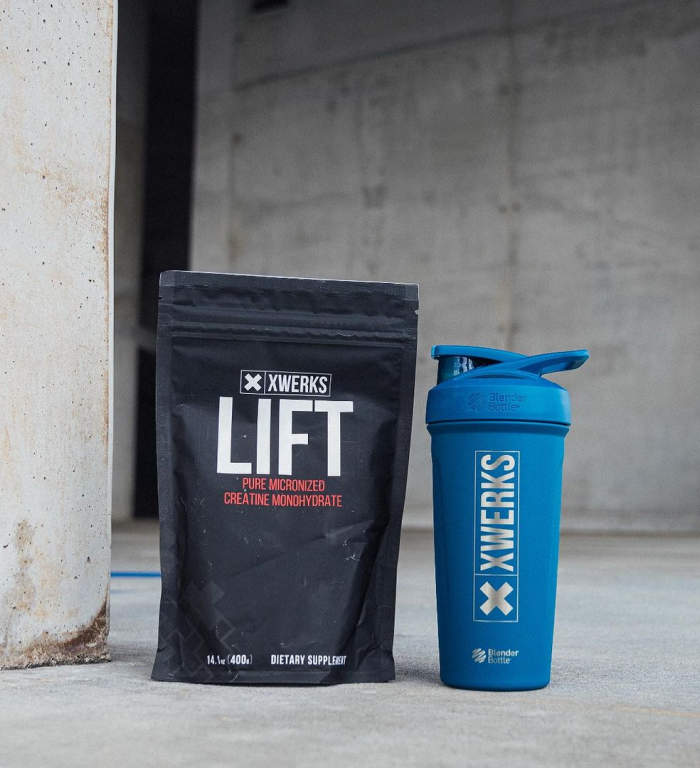
XWERKS Lift — 5g micronized creatine monohydrate per scoop. One ingredient, no fillers, no "mega-dose" marketing. The exact research-backed dose, at the exact form used in the studies showing benefit. Unflavored, mixes into any drink.
Shop Lift