Best Protein Powder for Weight Loss: What Actually Helps You Lose Fat
Short answer: the best protein powder for weight loss is a clean whey isolate — high protein, low calories, low sugar, and no fillers. Protein is the most satiating and muscle-preserving macronutrient, which is exactly what you want in a calorie deficit. But no powder "burns fat" on its own. Here's how to use one effectively, and what to ignore.
Protein powder shows up in nearly every weight-loss plan for good reason — but the reason is often misunderstood. A protein shake doesn't melt fat, boost metabolism dramatically, or contain magic "fat-burning" compounds. What it actually does is far more useful: it helps you stay full on fewer calories, preserves the muscle you'd otherwise lose while dieting, and makes hitting a high-protein target easy. Those three things are the real levers of successful fat loss. The catch is that the "weight loss" and "diet" protein powders on the shelf are often the worst choice for the job. Here's what actually matters.

TL;DR
- Protein helps fat loss three ways: it's the most satiating macro (keeps you full), it preserves muscle in a calorie deficit, and it has the highest thermic effect (burns slightly more calories to digest).
- The best choice is a clean whey isolate — high protein per calorie, low sugar, low fat, minimal ingredients. ~25g protein for ~110-120 calories is the target profile.
- Ignore "diet"/"slimming"/"lean" protein powders with fat-burner blends. Green tea extract, CLA, L-carnitine, and raspberry ketones at label doses do little to nothing. They add cost and clutter, not fat loss.
- No powder burns fat by itself. Fat loss comes from a sustained calorie deficit. Protein powder is a tool that makes the deficit easier to maintain and protects your muscle while you're in it.
- Higher protein intake (0.7-1g per lb of body weight) is one of the most reliable diet strategies — a shake makes hitting that target practical without many calories.
How protein actually supports fat loss
1. Satiety — it keeps you full
Protein is the most filling of the three macronutrients. Higher-protein meals increase satiety hormones and blunt hunger, which makes a calorie deficit far easier to sustain. The hardest part of dieting isn't the math — it's the hunger. A protein shake is a low-calorie, high-satiety way to control appetite between meals or bridge to your next one.
2. Muscle preservation in a deficit
When you lose weight, you want to lose fat — not muscle. In a calorie deficit, inadequate protein leads your body to break down muscle for energy, which lowers your metabolism and leaves you "skinny-fat" rather than lean. Adequate protein (combined with resistance training) signals your body to hold onto muscle while the fat comes off. This is the single most important reason to prioritize protein while dieting.
3. Thermic effect of food
Your body burns more calories digesting protein than carbs or fat — roughly 20-30% of protein's calories are used up in digestion, versus 5-10% for carbs and 0-3% for fat. It's a modest effect, but it means a high-protein diet has a small metabolic edge. Not magic, but real.
What to look for in a weight-loss protein
High protein per calorie
This is the key metric. You want maximum protein for minimum calories — that's what makes a shake filling and muscle-sparing without eating into your calorie budget. A quality whey isolate delivers ~25g protein for ~110-120 calories. Cheaper concentrates and "gainer"-style products pack in more carbs and fat, raising the calorie count.
Low sugar, low fat
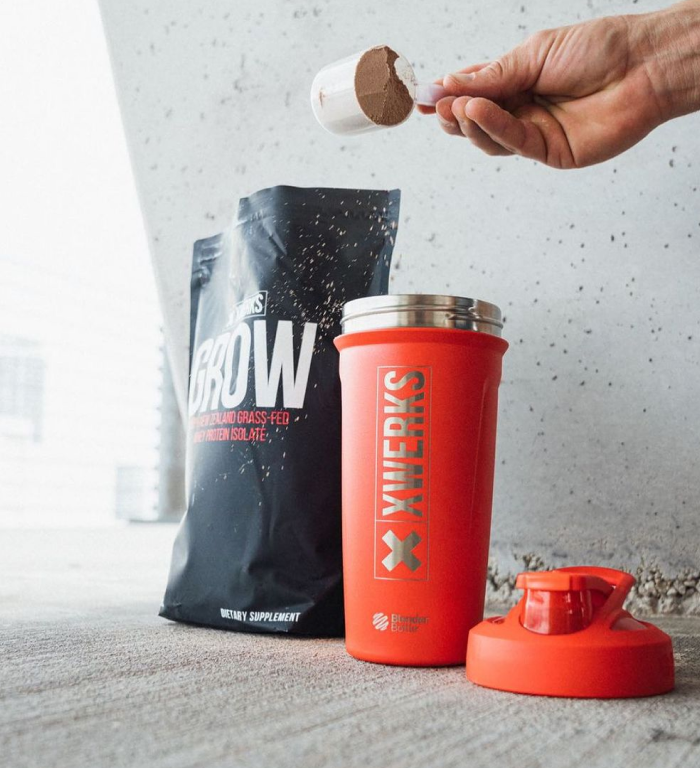
Skip products with added sugar or high fat content — they inflate calories without adding satiety benefit. Grow has zero added sugar and minimal fat, keeping the calories almost entirely in the protein.
Whey isolate over concentrate
Isolate is more refined — higher protein percentage, lower lactose, lower fat and carbs. That higher protein-per-calorie ratio is exactly what you want when dieting. (Isolate is also easier on digestion — see protein for sensitive stomachs.)
A short, clean ingredient list
The fewer ingredients, the better. You don't need a "fat-burning matrix" — you need protein. Grow has four ingredients. No proprietary blends, no fillers, no ineffective add-ins.
Good taste and mixability
The best weight-loss protein is one you'll actually drink consistently. A shake you look forward to is one that keeps you on plan. See best-tasting whey protein.
Why "diet" and "slimming" proteins are usually the wrong pick
The protein powders explicitly marketed for weight loss — "lean," "slim," "diet," "skinny" formulas — are frequently the worst choice for the goal. Here's why:
| "Diet" protein claim | The reality |
|---|---|
| Added "fat burners" (CLA, green tea, L-carnitine) | At label doses, minimal to no measurable fat-loss effect. Cost without benefit. |
| "Only 90 calories!" | Often achieved by underdosing protein (15-18g), which reduces satiety and muscle protection. |
| Added fiber for "fullness" | Cheap bulking; can cause bloating. Protein itself is the satiety driver. |
| "Metabolism boosting" | The thermic effect comes from protein itself — no special ingredient needed. |
| Premium "weight-loss" pricing | You pay more for less protein and useless add-ins. A clean isolate costs less and works better. |
The better move: buy a clean, high-protein isolate and let the protein do the work. You'll get more protein per calorie, better satiety and muscle preservation, and a lower price than most "diet" formulas.
How to use protein powder for weight loss
Hit a high daily protein target
Aim for roughly 0.7-1g of protein per pound of body weight per day while dieting — the higher end helps preserve muscle and control hunger in a deficit. For a 160-lb person, that's ~112-160g/day. Most people fall short from food alone; one or two shakes make the target realistic. One scoop of Grow adds 25g for only ~110 calories.
Use it strategically for hunger
A protein shake works well as a mid-morning or afternoon appetite-control tool, a low-calorie snack replacement, or a post-workout option. Because it's filling and low-calorie, it helps you get through the gaps where you'd otherwise reach for something calorie-dense.
Keep the shake simple
Water or unsweetened almond milk keeps the calories low. Blending with fruit, nut butter, or oats adds nutrients but also calories — fine if it fits your budget, but for pure appetite control, a simple water-based shake is the lowest-calorie option.
Pair with resistance training
Protein preserves muscle best when you're also training. Lifting while dieting signals your body to keep muscle, so the weight you lose comes from fat. Protein + resistance training is the combination that produces a lean result rather than just a smaller version of the same body composition. See whey protein for weight loss for the deeper mechanism.
Common questions
Can I lose weight just by drinking protein shakes?
Weight loss requires a calorie deficit, whatever the source. Replacing a high-calorie meal or snack with a lower-calorie protein shake can help create that deficit, but the shake isn't doing anything magical — it's reducing your calorie intake while keeping you full and protecting muscle. A whole-food-based diet with protein shakes as support is more sustainable and nutritious than an all-shake approach.
Whey or plant protein for weight loss?
Both work — the key is high protein per calorie and adequate total intake. Whey isolate has a slight edge for satiety and muscle preservation (higher leucine, complete profile) and tends to be higher protein per calorie. Plant proteins (pea/rice blends) are a fine choice for vegans or those avoiding dairy; just check they're not loaded with added carbs.
Will protein powder make me gain weight?
Only if it pushes you into a calorie surplus. Protein powder is just food — calories count. Used to replace higher-calorie foods or fill a protein gap within your calorie budget, it supports fat loss. Added on top of an already-adequate diet, the extra calories count like any other. It's a tool, and how you use it determines the result.
Is a "weight gainer" the opposite thing?
Yes — mass gainers are loaded with carbs and calories to help people gain weight. Avoid them if fat loss is your goal; they're the wrong tool. A clean isolate is the opposite end of the spectrum: maximum protein, minimum calories.
The Bottom Line
The best protein powder for weight loss is a clean whey isolate — high protein, low calories, low sugar, minimal ingredients. The profile to look for is roughly 25g protein for 110-120 calories with no added sugar or fillers. Protein supports fat loss through satiety (staying full), muscle preservation (losing fat, not muscle), and a modest thermic-effect edge.
Skip the "diet," "slim," and "lean" formulas with fat-burner blends — the added ingredients do little to nothing, the protein is often underdosed, and you pay more for less. A straightforward high-quality isolate outperforms them at a lower cost.
Remember that no powder burns fat by itself. Fat loss comes from a sustained calorie deficit; protein powder is the tool that makes the deficit easier to maintain and protects your muscle while you're in it. XWERKS Grow — 25g protein, 110 calories, 0g sugar, four ingredients — is built exactly for that job.
Maximum Protein. Minimum Calories.
XWERKS Grow — 25g grass-fed whey isolate, 110 calories, 0g added sugar, four clean ingredients. The satiety and muscle preservation you need in a deficit, without the fillers or fake "diet" gimmicks.
Shop GrowFurther Reading
Whey Protein for Weight Loss — The deeper mechanism of protein and fat loss.
Best Protein Powder for Women — Why there's no need for a special "women's" formula.
Best Protein Powder for Muscle Gain — The other side of body composition.
Whey Protein Isolate Benefits — Why isolate is the best base for a cut.
Best-Tasting Whey Protein — Because the shake you enjoy is the one you'll stick with.
References
1. Leidy HJ, et al. The role of protein in weight loss and maintenance. Am J Clin Nutr. 2015;101(6):1320S-1329S.
2. Halton TL, Hu FB. The effects of high protein diets on thermogenesis, satiety and weight loss: a critical review. J Am Coll Nutr. 2004;23(5):373-385.
3. Pasiakos SM, et al. Effects of high-protein diets on fat-free mass and muscle protein synthesis following weight loss: a randomized controlled trial. FASEB J. 2013;27(9):3837-3847.
4. Wycherley TP, et al. Effects of energy-restricted high-protein, low-fat compared with standard-protein, high-carbohydrate diets: a meta-analysis of randomized controlled trials. Am J Clin Nutr. 2012;96(6):1281-1298.
5. Westerterp-Plantenga MS, et al. Dietary protein, weight loss, and weight maintenance. Annu Rev Nutr. 2009;29:21-41.