

TL;DR
- "Grass-fed whey" labeling is loosely regulated in the US. Most American "grass-fed whey" products come from cows that graze part-time and supplement with grain — meaningfully different from the year-round pasture-raised standard.
- The country of origin matters more than most people realize: New Zealand grass-fed dairy has the strictest standards globally — pasture-raised year-round (climate permits), no rBST hormones (banned in NZ), no routine antibiotics, no grain supplementation in summer months.
- Filtration method matters as much as grass-fed sourcing. Cross-flow microfiltration preserves bioactive compounds (lactoferrin, immunoglobulins, alpha-lactalbumin); ion-exchange filtration destroys them through harsh chemical processing.
- Real grass-fed whey advantages: higher omega-3 content, more conjugated linoleic acid (CLA), higher beta-carotene, no synthetic hormones, better animal welfare standards. Differences are real but modest at typical serving sizes.
- Skip: vague "grass-fed" claims without country of origin, "grass-fed" products at mass-market prices ($25 for 5lb tub), products with proprietary blends or excessive ingredient lists, ion-exchange filtered products at premium pricing.
"Best grass-fed whey protein" is one of the most quality-conscious supplement queries — the search is dominated by buyers willing to pay premium pricing for cleaner sourcing, but most ranking articles fail to address the actual quality variables that matter. The honest picture: "grass-fed whey" is a meaningful category, but the labeling is loosely regulated and quality varies dramatically between products marketing similar claims. The best grass-fed whey isn't determined by who has the prettiest packaging or the most aggressive "premium" marketing — it comes down to specific, verifiable variables: country of origin (and the dairy quality standards that country enforces), pasture-raised vs. grass-fed terminology distinctions, filtration method (cross-flow microfiltration vs ion-exchange), bioactive compound preservation, hormone and antibiotic policies, and ingredient transparency. This guide covers what "grass-fed" actually means at the regulatory level, why country of origin matters more than most consumers realize (the NZ vs. US dairy quality difference is dramatic), the filtration variables that determine final whey quality, what to look for on labels, what to avoid (the products that use "grass-fed" claims without delivering the substance), and how XWERKS Grow compares against the leading grass-fed whey protein options on the market.
What "grass-fed" actually means
"Grass-fed" labeling on dairy products in the United States is governed by significantly weaker standards than most consumers assume. The USDA grass-fed claim was withdrawn in 2016, leaving the term largely unregulated for marketing purposes. What this means in practice:
"Grass-fed" can mean almost anything in US dairy: Some products labeled grass-fed come from cows that graze pasture for a portion of the year and supplement with grain during winter months or for production efficiency. Others come from cows raised primarily on grain feedlots with limited pasture access marketed as "grass-fed" because the cows technically eat grass at some point.
Voluntary certification programs add some structure: The American Grassfed Association (AGA) certifies dairy producers under stricter standards than commodity "grass-fed" labeling. AGA-certified products typically require year-round pasture access, no grain supplementation, no antibiotics, and animal welfare standards. But certification is optional, and most "grass-fed whey" products on the market aren't AGA certified.
"100% grass-fed" vs. "grass-fed": The most meaningful distinction. "100% grass-fed" implies no grain supplementation. Plain "grass-fed" can mean partial pasture access with grain supplementation. Read labels carefully.
Pasture-raised vs. grass-fed: Often used interchangeably but technically different. Pasture-raised refers to animals raised on pasture; grass-fed refers to diet content. A cow can be grass-fed without being pasture-raised (eating grass indoors) or pasture-raised without being grass-fed (grazing pasture but eating grain). Quality dairy is typically both.
The practical result: a product labeled "grass-fed whey" can range from genuinely high-quality NZ pasture-raised year-round dairy to commodity US dairy with minimal pasture access. Country of origin and certification matter more than the bare "grass-fed" claim alone.
Why country of origin matters dramatically
New Zealand has the strictest dairy quality standards globally — and a climate that supports year-round pasture-raised dairying. The differences from US commodity dairy are substantial:
Year-round pasture grazing: NZ's mild climate allows cows to graze pasture nearly year-round (with brief indoor periods only during severe weather). US dairy operations in colder regions cannot match this — cows shift to indoor housing and grain feeding for substantial portions of the year regardless of "grass-fed" labeling.
No rBST/rBGH (synthetic growth hormones): Recombinant bovine growth hormone is banned in New Zealand, the European Union, Canada, and most of the developed world. It remains permitted in US dairy. Quality NZ grass-fed whey is rBST-free by regulation, not by voluntary brand policy.
Strict antibiotic policies: NZ dairy operates under strict antibiotic regulations — antibiotics are used only for sick animals, not preventatively in healthy herds. US dairy historically used antibiotics more broadly, though regulations have tightened recently.
Higher animal welfare standards: NZ dairy welfare standards exceed US commodity standards across multiple measures — pasture access, herd density, calving practices, slaughter standards.
Smaller average herd sizes: NZ dairy farms average 400-500 cows; US dairy operations frequently exceed 2,000+ cows. Smaller operations correlate with better individual animal welfare and product quality.
Climate-driven grass quality: NZ pastures have specific grass species (perennial ryegrass, white clover) that produce milk with documented higher omega-3 content, higher conjugated linoleic acid (CLA), and higher beta-carotene than typical North American pasture grasses.
The practical translation: a "grass-fed whey" labeled product from New Zealand typically reflects genuinely superior dairy quality compared to a "grass-fed whey" from American commodity dairy, even when both products use the same labeling language.
Why grass-fed matters for whey protein specifically
Higher omega-3 content
Modest but real differencesGrass-fed dairy contains 50-75% more omega-3 fatty acids than grain-fed dairy. The amount per whey serving is small (whey isolate is largely fat-stripped), but reflects the broader quality of the source dairy. The omega-3 advantage is more pronounced in grass-fed whey concentrate and butter than in isolate.
More conjugated linoleic acid (CLA)
2-3x higher in grass-fed dairyCLA is a fatty acid with potential health benefits including modest body composition support and immune function effects. Grass-fed dairy contains 2-3x more CLA than grain-fed dairy. Like omega-3s, the per-serving amount in whey isolate is small but indicative of source quality.
Higher beta-carotene
Visible in product colorGrass-fed dairy contains more beta-carotene (vitamin A precursor) from the green pasture grass. This is why grass-fed whey isolate often has a slightly cream-colored or yellowish tint compared to the very white color of grain-fed whey. The slight color difference signals genuine grass-fed sourcing.
No synthetic hormones
Quality grass-fed = rBST-freeQuality grass-fed whey, particularly from NZ or EU sources, is produced without rBST (recombinant bovine growth hormone). Whether you consider this a meaningful health concern is personal — the FDA considers rBST-treated milk safe, while many other countries have banned it. Grass-fed sourcing typically means rBST-free regardless of whether you actively avoid it.
Bioactive compound preservation
Cross-flow microfiltration matters more than grass-fed aloneWhey contains bioactive compounds (lactoferrin, immunoglobulins, alpha-lactalbumin, beta-lactoglobulin, glycomacropeptide, serum albumin, lactoperoxidase) that support immune function and recovery. These compounds are preserved by gentle filtration (cross-flow microfiltration) and destroyed by harsh processing (ion-exchange filtration). Grass-fed dairy starts with potentially higher bioactive content; the filtration method determines whether that survives processing.
Animal welfare and ethical considerations
For consumers prioritizing thisFor consumers who care about how dairy cows are raised — pasture access, herd density, antibiotic use, slaughter practices — grass-fed sourcing typically aligns with better animal welfare standards. NZ and EU dairy welfare standards exceed US commodity standards across most measures.
Filtration method matters as much as grass-fed sourcing
"Grass-fed" tells you about the source dairy. The filtration method tells you what survived processing. Two whey products from identical grass-fed dairy can have meaningfully different bioactive content depending on which filtration method was used.
Cross-flow microfiltration (CFM) — the premium method:
Liquid whey is forced through ceramic or polymeric membranes with extremely fine pores under low pressure. Protein molecules are retained while smaller molecules (lactose, water, some fats) pass through. The process operates at low temperatures (typically below 50°F / 10°C) and uses no chemicals or harsh conditions.
What this preserves: bioactive compounds (lactoferrin, immunoglobulins, alpha-lactalbumin, beta-lactoglobulin, glycomacropeptide) in their native form. Maintains protein structural integrity. Produces a cleaner-tasting product without harsh chemical residues.
Cost: More expensive equipment and slower processing. Quality grass-fed whey producers absorb this cost; commodity producers cut corners with alternatives.
Ion-exchange filtration — the older, harsher method:
Whey passes through ion-exchange columns that bind proteins based on electrical charge. Acid or base solutions then release the proteins. The process is harsher and at higher temperatures.
Drawbacks: Denatures bioactive proteins. The acid/base exposure breaks delicate protein structures. Can result in higher beta-lactoglobulin (a major allergen) concentration. Bioactive fractions are partially destroyed regardless of how good the source dairy was.
Why it persists: Cheaper. Produces extremely high protein percentages (often 95%+ on label). Some commodity products still use this method despite the bioactive cost.
The practical implication for grass-fed buyers:
Paying premium pricing for grass-fed whey that uses ion-exchange filtration largely defeats the purpose. The bioactive compounds that justify the grass-fed premium are partially destroyed during ion-exchange processing. Quality grass-fed whey producers use cross-flow microfiltration; products that don't specify the filtration method often use ion-exchange or commodity processing.
Look for: "Cross-flow microfiltered," "CFM whey," "low-temperature processed," or specific microfiltration descriptions on quality grass-fed whey labels.
What to look for in grass-fed whey protein
Country of origin specified
New Zealand or Ireland preferredQuality grass-fed whey specifies country of origin. Vague "imported dairy" or "from international sources" claims usually means commodity sourcing. New Zealand and Ireland have the strictest dairy quality standards globally; products from these origins typically reflect genuinely better source quality than US commodity grass-fed.
Cross-flow microfiltration specified
Look for "CFM," "cross-flow microfiltered," or specific descriptionsThe most important processing variable. Quality grass-fed whey producers state filtration method on the label or product description. Products that don't specify often use ion-exchange or commodity processing — which destroys much of the bioactive content the grass-fed sourcing provides.
rBST/rBGH-free disclosure
Should be explicit on labelQuality grass-fed whey is produced without synthetic growth hormones. NZ-origin whey is rBST-free by regulation; US-origin grass-fed whey should still specify rBST-free explicitly. Products that don't specify may include rBST-treated dairy despite "grass-fed" claims.
Whey isolate vs concentrate
Both work; isolate is purerWhey isolate (90%+ protein): More refined; minimal lactose and fat; typically more expensive. Better for lactose-sensitive users and calorie-conscious athletes. Slightly fewer bioactive compounds than concentrate due to additional processing.
Whey concentrate (70-80% protein): Less processed; higher lactose and fat content; less expensive. Retains more bioactive compounds since processing is minimal. Better for users who tolerate lactose well and aren't calorie-conscious.
For grass-fed whey specifically, both forms are legitimate choices. Isolate is generally preferred for performance use; concentrate is preferred for users prioritizing maximum bioactive content.
Minimal ingredient list
4-7 ingredients idealQuality grass-fed whey isolate typically has 4-7 total ingredients: whey protein isolate, natural flavoring, sweetener (stevia or sucralose), and possibly lecithin/xanthan gum for mixability. Products with 12+ ingredients usually include marketing additives at sub-clinical doses or filler ingredients masking lower-quality base whey.
Natural sweeteners preferred
Stevia or monk fruit; sucralose acceptableQuality grass-fed whey typically uses natural sweeteners (stevia, monk fruit) or single-source artificial sweeteners (sucralose alone). Avoid products combining 3-4 sweeteners (sucralose + ace-K + erythritol + stevia) — usually signals flavor masking compensating for lower-quality base whey.
Reasonable protein percentage in scoop
25g protein in 30g scoop = 83% protein contentQuality grass-fed whey isolate scoops are 25-30g delivering 24-26g protein (83-87% protein content). Products with 30-35g scoops delivering 25g protein (~70%) suggest concentrate-heavy formulations or fillers masquerading as isolate. The protein percentage in the actual scoop tells you what you're getting beyond label claims.
What to avoid in grass-fed whey
• Vague "grass-fed" claims without country of origin: Usually means US commodity dairy with minimal pasture access. If the product doesn't specify NZ, Ireland, or specific certified sources, the "grass-fed" claim is largely marketing.
• "Grass-fed" products at mass-market pricing ($25 for 5lb tub): Genuine grass-fed dairy costs more to produce. Premium grass-fed whey at suspiciously low prices indicates commodity sourcing dressed up with marketing claims. Quality grass-fed whey isolate typically costs $50-80 for 30 servings.
• Products with proprietary blends: "Whey protein matrix" or "performance protein blend" hides the proportion of cheaper concentrate to expensive isolate. Quality grass-fed whey lists the specific protein source clearly. Skip in favor of single-source isolate products.
• Ion-exchange filtered grass-fed whey: Defeats much of the grass-fed sourcing benefit. The bioactive compounds the grass-fed dairy provides are partially destroyed during ion-exchange processing. Look for cross-flow microfiltration specifically.
• Excessive thickeners and gums: Multiple gums combined (xanthan + guar + carrageenan) often indicate the manufacturer is masking poor base protein quality with texture additives. Quality grass-fed whey doesn't need extensive thickener stacks.
• "Amino spiked" products: Some manufacturers add cheap amino acids (glycine, taurine, creatine) to inflate the total protein number on the label. Quality grass-fed whey doesn't need amino spiking; the source whey provides adequate amino acid profile naturally.
• Multiple sweetener combinations (3-4 sweeteners): Usually signals flavor masking. Quality grass-fed whey typically uses one or two sweeteners (stevia, monk fruit, sucralose alone or with stevia).
• "Grass-fed" plant proteins: Plant proteins (pea, rice, hemp) aren't dairy products and the "grass-fed" labeling is meaningless marketing. If you want plant protein, evaluate it on its own merits — grass-fed terminology applies only to dairy.
• Products with synthetic colorings: Some commodity grass-fed whey adds beta-carotene artificially to mimic the color that genuine grass-fed dairy has naturally. Read ingredient lists for added colorings.
• "Premium" packaging without specific quality claims: Aesthetic premium packaging doesn't equate to premium product. Look for specific verifiable claims (NZ-sourced, cross-flow microfiltered, AGA-certified, rBST-free) rather than vague premium positioning.
The complete grass-fed whey protein decision framework
Step 1: Verify country of origin
Check for specific country (New Zealand, Ireland, USA with state if possible). Skip products with vague "imported" or unspecified origins. NZ and Ireland have the strictest dairy quality standards; specific US sources can also be quality but require more verification.
Step 2: Verify filtration method
Look for "cross-flow microfiltration" or "CFM" specifically. Avoid products that don't specify filtration method (typically means ion-exchange or commodity processing).
Step 3: Verify rBST/rBGH-free status
NZ-origin whey is rBST-free by regulation. US-origin grass-fed whey should explicitly state rBST-free on the label.
Step 4: Choose isolate vs concentrate based on goals
Whey isolate: more processing, higher protein percentage, lower lactose/fat, better for performance use and lactose-sensitive users. Whey concentrate: less processing, more bioactive compounds, lower cost, better for users prioritizing whole-food-style nutrition.
Step 5: Evaluate ingredient list and additives
Minimal ingredient list (4-7 ingredients), natural sweeteners preferred, no proprietary blends, no excessive thickeners. The ingredient list reveals whether you're paying for grass-fed whey or marketing claims with fillers.
Step 6: Verify reasonable protein percentage in scoop
25g protein in 30g scoop = 83% protein content (quality isolate). 25g protein in 35g+ scoop indicates concentrate-heavy or filler-laden formulation despite "isolate" labeling.
XWERKS Grow vs the leading grass-fed whey protein options — head-to-head
Now that you understand what makes a quality grass-fed whey protein — country of origin, filtration method, rBST-free policy, transparent ingredients — here's how XWERKS Grow compares to the most popular grass-fed whey protein options on the market. Notice the country-of-origin and filtration-method differences that often correlate with quality but rarely show up in marketing comparisons.
| Criterion | XWERKS Grow | Transparent Labs Grass-Fed | Naked Whey | Levels Grass-Fed Whey | Promix Grass-Fed | Garden of Life Sport |
|---|---|---|---|---|---|---|
| Country of origin | New Zealand | USA (sourced from grass-fed cows) | USA (small farms) | USA (Wisconsin) | USA (small farms) | USA (organic dairy) |
| Whey form | Whey protein isolate | Whey protein isolate | Whey protein concentrate | Whey protein isolate | Whey protein concentrate | Whey protein blend |
| Filtration method | Cross-flow microfiltration | Cross-flow microfiltration | Cross-flow microfiltration | Cross-flow microfiltration | Cross-flow microfiltration | Not disclosed |
| Protein per serving | 25g (in 30g scoop) | 28g (in 35g scoop) | 25g (in 30g scoop) | 25g (in 30g scoop) | 25g (in 30g scoop) | 24g (in 35g scoop) |
| Protein percentage | ~83% | ~80% | ~83% | ~83% | ~83% | ~69% |
| rBST/rBGH-free | ✓ NZ regulation | ✓ Voluntary policy | ✓ Voluntary policy | ✓ Voluntary policy | ✓ Voluntary policy | ✓ Organic certified |
| Sweetener | Stevia (natural) | Stevia (natural) | Unflavored or coconut sugar | Stevia (natural) | Stevia or unflavored | Stevia + erythritol |
| Ingredient count | 4-5 ingredients | 4-5 ingredients | 1-3 ingredients | 5-6 ingredients | 3-4 ingredients | 10+ ingredients |
| Cost per serving | ~$2.30 | ~$2.20 | ~$1.85 | ~$1.65 | ~$1.85 | ~$2.40 |
| Best for | NZ-quality + isolate + flavor variety | USA grass-fed + transparent labels | Maximum minimalism (1-3 ingredients) | Budget-conscious quality | Concentrate preference + minimal additives | Organic certification priority |
Country of origin is the primary differentiator. Grow's New Zealand sourcing reflects the strictest dairy quality standards globally — pasture-raised year-round, rBST banned by regulation, no routine antibiotics, smaller average herd sizes. The five US-sourced competitors are quality products with various certifications, but US dairy operates under different regulatory standards. For consumers prioritizing source quality over all other variables, NZ origin matters meaningfully.
Filtration method is the secondary differentiator. Five of the six products in this comparison use cross-flow microfiltration — the gentle method that preserves bioactive compounds. Garden of Life Sport doesn't disclose filtration method, which often correlates with commodity processing. The cross-flow microfiltration consistency across the premium grass-fed category reflects the importance of this processing variable.
Whey form considerations: Grow, Transparent Labs, and Levels are isolates (90%+ protein, lower lactose/fat). Naked Whey and Promix are concentrates (70-80% protein, higher bioactive content but more lactose/fat). Garden of Life Sport is a blend — the lower 69% protein percentage reflects this. The right choice depends on whether you prioritize protein percentage (isolate) or maximum bioactive preservation (concentrate).
Where Grow wins: NZ sourcing (regulatory advantage over voluntary US grass-fed claims), cross-flow microfiltration (preserves bioactive compounds), single-ingredient focus (whey protein isolate, not blends), real food flavoring (cocoa bean for chocolate, vanilla bean for vanilla), stevia-only sweetening, established brand with consistent quality. The NZ + isolate + transparent labels combination is the differentiator.
Where competitors win: Naked Whey for maximum minimalism (1-3 ingredients, unflavored option). Levels Grass-Fed for budget-conscious quality at lower price point. Promix for users preferring whey concentrate's higher bioactive content. Transparent Labs for US-sourced grass-fed with similar quality standards. Garden of Life for users prioritizing organic certification specifically.
The honest framing: All six products in this comparison are quality choices using cross-flow microfiltration (where disclosed) and some form of grass-fed sourcing. The differences are in country of origin (NZ vs US), whey form (isolate vs concentrate), additive profiles, and pricing. The right choice depends on which variables you prioritize most. Grow's NZ sourcing is the meaningful differentiator for consumers who care about the strictest dairy quality standards globally.
How XWERKS Grow is made
The full manufacturing chain
• Source: Grass-fed cows in New Zealand, pasture-raised year-round under NZ's strictest-globally dairy quality regulations
• Hormone and antibiotic policy: No rBST/rBGH (banned in NZ), no routine antibiotic use (NZ regulations restrict to therapeutic use only)
• Filtration method: Cross-flow microfiltration — preserves bioactive compounds (lactoferrin, immunoglobulins, alpha-lactalbumin, beta-lactoglobulin, glycomacropeptide, serum albumin, lactoperoxidase)
• Drying: Spray drying to powder form
• Flavoring: Real cocoa bean for chocolate, vanilla bean for vanilla, peanut butter powder + cocoa for peanut butter — actual food-derived flavoring rather than synthetic flavor compounds
• Sweetening: Stevia only — no sucralose, no acesulfame K, no sugar alcohols
• Final ingredient list: Whey protein isolate (NZ grass-fed), natural flavors (cocoa, vanilla bean, peanut butter, etc.), xanthan gum (for mixability), stevia (sweetener)
• Result: 25g protein per 30g scoop (83% protein content), under 1g lactose, 0g sugar, 110 calories, with bioactive compound preservation
Common questions about grass-fed whey protein
"Is grass-fed whey actually worth the extra cost?"
Honest answer: it depends on what you value. The performance differences between grass-fed and conventional whey at typical serving sizes are modest. The meaningful differences are in source quality (animal welfare, pasture-raised standards), bioactive preservation, and absence of synthetic hormones. If you care about these variables, grass-fed is worth the premium. If you only care about protein quantity per serving, conventional whey isolate works fine at lower cost.
"What's the difference between grass-fed whey isolate and concentrate?"
Same source dairy; different processing. Concentrate (70-80% protein) preserves more bioactive compounds because processing is minimal. Isolate (90%+ protein) is more refined with lower lactose and fat but slightly fewer bioactive compounds. Both are legitimate grass-fed whey choices; the right one depends on whether you prioritize protein percentage or bioactive content.
"Does grass-fed whey taste different than conventional whey?"
Yes, modestly. Quality grass-fed whey often has cleaner flavor profile (less of the "chalky" or "chemical" taste of cheaper conventional whey) and slight differences in mouthfeel. The differences are noticeable in side-by-side comparisons but small in absolute terms. The primary taste driver is sweetener choice and flavoring quality, not grass-fed sourcing alone.
"Is grass-fed whey better for muscle gain?"
The amino acid profile of grass-fed whey is essentially identical to conventional whey (same source species, same protein structure). Per gram of protein, both produce the same muscle protein synthesis response. The grass-fed advantages are in source quality and bioactive preservation, not in muscle-building effects per gram of protein.
"Can lactose-intolerant people use grass-fed whey?"
Whey isolate (grass-fed or conventional) typically contains under 1g lactose per serving — tolerated by most lactose-intolerant individuals. Whey concentrate contains 4-8g lactose per serving — more likely to cause issues. Severe lactose intolerance: try whey isolate first; if symptoms persist, consider hydrolyzed whey or non-dairy alternatives.
"Is grass-fed whey safe during pregnancy and breastfeeding?"
Quality whey protein is generally considered safe during pregnancy and breastfeeding for women who are not allergic to dairy. The grass-fed sourcing offers additional reassurance regarding hormone-free dairy. Always discuss supplement use with your obstetrician.
"How much grass-fed whey should I take daily?"
Same dosing as conventional whey — based on total daily protein needs (1.6-2.2g/kg body weight for active adults), distributed across meals at 25-35g per serving. Grass-fed sourcing doesn't change dosing recommendations.
The Bottom Line
"Grass-fed whey" is a meaningful category but loosely regulated. The bare claim doesn't tell you much; country of origin, filtration method, and ingredient transparency matter dramatically more.
Country of origin matters more than most consumers realize. New Zealand grass-fed dairy operates under the strictest globally — year-round pasture grazing, rBST banned by regulation, restricted antibiotic use, smaller average herd sizes. NZ-origin grass-fed whey typically reflects genuinely superior dairy quality vs. US commodity grass-fed claims.
Filtration method matters as much as grass-fed sourcing. Cross-flow microfiltration preserves bioactive compounds (lactoferrin, immunoglobulins); ion-exchange filtration partially destroys them. Quality grass-fed whey uses cross-flow microfiltration; products that don't specify often use commodity processing that defeats the grass-fed premium.
What to look for: specific country of origin (NZ or Ireland preferred), cross-flow microfiltration, rBST/rBGH-free disclosure, minimal ingredient list (4-7 ingredients), natural sweeteners, reasonable protein percentage in scoop (83%+ for isolate).
What to skip: vague "grass-fed" claims without country specification, suspiciously low pricing, proprietary blends, ion-exchange filtered products at premium pricing, multiple sweetener stacks, "amino spiked" formulations.
Quality options across the category: XWERKS Grow (NZ grass-fed isolate, cross-flow microfiltered), Transparent Labs Grass-Fed (US grass-fed, transparent labels), Naked Whey (US, minimal ingredients), Levels Grass-Fed (US, budget-conscious quality), Promix (US, concentrate preference), Garden of Life Sport (organic certified blend). Each fits different priority profiles.
Dig deeper: how is protein powder made · best tasting whey protein · protein for women · protein for marathon runners
Grass-Fed Whey Protein From the World's Strictest Dairy
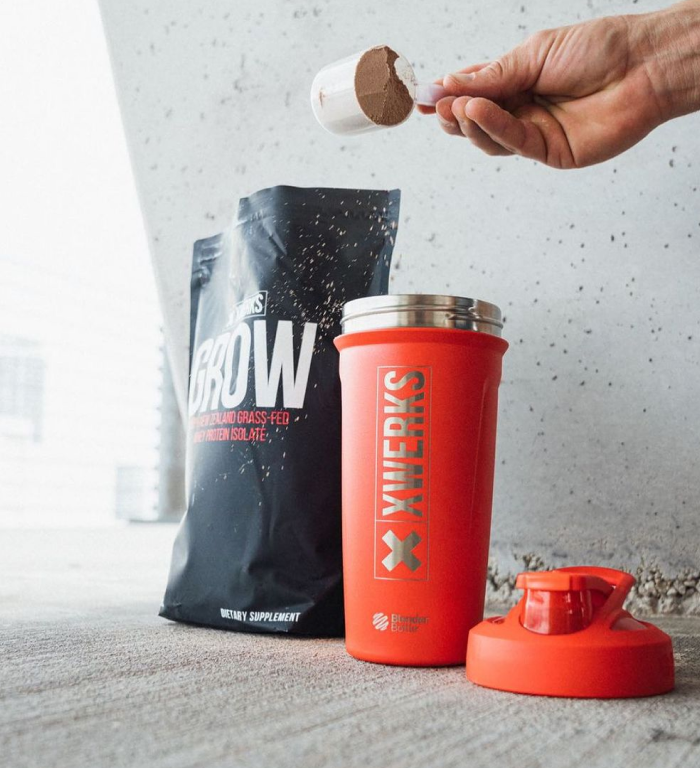
XWERKS Grow — 100% New Zealand grass-fed whey protein isolate, cross-flow microfiltered to preserve bioactive compounds (lactoferrin, immunoglobulins, alpha-lactalbumin). 25g protein per 30g scoop, real food flavoring (cocoa bean, vanilla bean, peanut butter powder), stevia-only sweetening. Four ingredients total. The grass-fed whey protein where the source dairy quality matches the marketing claims.
Shop Grow