Updated May 2026: This article has been updated with the latest market developments — record spot prices confirmed by the USDA, major brands reporting "historic highs" on earnings calls, and $11 billion in announced US capacity expansion. See the May 2026 Update section below.
What's Behind the Empty Shelves?
If you've been shopping for protein powder lately, you've probably noticed something alarming: higher prices, limited stock, and your favorite brands warning of delays. Welcome to the 2025-2026 whey protein crisis—a perfect storm that's reshaping the entire nutrition industry.
The Numbers Don't Lie
US whey protein concentrate and isolate have become essentially unavailable for new buyers seeking significant volumes, with producers having sold their inventory well into 2026. Prices have skyrocketed to unprecedented levels to numbers the market has never seen before.
Some protein powders have seen price increases of 50-110% from 2024 to 2025, and the situation shows no signs of improving soon.
The Unexpected Culprit: GLP-1 Medications
Here's the twist nobody saw coming: weight loss drugs are driving the protein shortage.
Approximately 12% of Americans now use GLP-1 medications like Ozempic and Wegovy, and healthcare providers are prescribing whey protein alongside these treatments. Why? Because studies reveal that people on these medications can lose 25-40% of their weight as lean muscle mass—not just fat. To combat this muscle loss, patients need high-quality protein, and whey is the gold standard.
This surge in medical demand has collided with already-booming interest in functional foods, protein bars, high-protein snacks, and sports nutrition products. The whey protein market was already projected to grow at 7.7% annually through 2033, but the GLP-1 boom accelerated that timeline dramatically.
A Global Supply Chain in Crisis
The shortage originates primarily in the United States, where dairy producers simply cannot keep up with demand. Manufacturers are ramping up production, but building new facilities takes time—most won't come online until 2027.
This has triggered a global scramble. Buyers from China, traditionally reliant on US whey, are now turning to European suppliers. European buyers are keeping purchases closer to home. But even Europe's capacity may not be enough to satisfy worldwide demand.
Major dairy companies are responding with massive investments. Glanbia is adding 10 million pounds of whey protein isolate capacity through a joint venture in New Mexico. Ireland's Tirlán committed €126 million to boost premium whey production. Idaho Milk Products injected $200 million into new facilities. But all of these projects won't be fully operational until 2026-2027.
What This Means for Consumers
Higher prices aren't going away. Even after supply increases, the new pricing may become the long-term reality. Some companies are switching to lower-quality whey from regions with less stringent standards, though premium brands are standing firm on grass-fed, high-quality sources.
Stock shortages will continue. Product delays are hitting companies across the board. One ramen company using whey protein isolate had to delay production until February 2026 due to supply constraints.
Alternative proteins are gaining ground. With whey in short supply, plant-based proteins from peas, hemp, and soy are becoming more attractive. Canadian pea protein production increased by 1 million tons, and Chinese yeast proteins are emerging as budget-friendly alternatives.
Looking Ahead: The 2026 Tipping Point
The situation may intensify dramatically in mid-2026. Patents on semaglutide (the active ingredient in Ozempic) are expiring in major markets including China, India, Brazil, and Turkey—countries representing about 25% of the world's obese population. When cheap generic versions flood these markets, demand for whey protein could explode further.
Industry analysts estimate that if just 25% of obese people in these countries start using GLP-1 medications and consuming recommended protein doses, the world would need an additional 3 billion kilograms of whey protein by the end of 2026.
The Bottom Line
This isn't just a temporary supply hiccup—it's a fundamental restructuring of the global protein market. The convergence of medical demand, functional food trends, and climate factors affecting dairy production has created a scarcity that won't resolve quickly.
For consumers, the message is clear: protein powder has shifted from a commodity to a premium product. The days of budget-friendly tubs are fading. Quality matters more than ever, and those willing to pay for grass-fed, pure sources will find their options increasingly limited but worth the investment.
Whether you're an athlete, a health enthusiast, or someone on a GLP-1 medication, understanding this shortage helps you make informed choices—and maybe stock up, because 2026 looks like it's going to be a wild ride for the protein industry.
XWERKS is committed to continue to only use the highest quality grass-fed whey sourced from New Zealand.
May 2026 Update: Where the Whey Market Stands Now
In the months since this article was first published, the whey protein shortage has not eased — it has been confirmed and quantified by official market data and by major industry players speaking publicly. Here is what has developed.
Record prices, now confirmed by USDA data
The price surge that was emerging in early 2026 has continued. According to USDA market data reported in May 2026, whey protein concentrate (80% protein) spot prices have climbed past $11 per pound, and whey protein isolate is sitting firmly in the $12 range — levels the market has never seen before. Standard whey powder prices have risen more than 50% since January 2026 alone, on top of the increases that had already accumulated through 2024 and 2025.
To put the longer arc in perspective: industry analysts have tracked whey concentrate pricing climbing more than 50% between August 2024 and December 2025, and finished protein products have seen increases of 50 to 110% compared to 2024.
Major brands are saying it out loud
What was once supply-chain chatter is now being confirmed on corporate earnings calls. BellRing Brands — the company behind Premier Protein and Dymatize — told investors that whey protein prices have reached "historic highs," with CEO Darcy Davenport noting that tight supply is also pushing up the cost of non-fat dry milk, another protein-fortification ingredient. At least one major protein competitor has already announced a significant price increase, and Davenport indicated that most players in the category will likely need to reassess their pricing.
The USDA has formally noted that unprecedented demand is causing the shortage, with some suppliers already sold out for the remainder of the year.
The bottleneck is processing, not milk
One important clarification that has come into sharper focus: the shortage is not caused by a lack of milk. Global dairy production and cheese manufacturing — the source of whey as a byproduct — remain relatively stable. The real constraint is processing capacity: converting liquid whey into concentrated or isolated protein powder requires extensive filtration infrastructure that takes years of investment, regulatory approval, and specialized equipment to expand. Most existing facilities were built around steady, predictable demand growth — not the sharp spike the GLP-1 era has produced.
A telling side effect: as US producers ramp up whey output, they are also generating more butterfat as a co-product, creating a butterfat surplus and falling butterfat prices even as whey prices hit records.
$11 billion in expansion — but relief is still a year-plus away
The industry is investing heavily to catch up. US dairy producers have announced $11 billion in new and expanded manufacturing capacity across 19 states, and the International Dairy Foods Association expects US milk production to grow by 15 billion pounds by 2030 to meet protein demand. That is genuine, large-scale commitment — but new processing capacity takes time to build and bring online. Most analysts still expect meaningful supply relief no earlier than late 2026, and more likely 2027.
Why your tub hasn't doubled in price — yet
If you have noticed prices creeping up but not exploding, there is a reason. Ingredient-cost increases take time to reach retail shelves — industry analysts estimate it typically takes 12 to 18 months for commodity cost increases to show up in retail pricing. Many brands have so far absorbed part of the cost internally, accepting tighter margins, scaling back promotions, and quietly rationalizing pack sizes (several brands have dropped their largest tub sizes). Some industry observers expect the more visible retail price shifts to land in Q1 or Q2 of 2027.
In other words: the price you pay today may still not reflect the full cost increase that has already happened upstream. For consumers, that reinforces the case for buying quality whey you trust when you find it at a fair price.
What this means for you — May 2026
The shortage is a market condition, not a training crisis. Whey is harder to find and more expensive, but adapting your approach now does not compromise your progress. If you rely on protein powder, a few practical points stand:
• If you find quality whey at a fair price, it is reasonable to buy a larger quantity as a hedge, since tight supply is expected to persist for months. Whey protein, stored cool, dry, and sealed, keeps well.
• Watch for quiet quality downgrades. As covered above, some manufacturers are switching to cheaper whey from less stringent sources, reformulating, or shrinking pack sizes to mask cost increases. Check labels, protein-per-scoop, and serving counts — not just the front-of-tub price.
• Plant proteins remain the steadier-priced alternative. Pea and rice protein have held more stable on price than whey. They are not identical to whey — whey's amino acid profile and digestibility are hard to match — but they are a legitimate option if budget is the priority. See our comparison of whey protein vs pea protein.
• Quality is now a deliberate choice. In a tight market, the gap between premium grass-fed whey and bargain commodity whey becomes more visible — in price, and in what you are actually getting.
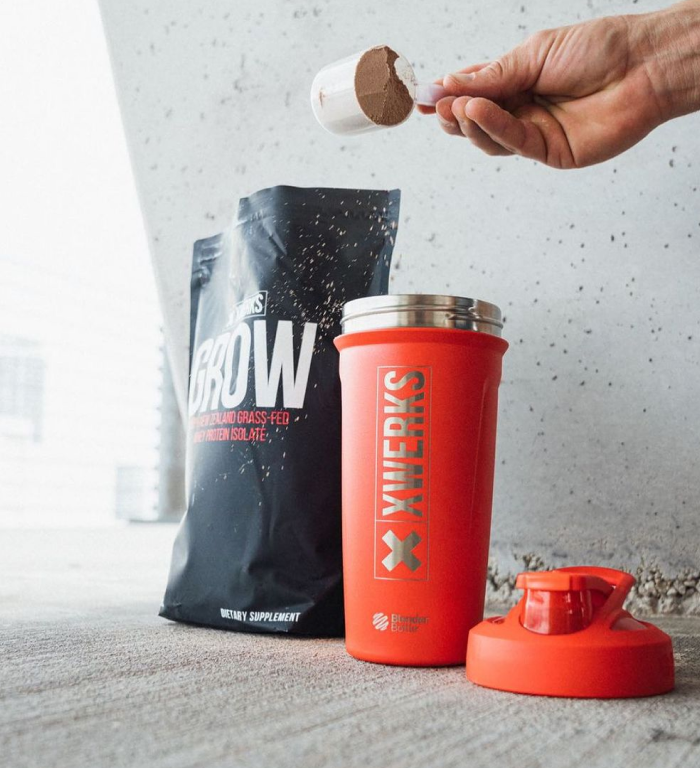
XWERKS's position has not changed: Grow continues to use only high-quality grass-fed whey isolate sourced from New Zealand. We are not reformulating to a cheaper protein source or quietly downgrading what goes in the tub. In a market where shortcuts are increasingly tempting, holding the line on sourcing is the commitment we are making to the people who rely on us.
This update reflects market reporting as of May 2026. The whey market remains volatile; prices and availability are continuing to move.

Grass-fed NZ whey isolate — no reformulation, no quiet downgrade
In a market where many brands are quietly switching to cheaper whey, shrinking pack sizes, or reformulating to lower-grade protein to mask cost pressure, XWERKS Grow continues to use 100% grass-fed New Zealand whey isolate. 25g protein, 110 calories, four ingredients — the same Grow that earned its independent-reviewer rankings, sourcing held steady through the shortage.
Shop Grow →