Balance Your Daily Protein Intake Across Meals
TL;DR
- Most people eat almost no protein at breakfast and load it at dinner — a typical distribution pattern of 10g / 25g / 60g across three meals.
- Research supports a more balanced pattern. A 2020 Yasuda study showed a trend toward greater muscle growth (+2.5 kg vs +1.8 kg over 12 weeks, p=0.06) when protein was evenly distributed rather than skewed to dinner — though the result didn't quite reach statistical significance.
- The mechanism is real: each meal above ~0.24-0.4g/kg body weight (roughly 20-40g protein) triggers a distinct muscle protein synthesis response. Meals below the threshold don't. Skewing means fewer trigger events per day.
- Practical target: 4-5 meals per day at 25-40g protein each, distributed across the day. A morning whey shake is the easiest way to close the breakfast gap.
Most people load their protein intake toward dinner. A typical day looks like 10g at breakfast (cereal, toast, maybe a coffee), 25g at lunch (sandwich, salad), and 60g at dinner (big meat-and-sides meal). That distribution adds up to roughly the right daily number for some people — but it's a suboptimal pattern for muscle growth and recovery. Research on muscle protein synthesis shows that each meal triggers a distinct anabolic response when it crosses a leucine threshold of roughly 0.24-0.4g protein per kg body weight (about 20-40g protein for most adults). Meals below that threshold don't meaningfully stimulate muscle protein synthesis. A 2020 randomized trial from Ritsumeikan University (Yasuda et al., PMID 32321161) specifically tested this in young men doing 12 weeks of resistance training and found that evenly distributing protein produced a trend toward ~39% greater muscle mass gain compared to the typical skewed pattern (+2.5 kg vs +1.8 kg total lean tissue, p=0.06) — though the result fell just short of statistical significance. The honest framing: total daily protein is still the most important factor (by a wide margin), but once you're hitting your daily target, distributing across 4-5 meals at 25-40g each optimizes the anabolic response further.
What most people's protein distribution actually looks like
The typical pattern: dinner-loaded
Surveys of protein intake consistently show the same pattern: breakfast ~10-15g, lunch ~25-30g, dinner ~50-70g. Over a full day, this can add up to adequate total protein — maybe 80-100g for an average adult. But the distribution is wrong for maximizing muscle protein synthesis.
The breakfast gap is particularly common. Cereals, oatmeal, toast, bagels, and smoothies without added protein all deliver 5-15g of protein — below the meal threshold needed to trigger muscle protein synthesis meaningfully. You're essentially "skipping" the morning anabolic opportunity.
Why this matters for muscle
Muscle protein synthesis (MPS) isn't one continuous process — it's a series of pulses triggered by meals. When you eat a meal containing enough protein (and enough leucine), MPS rises for 2-4 hours, then returns to baseline. Meals below the leucine threshold don't produce meaningful MPS response.
This means the number of MPS-triggering meals per day matters. Three large meals with one sub-threshold breakfast = 2 MPS pulses. Four balanced meals = 4 pulses. Over a year of training, that difference compounds.
What the research actually shows
Yasuda et al. 2020 — the breakfast distribution study
Published in Journal of Nutrition, this 12-week randomized trial followed 26 young men (average age 21) doing supervised resistance training 3x/week while consuming 1.3g protein per kg body weight daily — the same total protein in both groups but distributed differently:
HBR group (high breakfast, n=12):Breakfast 0.33 g/kg · Lunch 0.46 g/kg · Dinner 0.48 g/kg
LBR group (low breakfast, n=14):
Breakfast 0.12 g/kg · Lunch 0.45 g/kg · Dinner 0.83 g/kg
Results after 12 weeks:
HBR: +2.5 kg lean tissue · LBR: +1.8 kg lean tissue
P = 0.06 (trend; large effect size, Cohen's d = 0.795)
Important nuance the study sometimes gets oversold on: The 39% relative difference in muscle mass gain (+2.5 vs +1.8 kg) sounds dramatic, but the p-value of 0.06 means the result did not quite reach statistical significance at the standard p<0.05 cutoff. The effect size was large, suggesting the finding is likely real — but small studies (n=26 total) can produce large effects that don't replicate at scale.
Another caveat: The study used 1.3g/kg total protein daily — on the lower end of athlete recommendations (1.6-2.2g/kg). The distribution effect may be larger at lower total protein and smaller when total protein is already high enough to hit the leucine threshold in every meal.
The leucine threshold mechanism
Why each meal needs to cross a threshold
The key trigger for muscle protein synthesis is leucine, an essential amino acid that activates the mTOR signaling pathway. Research identifies a leucine threshold per meal for maximally stimulating MPS: approximately 2.5-3g of leucine for younger adults, 3-3.5g for older adults due to anabolic resistance.
To hit this leucine threshold with typical food sources, you need:
• Whey isolate: ~20-25g (highest leucine concentration, ~10-12%)
• Animal protein (meat, fish, eggs, dairy): ~25-30g
• Plant protein (most sources): ~35-40g (lower leucine % means larger doses needed)
Why "grazing" on small amounts doesn't work
Six small snacks of 15g protein each totals 90g daily — sounds adequate, but if none of those snacks cross the leucine threshold, you get minimal MPS stimulation. The same 90g distributed as three meals of 30g each produces three distinct MPS pulses. Dose per meal matters, not just daily total.
The practical protocol
Target: 4-5 meals at 25-40g protein each
For most adults, the sweet spot is 4-5 eating occasions per day, each providing 25-40g of quality protein (at or above the leucine threshold). This pattern:
• Hits your daily protein target (1.6-2.2g/kg for athletes)
• Produces 4-5 MPS-triggering pulses per day
• Is distributed across your waking hours for sustained amino acid availability
• Supports appetite control and satiety
Why 4-5 and not 8-10
Research on meal frequency and muscle protein synthesis suggests diminishing returns beyond 4-5 MPS stimulations per day. Eating 8 small meals doesn't produce 8 pulses — the closer together meals are, the less each one adds. Aim for 3-4 hour gaps between protein-containing meals for optimal pulse pattern.
Practical numbers by body weight
A 70kg (155-lb) person targeting 1.8g/kg = 126g daily. Distributed across 5 meals = ~25g per meal. Easily achievable.
An 85kg (187-lb) lifter targeting 2.0g/kg = 170g daily. Distributed across 5 meals = ~34g per meal. Still realistic with one or two whey shakes supplementing whole-food meals.
Calculate your exact daily target: XWERKS Protein Calculator →
Fixing the breakfast gap
The usual breakfast problem
Traditional American breakfast — cereal with milk, oatmeal, toast with peanut butter, bagel, smoothie without added protein — delivers 5-15g of protein. This is the single biggest distribution problem most people have.
Easy breakfast protein upgrades
• Whey shake added to any breakfast: 25g protein in 60 seconds. Mix with oatmeal, blend into a smoothie, drink alongside coffee.
• 3-4 eggs: 18-24g protein. Scrambled, fried, hard-boiled — versatile and cheap.
• Greek yogurt bowl: 1 cup plain Greek yogurt (23g) + berries + nuts. Fast to prepare.
• Cottage cheese: 1 cup = 28g protein. Pair with fruit or mix with cereal.
• Egg + ham/turkey + cheese wrap: 25-35g protein. Can be prepped ahead.
• Leftover dinner protein for breakfast: 4oz leftover chicken = 30g. Stop thinking of breakfast foods as different from other meals.
Sample 150g protein day (for a 75kg / 165-lb adult at 2.0g/kg)
Total: ~161g across 5 meals. Each meal above leucine threshold. No single meal overloaded.
When distribution matters less
• You're already hitting your daily protein target consistently
• You're training seriously for muscle growth or preservation
• You're older (40+) with anabolic resistance making per-meal dosing more important
• You're in a caloric deficit where every MPS pulse matters for muscle preservation
Special cases
Intermittent fasting
If you eat all your daily protein in a compressed window (e.g., 8-hour eating window), distribution within that window still matters. Aim for 2-3 meals at 40-50g each during the feeding window, rather than one giant 150g meal and one small one. Some research suggests IF practitioners may benefit from slightly higher total protein intake (1.8-2.2g/kg) to compensate for less MPS-stimulation time.
Older adults (40+)
Anabolic resistance makes per-meal dosing more important as you age. Older adults need 30-40g protein per meal to maximally stimulate MPS (vs 20-25g for younger adults). Hitting 3-4 of these doses daily is more effective than 5-6 smaller ones. See Protein for Bodybuilders Over 40 for detail.
Plant-based athletes
Plant proteins have lower leucine content, so per-meal doses should be higher (30-40g plant protein per meal) to cross the leucine threshold. Combining plant sources (rice + beans, pea + rice protein blends) or using isolated soy protein improves the profile.
Pre-bed protein
If your last meal is 3+ hours before bed, a pre-bed protein dose (20-40g) supports overnight muscle protein synthesis. Casein is traditional (slow-digesting); whey also works. Particularly valuable during high-training-volume phases or cutting phases. This adds a 6th "meal" for dedicated lifters — worth considering if your daily target allows the calories.
Common distribution mistakes
The "I'm not hungry at breakfast" trap
Real answer: a whey shake solves this. Drinking 25g of protein in a shake doesn't require the appetite that 3 eggs does. For people who genuinely can't stomach breakfast, a protein shake 1-2 hours after waking works almost as well as breakfast-with-meal for distribution purposes.
Overloading one meal
Some people hit 150g daily with a single 100g-protein dinner plus small meals elsewhere. This is sub-optimal — research suggests meals above 40-50g may not produce proportionally larger MPS responses. You get more benefit from 5 meals of 30g than 3 meals of 15-15-100g. Cap individual meals around 40g for most efficient use of protein.
Grazing on sub-threshold snacks
Handful of nuts (5g protein), cheese stick (6g), hummus and carrots (3g) — these add to daily totals but don't cross the leucine threshold. If you're grazing, stack items or add a whey shake periodically to ensure at least 4-5 threshold-crossing meals per day.
The Bottom Line
Protein distribution across meals matters — but less than total daily protein. Hit your daily target first (1.6-2.2g/kg for athletes), then optimize distribution.
Target 4-5 meals per day at 25-40g protein each. Each meal should cross the leucine threshold (~2.5-3g leucine, typically 20-30g animal protein or 30-40g plant protein).
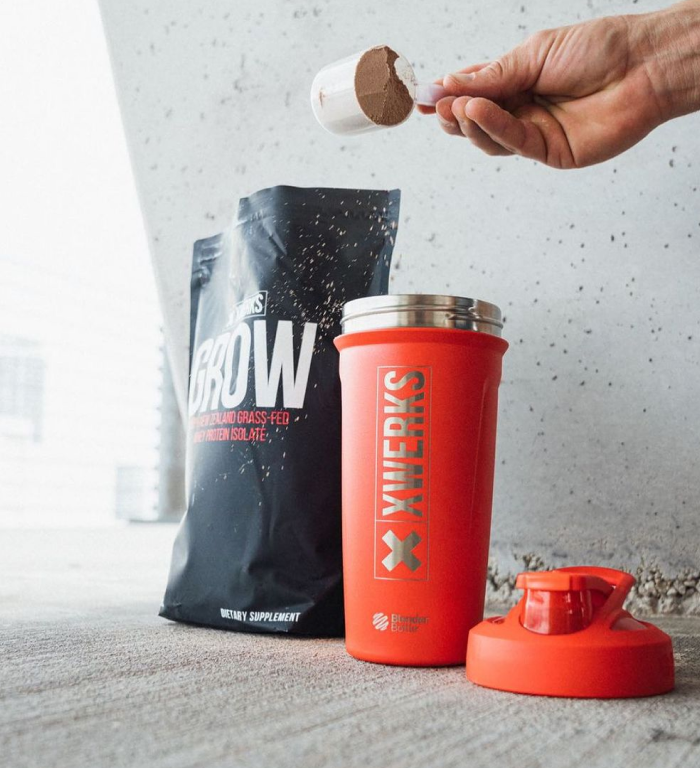
The breakfast gap is where most people fall short. A whey shake added to any breakfast in 60 seconds delivers 25g of protein and triggers the first MPS pulse of the day — XWERKS Grow mixes into coffee, oatmeal, or just water.
Close the Breakfast Protein Gap
XWERKS Grow — 25g NZ grass-fed whey isolate per scoop, 2.5-3g leucine per serving. Mixes in 60 seconds into coffee, smoothies, or water. The easiest way to fix the most common distribution mistake.
SHOP GROW →Further Reading
11 High-Protein Foods (Ranked by Practical Use)
Top 5 High-Protein Fast Food Orders
Protein Powder for Bodybuilders Over 40
References
1. Yasuda J, Tomita T, Arimitsu T, Fujita S. Evenly Distributed Protein Intake over 3 Meals Augments Resistance Exercise-Induced Muscle Hypertrophy in Healthy Young Men. J Nutr. 2020;150(7):1845-1851. PMID: 32321161.
2. Moore DR, Areta J, Coffey VG, et al. Daytime pattern of post-exercise protein intake affects whole-body protein turnover in resistance-trained males. Nutr Metab (Lond). 2012;9(1):91.
3. Mamerow MM, Mettler JA, English KL, et al. Dietary protein distribution positively influences 24-h muscle protein synthesis in healthy adults. J Nutr. 2014;144(6):876-880.
4. Schoenfeld BJ, Aragon AA. How much protein can the body use in a single meal for muscle-building? J Int Soc Sports Nutr. 2018;15:10.
5. Morton RW, et al. Meta-analysis of protein supplementation on resistance training-induced gains. Br J Sports Med. 2018;52(6):376-384.
6. Moore DR, Churchward-Venne TA, Witard O, et al. Protein ingestion to stimulate myofibrillar protein synthesis requires greater relative protein intakes in healthy older versus younger men. J Gerontol A Biol Sci Med Sci. 2015;70(1):57-62.