In gym discussions, “steroids” usually means anabolic-androgenic steroids, including testosterone and related drugs. The broader steroid family also includes corticosteroids used for inflammation. This article focuses on the comparison people usually mean: anabolic steroids versus peptides marketed for performance or recovery.
What is the difference between peptides and steroids?
The main difference is chemical structure: peptides are amino-acid chains, while steroids share a four-ring carbon framework. “Peptide” describes a broad class of molecules, not one drug, one effect, or one safety profile. [1] [2]
| Question | Peptides | Anabolic steroids |
|---|---|---|
| Basic structure | Amino acids joined together. | A steroid framework with four connected rings. |
| Examples discussed in fitness | BPC-157, CJC-1295 and ipamorelin. | Testosterone, nandrolone and stanozolol. |
| Biological action | Varies by molecule and receptor; there is no single peptide mechanism. | Act through androgen receptors, affecting gene expression. |
| U.S. status | Depends on the exact drug and formulation; some peptide medicines are approved and others are unapproved. | Anabolic steroids are Schedule III controlled substances. |
| Sport eligibility | Several performance-related peptides are prohibited by WADA. | Anabolic agents are prohibited by WADA. |
Comparison sources: the Endocrine Society statement, DEA scheduling guidance, FDA compound-specific safety information, and WADA Prohibited List.
Do peptides work like anabolic steroids?
Peptides do not share the defining androgen-receptor mechanism of anabolic steroids. Anabolic steroids affect gene expression through androgen receptors; this does not mean they rewrite a person's DNA sequence. Peptide effects depend on the particular molecule and its biological target. [3]
Some substances grouped into performance discussions affect growth-hormone pathways. Others have different targets or remain poorly studied in humans. Describing every peptide as a gentle “signal amplifier” hides those differences and does not establish either effectiveness or safety.
Is MK-677 a peptide or a steroid?
MK-677, also called ibutamoren, is a nonpeptide growth-hormone secretagogue, not an anabolic steroid. “Secretagogue” means a substance that stimulates secretion; in this case, growth-hormone release. A published human study explicitly identifies ibutamoren as a nonpeptide compound. [4]
MK-677 often appears beside peptides in marketing because of its growth-hormone-related effects. That grouping does not make MK-677 a peptide. WADA lists ibutamoren under growth-hormone secretagogues and their mimetics. [5]
Are peptides legal in the United States?
Peptide drugs do not have one shared legal or approval status. The exact product matters: FDA-approved peptide/protein medicines exist, including insulin products, while other compounds marketed for recovery lack an approved human-use product. The FDA's insulin history documents approved insulin medicines. [6]
The FDA identifies potential safety concerns for compounds including BPC-157, CJC-1295 and ipamorelin. Compounding is a separate question from FDA approval: compounded drugs are not FDA-approved, and the FDA does not review each compounded product for safety, effectiveness and quality before marketing. [7] [8]
Anabolic steroids, including testosterone, are listed by the DEA as Schedule III controlled substances. A product being available online is not evidence that it is approved for your intended use. Ask a licensed clinician or pharmacist about the exact medicine and formulation. [9]
Are peptides and steroids banned in sport?
WADA prohibits anabolic agents and several specific peptides and related substances at all times. BPC-157 appears under S0; anabolic agents fall under S1; and CJC-1295, ipamorelin, growth hormone and ibutamoren are covered by S2. “Not a steroid” does not mean permitted in competition. [5]
Athletes should check the current rules for the exact substance with their anti-doping organization. Medical approval and eligibility under sport rules are separate questions.
Are peptides safer than anabolic steroids?
There is no sound basis for calling all peptides safer than anabolic steroids. Safety depends on the compound, dose, route, product quality and person using it. Limited human evidence is a reason for uncertainty, not proof of low risk.
Nonmedical anabolic-steroid use is associated with cardiovascular, hormonal, reproductive and psychiatric harms. The Endocrine Society's scientific statement discusses these risks and the limitations of the available evidence. Prescribed treatment under medical supervision is a different situation from high-dose performance use. [3]
For BPC-157, the FDA notes insufficient information to know whether administration would harm humans, along with impurity and immune-response concerns. For CJC-1295, the FDA reports serious adverse events including increased heart rate and a systemic vasodilatory reaction. Those findings contradict blanket claims that research peptides are inherently mild. [7]
Where do testosterone-support supplements fit?
A testosterone-support supplement is a different product category from prescription testosterone or a peptide drug. Ingredient studies do not, by themselves, demonstrate that a finished supplement reproduces the effects of a prescription medicine.
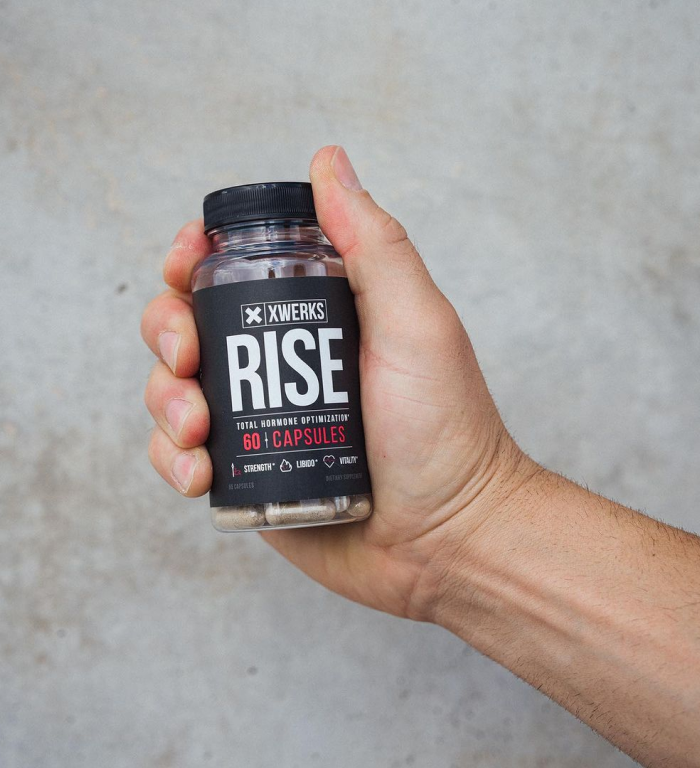
XWERKS Rise lists tongkat ali, shilajit, zinc, boron and BioPerine. Review the current ingredient panel and directions when comparing supplements. Rise should not be presented as a treatment for low testosterone or a substitute for prescribed hormone therapy.
Sources and further reading
- National Cancer Institute: peptide definition.
- National Cancer Institute: steroid definition.
- Pope and colleagues: Endocrine Society scientific statement on performance-enhancing drug harms (2014).
- Codner and colleagues: study of the nonpeptide secretagogue ibutamoren (2001).
- World Anti-Doping Agency: Prohibited List.
- FDA: history of insulin and approved insulin products.
- FDA: compounding substances with potential significant safety risks.
- FDA: compounding questions and answers.
- DEA: drug scheduling.
Related XWERKS reading: Tongkat Ali FAQ, TRT Side Effects, and Low Testosterone in Young Males.