Tongkat Ali vs. Fadogia Agrestis: One Has the Research, the Other Has the Hype
Andrew Huberman put both of these ingredients on the map. But when you dig into the actual science, the gap between them is enormous. Here's what the research says — and what it doesn't.
If you've spent any time in the testosterone optimization space over the past few years, you've heard the stack: Tongkat Ali + Fadogia Agrestis. It's become almost gospel in fitness and biohacking circles, largely driven by its endorsement on popular podcasts.
But popularity isn't science. And when you actually pull the research on these two ingredients, what you find is a massive asymmetry: one has decades of human clinical data across multiple populations and endpoints. The other has a handful of rat studies from a single research lab in Nigeria — and some of those studies raised safety red flags.
Let's look at both, honestly.

Tongkat Ali: The Research Is Real
Tongkat Ali (Eurycoma longifolia) is a plant native to Southeast Asia — primarily Malaysia, Indonesia, and Vietnam — where it's been used in traditional medicine for centuries. But unlike many traditional remedies, Tongkat Ali has actually been subjected to rigorous modern research, including randomized, double-blind, placebo-controlled trials in humans.
The bioactive compounds responsible for its effects are a class of peptides called eurypeptides, along with quassinoids like eurycomanone. These compounds appear to work through several mechanisms: stimulating luteinizing hormone (LH) secretion, which signals the testes to produce more testosterone; inhibiting aromatase, the enzyme that converts testosterone to estrogen; and reducing cortisol, the stress hormone that directly antagonizes testosterone production.
What the Human Studies Show
A systematic review and meta-analysis published in 2022 examined nine randomized controlled trials and concluded that Tongkat Ali supplementation significantly increases total testosterone in adult males — particularly those with low baseline levels. The evidence is strongest for men over 40 with suboptimal testosterone, but benefits have been observed across age groups.
Here's a snapshot of the key findings across multiple studies:
The dosing that appears consistently in the literature ranges from 200mg to 400mg per day of a standardized water extract, typically taken for 4 to 12 weeks. The mechanism isn't about slamming your endocrine system with exogenous hormones — it's about supporting your body's own production pathways while simultaneously reducing the cortisol that suppresses them.
Fadogia Agrestis: The Evidence Problem
Fadogia Agrestis is a shrub native to Nigeria. In traditional West African medicine, it's been used as an aphrodisiac. Its recent popularity in the supplement world is almost entirely attributable to its mention on the Huberman Lab podcast, where it was recommended alongside Tongkat Ali as part of a testosterone support protocol.
Here's the problem: there are zero published human studies on Fadogia Agrestis. Not one.
The entire body of research consists of a small number of animal studies, almost all conducted by the same research group at the University of Ilorin in Nigeria. Let's look at what those studies actually found.
Read that carefully. The same research group that found Fadogia increased testosterone in rats over 5 days also found that it caused testicular damage and liver/kidney membrane disruption over 28 days. The oxidative damage markers (MDA) increased nearly 300% at the highest dose. That's not a minor finding.
As Examine.com states plainly: "It is unclear whether or not consumption of Fadogia agrestis is safe at any dosage, so no dosage can be recommended." WebMD echoes: "There is no good scientific evidence to support any use."
The Side-by-Side Comparison
Why the "Huberman Stack" Got It Half Right
To be fair, Dr. Huberman's recommendation of Tongkat Ali is well-supported by the literature. It's an ingredient with a genuine evidence base. His typical recommendation of 400mg/day falls within the range used in clinical studies. That part of the protocol is solid.
The Fadogia recommendation is a different story. It was presented alongside Tongkat Ali as though the two had comparable evidence, and that framing misled a lot of people. Since then, many in the evidence-based fitness community have pushed back on the Fadogia piece specifically, citing the absence of human data and the toxicity signals from the animal research.
The broader lesson here is worth remembering: just because two ingredients are recommended together doesn't mean they have equal evidence. Tongkat Ali earned its place through research. Fadogia rode in on its coattails.
How Tongkat Ali Actually Works in Your Body
Understanding the mechanism matters because it explains both why Tongkat Ali works and why its effects are modest in healthy young men with already-normal testosterone.
The primary pathways are threefold. First, eurypeptides in Tongkat Ali stimulate the release of luteinizing hormone (LH) from the pituitary gland. LH is the chemical messenger that tells the Leydig cells in the testes to produce testosterone. Second, certain quassinoids act as aromatase inhibitors — they reduce the conversion of testosterone into estrogen, meaning more of what you produce stays as testosterone. Third, Tongkat Ali has demonstrated cortisol-reducing effects, and since cortisol and testosterone exist in a seesaw relationship, lowering one effectively supports the other.
This is why the research consistently shows the greatest benefits in men with low testosterone or elevated cortisol. If your levels are already optimal and your stress is well-managed, the effect will be more subtle. But for the significant percentage of men over 35 whose testosterone has declined — research suggests levels drop 1-2% annually after age 30 — the compounding benefit of supporting all three pathways simultaneously is meaningful.
The Bottom Line
Tongkat Ali has earned its reputation through real human clinical research — multiple RCTs, a meta-analysis, and decades of safe traditional use. The effective dose is well-established (200–400mg/day of standardized extract), the mechanisms are understood, and the safety profile is strong.
Fadogia Agrestis has zero human studies, no established safe dose, and published animal data showing potential liver, kidney, and testicular toxicity. Until human trials are conducted and safety is established, it's a gamble — not a supplement backed by science.
If you're going to put something in your body to support testosterone, choose the one with the evidence behind it.
What to Look for in a Tongkat Ali Supplement
Not all Tongkat Ali products are created equal. The research consistently uses standardized water-extracted root preparations — not raw root powder. The extraction process concentrates the bioactive eurypeptides and quassinoids that drive the hormonal effects. A product listing "Tongkat Ali root powder" without specifying extract ratio or standardization is not the same thing as what was used in the clinical trials.
Dosage matters too. The effective range in the literature is 200–400mg per day. Products using 50mg or 100mg are likely underdosed. And the research on Tongkat Ali synergizes well with other evidence-based ingredients — zinc (essential for testosterone synthesis), boron (which helps reduce SHBG, freeing up more testosterone), and shilajit (which has its own set of human trials supporting testosterone and strength).
Tongkat Ali at the Dose That Works
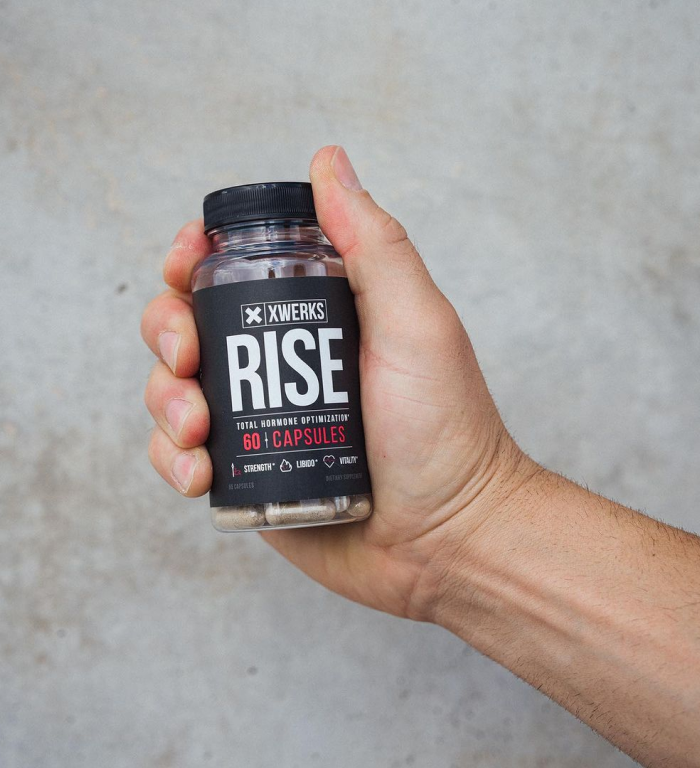
XWERKS Rise delivers 400mg of Tongkat Ali — the high end of the clinically studied range — alongside 250mg shilajit, 6mg boron, and 15mg zinc. Four ingredients. All research-backed. No Fadogia. No proprietary blends. No guessing.
SHOP RISE →References
1. Leisegang K, et al. Eurycoma longifolia (Jack) Improves Serum Total Testosterone in Men: A Systematic Review and Meta-Analysis of Clinical Trials. Medicina. 2022;58(8):1015.
2. Chinnappan SM, et al. Effect of Eurycoma longifolia standardised aqueous root extract on testosterone levels and quality of life in ageing male. Food & Nutrition Research. 2022.
3. Talbott SM, et al. Effect of Tongkat Ali on stress hormones and psychological mood state in moderately stressed subjects. JISSN. 2013;10(1):28.
4. Figueiredo et al. A 6-month, double-blind, placebo-controlled, randomized trial to evaluate the effect of Eurycoma longifolia and concurrent training on erectile function and testosterone levels in ADAM. Maturitas. 2021;145:78-85.
5. Henkel RR, et al. Tongkat Ali as a potential herbal supplement for physically active male and female seniors. Phytother Res. 2014;28(4):544-550.
6. Yakubu MT, et al. Aphrodisiac potentials of the aqueous extract of Fadogia agrestis stem in male albino rats. Asian J Androl. 2005;7(4):399-404.
7. Yakubu MT, et al. Effects of oral administration of aqueous extract of Fadogia agrestis stem on some testicular function indices of male rats. J Ethnopharmacol. 2008;111(2):288-292.
8. Yakubu MT, et al. Mode of cellular toxicity of aqueous extract of Fadogia agrestis stem in male rat liver and kidney. Hum Exp Toxicol. 2009;28(8):469-476.
9. George A, Henkel R. Phytoandrogenic properties of Eurycoma longifolia as natural alternative to testosterone replacement therapy. Andrologia. 2014;46:708-721.