

Low Stim Pre-Workout: Why 150mg of Caffeine Outperforms 400mg for Most Athletes
The supplement industry has normalized extreme caffeine doses — 300mg, 400mg, even 500mg per serving. But more stimulant doesn't mean more performance. Research shows that caffeine's performance benefits plateau well below these megadoses, while the side effects (jitters, anxiety, GI distress, heart rate spikes, sleep disruption, and tolerance escalation) scale linearly with dose. A low-stim pre-workout with 100-200mg of caffeine, supported by nootropics and performance ingredients, delivers better real-world training outcomes for most athletes.
The problem with high-stim pre-workouts
Diminishing returns on performance. Research consistently shows that caffeine's ergogenic (performance-enhancing) effects peak at approximately 3-6mg per kilogram of body weight. For a 180 lb (82 kg) person, that's 246-492mg — a wide range. But critically, most studies find that the performance benefit at 3mg/kg is nearly identical to the benefit at 6mg/kg. You get roughly the same strength, power, and endurance improvement from 250mg as from 500mg. The extra 250mg buys you almost nothing in performance — but substantially increases side effects.
Heart rate and pacing interference. High caffeine doses elevate resting heart rate and reduce heart rate variability. For endurance athletes, CrossFit athletes, Hyrox racers, and anyone doing work lasting longer than 15-20 minutes, an artificially elevated heart rate interferes with pacing, inflates perceived exertion early in the session, and causes premature fatigue. This is the opposite of what a pre-workout should do.
GI distress. Caffeine is a GI stimulant. At high doses, it can cause nausea, cramping, and urgency — problems that are amplified during training, particularly with movements that compress the abdomen (squats, deadlifts, burpees, wall balls). The higher the caffeine, the higher the GI risk.
Anxiety and jitters. For caffeine-sensitive individuals — which includes a significant genetic subset of the population (slow metabolizers with the CYP1A2 gene variant) — 300-400mg produces anxiety, restlessness, and shakiness that impair focus and fine motor control. These athletes perform measurably worse on high-stim products.
Sleep disruption. Caffeine's half-life is 5-6 hours. A 400mg pre-workout at 4pm means ~200mg still active at 10pm. Chronic sleep disruption lowers testosterone, impairs recovery, reduces muscle protein synthesis, and degrades training adaptations over time. The performance you gain in a single session is lost many times over through compromised sleep and recovery.
Tolerance escalation. Regular consumption of 300-400mg builds tolerance rapidly, requiring ever-higher doses to achieve the same subjective effect. This creates a cycle where athletes need 400mg to feel "normal" and 500-600mg to feel "energized" — doses that are genuinely unhealthy for sustained use.
What a low-stim pre-workout should contain
The best low-stim pre-workouts don't just reduce caffeine — they replace the missing stimulant effect with nootropic and performance ingredients that provide focus, energy, and endurance without the sympathetic nervous system overload.
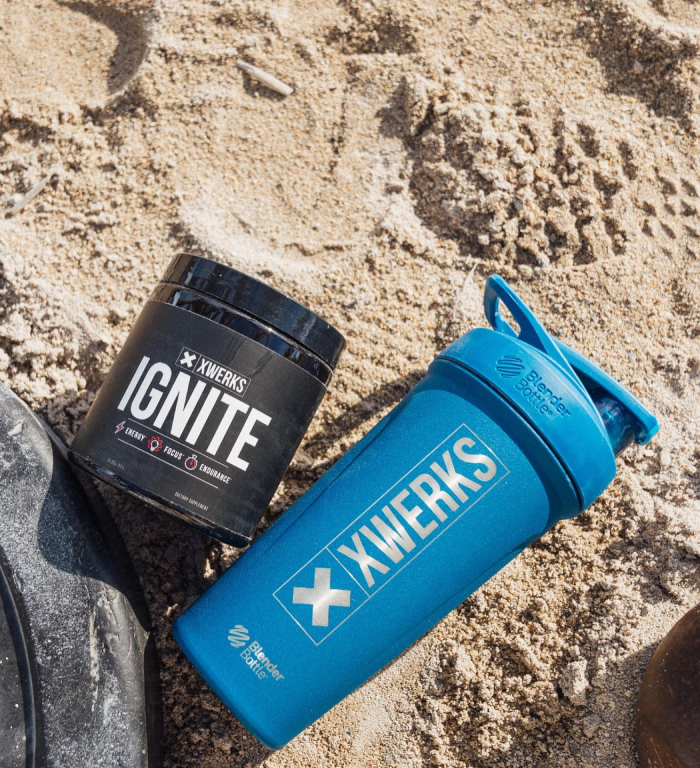
Moderate caffeine (100-200mg). Enough for meaningful alertness, focus, and performance enhancement. Not enough for jitters, anxiety, or sleep disruption. 150mg — the dose in XWERKS Ignite — is approximately one large cup of coffee. Research shows this dose provides nearly the same ergogenic benefit as 300-400mg with dramatically fewer side effects.
L-tyrosine (1,500-2,000mg). A dopamine and norepinephrine precursor that maintains focus, motivation, and cognitive performance under stress — without increasing heart rate or causing sympathetic arousal. This is the ingredient that replaces the "focus" component that people think they need more caffeine for. In reality, the focus effect of high-dose caffeine comes partly from dopamine — and L-tyrosine provides the precursor directly, without the cardiovascular cost. Ignite provides 2,000mg.
Rhodiola rosea (300-500mg). An adaptogen that reduces perceived exertion and delays fatigue onset through cortisol modulation — not stimulation. Rhodiola doesn't make you feel wired; it makes hard work feel more sustainable. This is particularly valuable for training sessions over 45 minutes where stimulant-based energy fades. Ignite provides 500mg.
DMAE (150-200mg). Supports acetylcholine production for the mind-muscle connection. Improves focus and mental clarity without stimulant properties. Ignite provides 200mg.
Citrulline malate (3,000mg+). Blood flow and nitric oxide — the pump, oxygen delivery, and nutrient transport to working muscles. Zero stimulant effect, pure physiological performance enhancement. Ignite provides 3,000mg.
Beta-alanine (1,500mg+). Acid buffering for muscular endurance in the 60-240 second work range. No stimulant effect. Ignite provides 1,500mg.
Who benefits from low-stim pre-workout?
Evening trainers. If you train after 3-4pm, a 400mg pre-workout will compromise your sleep. 150mg taken at 5pm leaves ~75mg at 10pm — a manageable level for most people that doesn't significantly impair sleep onset.
Endurance and hybrid athletes. Hyrox, CrossFit, running, cycling, swimming — any modality lasting 45+ minutes requires pacing and heart rate management that high-stim products interfere with.
Caffeine-sensitive individuals. Estimated 10-15% of the population are slow caffeine metabolizers who experience anxiety, jitters, and GI issues at moderate doses. Low-stim products keep them in the performance zone without the side effects.
Athletes who train 5-6x per week. Daily high-stim use builds tolerance and compounds sleep disruption. Moderate caffeine maintains its effectiveness without tolerance escalation, session after session.
Anyone who's experienced the post-workout crash. If you feel exhausted 2-3 hours after taking a high-stim pre-workout, you're experiencing the sympathetic nervous system crash. Low-stim products don't produce this because they never overshoot in the first place.
Women. Women tend to be more caffeine-sensitive on average (lower body weight, different CYP1A2 expression patterns), and the 300-400mg doses in many pre-workouts are formulated for 200+ lb males. 150mg is a more appropriate starting point for most female athletes.
The Bottom Line
More caffeine does not mean more performance. Research shows diminishing returns above 3mg/kg body weight (~250mg for most people), while side effects — jitters, anxiety, GI distress, heart rate interference, sleep disruption, tolerance — scale linearly with dose.
A low-stim pre-workout with 100-200mg caffeine, supported by L-tyrosine, rhodiola, DMAE, citrulline, and beta-alanine, delivers comparable training performance with dramatically fewer side effects — and is sustainable for daily use, year-round, without tolerance buildup.
XWERKS Ignite at 150mg caffeine is the sweet spot: meaningful stimulation, nootropic focus, endurance support, no crash, no jitters, no sleep compromise. The pre-workout you can take every session without paying for it later.
150mg Caffeine. Full Nootropic Stack. No Crash.
XWERKS Ignite — the low-stim pre-workout built for athletes who train hard, train often, and want performance without penalties.
SHOP IGNITE →Further Reading
What Are Nootropics? — The cognitive ingredients that replace the need for mega-dose caffeine.
Pre-Workout for Hyrox — Why endurance-strength races demand low-stim nutrition.
The Problem with Proprietary Blends — Why you need to know the exact caffeine dose.
Does Pre-Workout Expire? — Shelf life and ingredient stability.
References
1. Goldstein ER, et al. ISSN position stand: caffeine and exercise performance. JISSN. 2010;7:5.
2. Guest NS, et al. International society of sports nutrition position stand: caffeine and exercise performance. JISSN. 2021;18(1):1.
3. Pickering C, Kiely J. Are the current guidelines on caffeine use in sport optimal for everyone? Inter-individual variation in caffeine ergogenicity, and a move towards personalised sports nutrition. Sports Med. 2018;48(1):7-16.
4. Drake C, et al. Caffeine effects on sleep taken 0, 3, or 6 hours before going to bed. J Clin Sleep Med. 2013;9(11):1195-1200.
5. Jongkees BJ, et al. Effect of tyrosine supplementation on clinical and healthy populations under stress or cognitive demands. J Psychiatr Res. 2015;70:50-57.