For most healthy adults choosing their first strength-training supplement, plain creatine monohydrate is the more straightforward starting point. Adding HMB may help in some settings, but studies have not established a consistent advantage over creatine alone. Choose a combination for a specific, evidence-informed reason—not because more ingredients automatically mean more muscle.
This is our editorial judgment based on the research below, not a claim that HMB never works. XWERKS sells creatine monohydrate, so we explain both the supporting evidence and the limits of recommending our own product.
What is the difference between creatine and creatine + HMB?
Creatine + HMB combines two ingredients; it is not a new form of creatine. The creatine component can still be creatine monohydrate. Creatine supports the energy system used during repeated, high-intensity efforts, while HMB—beta-hydroxy-beta-methylbutyrate—is a metabolite of the amino acid leucine studied for its effects on muscle protein turnover.
NIH's exercise-supplement review supports creatine for repeated short bursts of intense activity. The ISSN HMB position stand describes potential HMB benefits while acknowledging varied findings in trained athletes. A plausible difference in mechanisms does not itself prove that the combination outperforms creatine.
| Decision point | Creatine monohydrate alone | Creatine + HMB |
|---|---|---|
| What you are buying | One active ingredient, if the label confirms it. | Creatine plus HMB; other ingredients depend on the formula. |
| Main evidence question | Does creatine support the kind of training you do? | Does adding HMB improve your chosen outcome beyond the same creatine dose? |
| Dose comparison | Check grams of creatine per daily serving. | Check creatine and HMB separately, including HMB form. |
| Practical tradeoff | Simpler routine and easier ingredient tracking. | Convenience if you want both; less flexibility to adjust one ingredient. |
| Value test | Cost per intended daily creatine serving. | Additional cost versus evidence for an additional benefit. |
Does adding HMB build more muscle or improve performance?
Some studies report benefits, but the findings are mixed and depend on the outcome. A 2019 systematic review of six combination studies found potentially favorable strength, anaerobic-performance, and body-composition results in some trials, rather than consistent improvements across every study. It did not find benefits for the reviewed muscle-damage markers or anabolic-catabolic hormone outcomes.
A positive early trial needs context
In a three-week trial involving 40 people, researchers compared placebo, creatine, HMB, and their combination during progressive resistance training. The authors reported additive effects on lean body mass and strength. HMB was 3 g/day; creatine was 20 g/day initially and then 10 g/day.
The trial was short, and lean body mass was estimated using bioelectrical impedance. Lean mass is not a direct measurement of newly built muscle fibers, particularly when creatine can change body water. These results do not establish that every commercial blend will deliver a fixed percentage more muscle.
Rowing performance is not the same as muscle growth
A 10-week trial in 28 elite male rowers used four groups of seven. The combination supplied 0.04 g/kg/day of creatine and 3 g/day of HMB. It improved rowing power at the 8 mmol/L blood-lactate point compared with the other groups, but body composition did not differ significantly. The study supports a narrow performance finding, not a general promise of extra muscle.
Not every direct comparison favors the combination
A 2020 collegiate rugby study concluded that adding HMB did not provide a greater ergogenic benefit than creatine monohydrate alone across the season. The more recent ISSN position stand also discusses both positive and null combination studies. Taken together, this is a reason to match the evidence to your situation rather than declare either universal superiority or universal uselessness.
Read the dose before comparing the claims
A study of 3 g of HMB does not directly validate a product serving containing 1.5 g. Likewise, doubling a combination product to reach a study's HMB amount also doubles its creatine and every other ingredient. Do not exceed label directions simply to recreate a research protocol.
For a real example, Transparent Labs' current Creatine HMB listing states 5 g of creatine monohydrate and 1.5 g of HMB per serving. That is useful label information; it is not proof that the finished product reproduces the trials above. Check the exact flavor and current Supplement Facts before purchase, since formulas can change.
Plain creatine is also easy to misunderstand: micronized creatine describes smaller particles, not the addition of HMB. Keep creatine form, particle size, and extra ingredients separate when reading labels.
A simple way to calculate whether the premium is worth it
Compare cost per day at the intended serving, then calculate the extra cost of the combination. Use the checkout price you would actually pay, including relevant delivery costs, and keep subscription and one-time prices separate.
- Daily cost = package price ÷ number of daily servings.
- Monthly premium = (combination daily cost − plain-creatine daily cost) × 30.
As an illustration—not current product pricing—suppose plain creatine costs $30 for 60 daily servings and a combination costs $45 for 30. That is $0.50 versus $1.50 per day, or a $30 monthly premium. The question is whether the added ingredient has enough evidence for your goal to justify that difference. The higher price alone tells you nothing about effectiveness.
Which option makes sense for you?
Start with plain monohydrate if you want a simple creatine routine. Establish consistent training and an appropriate nutrition plan before attributing a plateau to a missing supplement. If you already use creatine and want to evaluate HMB, define a measurable goal and compare the research population, dose, duration, and outcome with your own situation.
Neither option should be used to self-treat unexplained muscle loss or prolonged fatigue. Seek individualized advice if you have kidney disease, take medications, or have other medical concerns. For older adults, see our creatine guide for older adults rather than assuming findings in young athletes apply unchanged.
Dosing and safety: what should you keep in mind?
Follow the product directions; more is not automatically better. NIH describes creatine maintenance protocols commonly using 3–5 g/day. Creatine can increase body weight through water retention, and gastrointestinal symptoms can occur. Evidence of tolerability in healthy adults does not remove the need for clinical advice in people with medical conditions. See NIH's efficacy and safety review.
Do not count every early change on the scale as muscle growth. Our creatine and hydration guide explains the role of body water. With blends, inspect the entire label rather than assessing safety from the creatine component alone.
Where XWERKS Lift fits
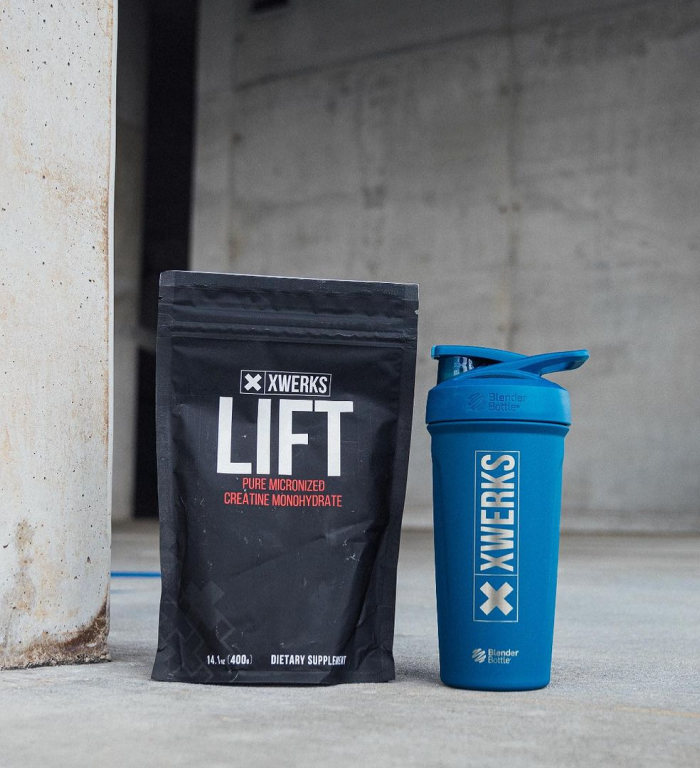
Lift is the plain-creatine option in this comparison. Its current Supplement Facts list one scoop providing 5 g of creatine monohydrate. It does not contain HMB. That makes it a straightforward choice for readers who want creatine without committing to a combination formula; the ingredient evidence is not a clinical trial of Lift itself.
Want a single-ingredient creatine routine? Review Lift's current label and serving directions.
View XWERKS LiftSources and review notes
Research and product information checked October 30, 2026. Sources are linked beside the relevant claims. The evidence comparison includes the 2019 systematic review, the newer ISSN position stand, and individual combination trials. PubMed abstracts were used where full text was unavailable. The cost example is an illustrative calculation, not a quoted offer.