Ashwagandha or tongkat ali? Start with your goal. Our reading of the evidence favors investigating ashwagandha for stress or sleep, while tongkat ali research more directly addresses testosterone in men. That does not establish a universal winner—or make either supplement a treatment for low testosterone.
The comparison below draws on NIH's ashwagandha evidence summary and a systematic review of tongkat ali clinical trials. These sources do not establish that one outperforms the other in a direct comparison.
Ashwagandha (Withania somnifera) and tongkat ali (Eurycoma longifolia) are different botanicals. Sharing space on the supplement shelf does not make their extracts, doses, or research interchangeable. The useful question is which evidence actually matches the outcome you want.
Ashwagandha vs. tongkat ali at a glance
| Your priority | What to investigate | What to keep in mind |
|---|---|---|
| Stress or sleep | Ashwagandha has trials focused on these outcomes. | Results depend on the extract, population, and study duration. |
| Testosterone support | Tongkat ali has a dedicated body of male hormone research. | A positive pooled result does not mean every man benefits. |
| Persistent fatigue or low libido | A clinical evaluation before choosing a supplement. | Symptoms alone cannot identify the cause. |
| Choosing a product | The complete Supplement Facts panel and relevant extract research. | The largest milligram number is not a reliable ranking system. |
What does the ashwagandha research show?
The clearest reason to consider ashwagandha is its research on perceived stress and sleep. In a 60-day randomized trial involving 64 adults with chronic stress, participants received either placebo or 300 mg of a particular root extract twice daily. The extract group improved on stress questionnaires and had lower serum cortisol relative to placebo.
That finding concerns a specific preparation and group of people. It does not prove that every gummy, powder, or capsule produces the same effect, or that lowering a cortisol measurement automatically improves athletic performance.
For sleep, NIH describes modest benefits across a small collection of trials, with more pronounced effects in participants with insomnia. Studies used different extracts and doses. This supports cautious interest, rather than expecting an immediate or guaranteed sleep aid.
If testosterone is your main question, our separate guide examines ashwagandha and testosterone. A study's hormone result should be considered alongside who participated and what else changed.
What does the tongkat ali research show?
Tongkat ali has promising but limited evidence for testosterone outcomes in men. A 2022 meta-analysis of five randomized trials found a positive overall effect on total testosterone. However, results varied substantially between studies, and the authors identified possible publication bias.
One detail matters when interpreting that headline: the pooled subgroup of men with normal baseline testosterone did not show a statistically significant increase. The low-testosterone subgroup did. Neither finding establishes a predictable response for an individual or proves equivalence to medical treatment.
Tongkat ali also has some stress research. A four-week trial of 63 moderately stressed adults tested 200 mg daily of a standardized root extract and reported improvements in selected mood measures and salivary hormone measurements. Salivary testosterone in a short trial is not the same outcome as diagnosing and treating low blood testosterone.
For persistent symptoms, speak with a clinician rather than choosing a supplement from a symptom checklist. Our guide to testosterone levels and testing explains why a single number needs context.
How to compare doses without being misled
Compare the actual extract and daily serving—not just the number on the front of the bottle. Use this four-part label check:
- Identify the plant and part. Look for the botanical name and whether the product uses root, leaf, or a combination.
- Separate extract weight from root equivalent. A root-equivalent amount describes starting material represented by an extract. It is not the mass of extract swallowed.
- Read the standardization. Check what constituent is measured and the basis for the stated percentage. An extraction ratio alone does not establish the chemical profile or clinical performance.
- Match the research. Look for the same preparation, amount, duration, and relevant population. A study of one extract cannot validate every product containing that plant.
A concrete example is Ashwa's published Supplement Facts panel: it lists 1,500 mg of root equivalent from 50 mg of a 30:1 extract, standardized to 3% withanolides (1.5 mg). That is 50 mg of extract, and the arithmetic does not make it equivalent to 600 mg of a different researched extract. Likewise, 100:1 versus 200:1 tongkat ali is not a simple potency contest.
The doses above describe research protocols, not a personal dosing prescription. Follow your product's directions and review suitability with a qualified clinician when needed.
Can you take ashwagandha and tongkat ali together?
The studies cited here do not establish that combining them works better than either alone. Evidence for each ingredient separately does not demonstrate synergy, the best combined dose, or the long-term safety of a stack.
Before adding both, write down the outcome you want to improve. Starting several ingredients at once makes it harder to tell which one helped—or caused a problem. Review the entire formula, especially if you use medication or already take other supplements.
Side effects and safety considerations
Ashwagandha: NIH notes possible stomach upset, nausea, and drowsiness; liver injury has also been reported. It can affect thyroid function and interact with medications. Avoid it during pregnancy, and seek professional advice for breastfeeding, thyroid or liver disease, or medication use. Evidence beyond roughly three months is limited.
Tongkat ali: Long-term safety should not be assumed from short clinical trials. In a 2021 assessment of a specific standardized water extract, EFSA identified potential DNA damage in preclinical testing and concluded that safety had not been established. That assessment does not show that every tongkat ali product has the same composition or risk; it does rule out treating the whole category as proven harmless.
Where XWERKS Ashwa and Rise fit
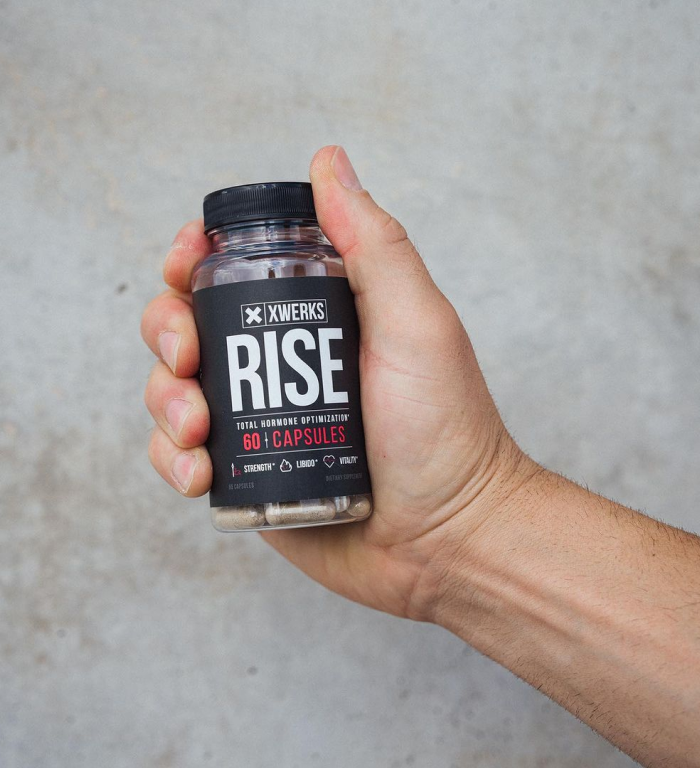
Ashwa is an ashwagandha gummy; Rise is a multi-ingredient formula containing tongkat ali. They are different product choices, not interchangeable versions of the same supplement.
The current Ashwa product page lists a serving of two strawberry gummies. The current Rise formula lists tongkat ali, shilajit, zinc, boron, and BioPerine. Check the full label before choosing: research on an isolated ingredient does not automatically demonstrate the effects of the finished blend.
Considering an ashwagandha gummy? Review Ashwa's ingredients, serving directions, and product details alongside the evidence above.
View XWERKS AshwaFrequently asked questions
Is tongkat ali better than ashwagandha for testosterone?
It has more directly targeted male testosterone research, but the evidence discussed here does not establish superiority over ashwagandha in a head-to-head trial. Your starting health status and the specific extract matter.
Can either replace testosterone treatment?
No. The cited supplement studies do not establish either as a replacement for prescribed treatment. Discuss symptoms and test results with your clinician.
Does a higher extract ratio mean a better supplement?
No. A ratio describes extraction, not a proven health outcome. Compare the measured constituents, serving amount, quality information, and research on that preparation.
Sources
- NIH Office of Dietary Supplements: Ashwagandha fact sheet.
- Chandrasekhar et al. (2012): Randomized ashwagandha stress trial.
- Leisegang et al. (2022): Tongkat ali and testosterone meta-analysis.
- Talbott et al. (2013): Tongkat ali stress and mood trial.
- EFSA (2021): Safety assessment of a tongkat ali root extract.
Research and product information checked October 29, 2026. This article is educational and does not provide a diagnosis or an individualized treatment plan.