Collagen vs Whey: Which Protein Do You Actually Need?
TL;DR
- They're not really competitors — collagen and whey do different jobs. Whey builds muscle; collagen supports connective tissue (skin, joints, tendons).
- For building muscle, whey wins decisively. It's a complete protein rich in leucine, the amino acid that triggers muscle protein synthesis. Collagen is incomplete and low in leucine — it's a poor muscle-building protein.
- For skin, hair, nails, joints, and tendon support, collagen has the edge — it supplies the specific amino acids (glycine, proline, hydroxyproline) those tissues are built from.
- If you can only pick one for fitness, choose whey. It covers your overall protein needs and muscle goals; collagen is a targeted add-on.
- Many people use both — whey as their primary protein, collagen as a supplemental dose for joint/skin support. They complement each other.
Collagen and whey are two of the most popular protein supplements, and they're constantly pitted against each other — but that framing is misleading. They're fundamentally different proteins that do fundamentally different jobs. Choosing between them isn't about which is "better" in the abstract; it's about what you're trying to accomplish. Here's exactly how they differ, what each is genuinely good for, and which one you should reach for.

The core difference: complete vs incomplete protein
The whole comparison comes down to amino acid profile. Whey is a complete protein — it contains all nine essential amino acids in good proportions, and it's especially rich in leucine, the amino acid that switches on muscle protein synthesis. That's what makes whey one of the most effective muscle-building proteins available.
Collagen is an incomplete protein — it's missing tryptophan and is low in leucine. But it's exceptionally rich in three amino acids (glycine, proline, and hydroxyproline) that are the building blocks of connective tissue. So collagen is poor at building muscle but well-suited to supporting the tissues it's made from: skin, joints, tendons, and ligaments.
Collagen vs whey at a glance
| Whey | Collagen | |
|---|---|---|
| Protein type | Complete (all 9 EAAs) | Incomplete (low/no tryptophan, low leucine) |
| Best for | Building & repairing muscle | Skin, hair, nails, joints, tendons |
| Key amino acids | Leucine & BCAAs | Glycine, proline, hydroxyproline |
| Muscle protein synthesis | Strong trigger | Weak |
| Source | Milk (dairy) | Animal connective tissue/skin/bone |
| Counts toward protein target? | Yes — high quality | Partially — lower quality for muscle |
When to choose whey
Building or maintaining muscle
This is whey's home turf. Its complete amino profile and high leucine content make it one of the most effective proteins for triggering muscle protein synthesis. If muscle is your goal, whey is the answer.
Post-workout recovery
Whey is fast-absorbing, delivering amino acids to muscle quickly when they're most useful after training. Collagen doesn't serve this role well.
Hitting your daily protein target
Because whey is a complete, high-quality protein, it counts fully toward your daily protein needs. It's the efficient choice for closing the gap between what you eat and the 1.6–2.0g/kg most active people need.
When to choose collagen
Skin, hair, and nail support
Collagen supplies the specific amino acids skin is built from, and some research suggests supplementation may support skin elasticity and hydration. This is collagen's most popular use case.
Joint, tendon, and connective tissue support
For people with joint discomfort, or athletes managing tendon/ligament stress, collagen (often paired with vitamin C, which is needed for collagen synthesis) may support connective tissue. Useful for high-impact sports and aging joints.
As a targeted add-on — not your main protein
Collagen works best as a supplemental dose for specific tissue goals, layered on top of adequate complete protein. It shouldn't be your primary protein source if muscle and overall protein intake matter to you.
Can you use both together?
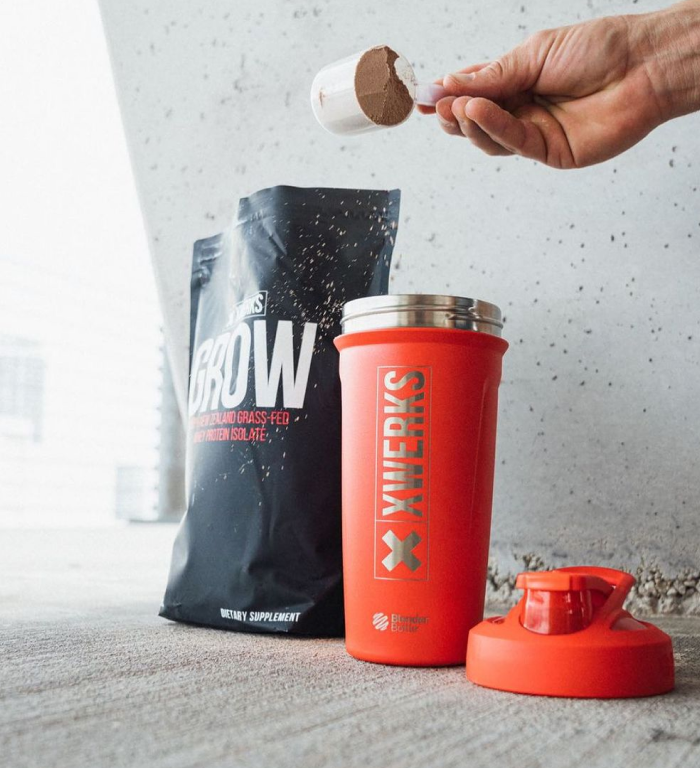
Absolutely — and many people do. They don't conflict; they cover different bases. A common setup is a whey isolate like XWERKS Grow as your everyday protein for muscle and recovery, plus a separate collagen dose (ideally with vitamin C) for skin and joint support. Just remember that collagen's protein doesn't fully "count" toward your muscle-building protein target — so track your complete protein (like whey and whole foods) separately when you're aiming for a daily intake goal.
The Bottom Line
Collagen vs whey isn't really a competition — they do different jobs. Whey is a complete, leucine-rich protein built for muscle building and recovery. Collagen is an incomplete protein rich in the amino acids that support skin, hair, nails, joints, and tendons.
For muscle and overall protein needs, choose whey — it's decisively better, and collagen can't fill that role. XWERKS Grow delivers 25g of complete grass-fed whey isolate with the leucine that actually drives muscle growth.
For skin and joint support specifically, collagen is the targeted tool — best used as an add-on alongside, not instead of, a quality complete protein. Plenty of people use both, and they complement each other well.
Further Reading
BCAA vs EAA: Which Do You Need?
References
1. Jäger R, et al. International Society of Sports Nutrition position stand: protein and exercise. J Int Soc Sports Nutr. 2017;14:20.
2. Paul C, et al. Significant amounts of functional collagen peptides can be incorporated in the diet. Nutrients. 2019;11(5):1079.
3. Shaw G, et al. Vitamin C-enriched gelatin supplementation before intermittent activity augments collagen synthesis. Am J Clin Nutr. 2017;105(1):136-143.
4. Devries MC, Phillips SM. Supplemental protein in support of muscle mass and health: advantage whey. J Food Sci. 2015;80(S1):A8-A15.