Does Protein Build Muscle? What Actually Drives Growth
TL;DR
- Protein doesn't build muscle by itself — resistance training is the stimulus, and protein is the raw material. You need both.
- Muscle grows when muscle protein synthesis exceeds breakdown over time. Training triggers synthesis; dietary protein supplies the amino acids that make it possible.
- The target for building muscle is roughly 1.6–2.0g of protein per kg of bodyweight per day — spread across the day, not crammed into one meal.
- Eating more protein than you need won't add extra muscle. Past the threshold, surplus protein is just used for energy or stored — muscle growth is capped by the training stimulus.
- Protein powder isn't magic — it's just a convenient way to hit your daily target. Whole foods and supplements both work.
"Does protein build muscle?" is one of the most fundamental questions in fitness — and the answer is more nuanced than a simple yes. Protein is essential for building muscle, but it doesn't do the job alone. Understanding the actual relationship between protein, training, and muscle growth will save you from both under-eating protein (and stalling your progress) and over-eating it (and wasting money on the assumption that more equals bigger). Here's how muscle is really built.

How muscle is actually built
Your muscles are in a constant state of turnover — protein is continuously broken down and rebuilt. Whether you gain, maintain, or lose muscle comes down to the balance between two processes: muscle protein synthesis (building) and muscle protein breakdown. When synthesis exceeds breakdown over time, you gain muscle.
Two things drive that balance in your favor: a training stimulus and adequate protein. Resistance training is the signal that tells your body to build muscle — it creates the demand. Dietary protein provides the amino acids that are the literal building blocks. Without the training stimulus, extra protein has nothing to build. Without adequate protein, the training stimulus has no materials to work with. Muscle growth requires both.
What protein actually does
Supplies amino acids — the building blocks
Protein breaks down into amino acids, which your body uses to repair and build muscle tissue. Of these, the essential amino acids — and one in particular, leucine — are the key drivers of muscle protein synthesis.
Triggers muscle protein synthesis via leucine
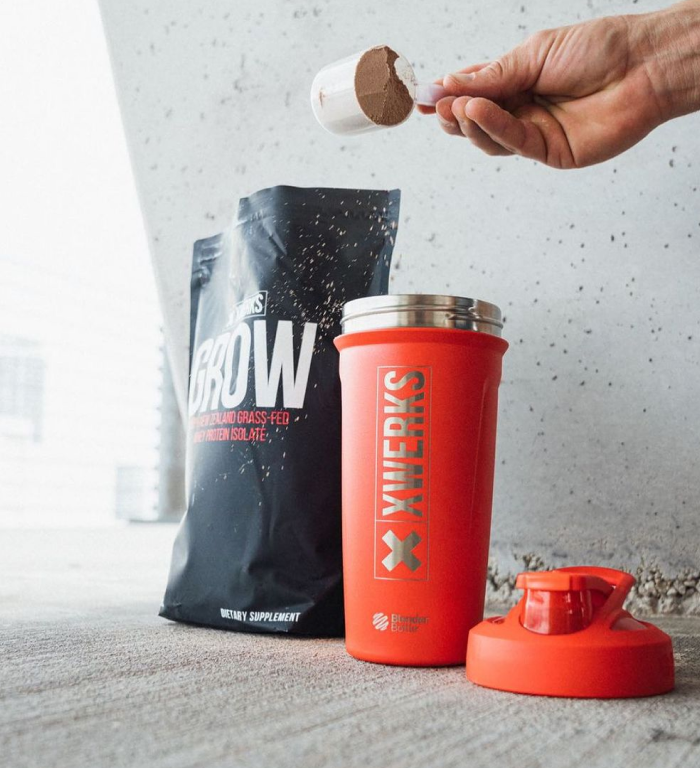
Leucine acts as a molecular "on switch" for muscle protein synthesis. A protein dose containing roughly 2.5–3g of leucine maximally stimulates the building response. This is why high-quality, leucine-rich proteins like whey are so effective — and why XWERKS Grow (whey isolate, rich in BCAAs including leucine) is an efficient muscle-building protein.
Supports recovery between sessions
Adequate protein helps repair the muscle damage from training, so you recover and adapt between sessions. Under-eating protein slows recovery and blunts your progress over time.
How much protein do you need to build muscle?
Just as important as the total is the distribution. Spreading protein across 3–4 meals of 25–40g each stimulates muscle protein synthesis more effectively than eating most of your protein in one or two large servings. This is where a protein shake becomes a practical tool — it makes it easy to add a feeding when whole-food meals don't line up.
Does more protein build more muscle?
This is the most common misconception. Once you're hitting your target (1.6–2.0g/kg), eating more protein doesn't build more muscle. Your rate of muscle growth is determined by your training stimulus, your recovery, and your consistency over months — not by how far you exceed your protein needs. Surplus protein beyond what's needed for muscle and other functions is simply used for energy or stored like any other excess calories.
The practical implication: hit your target reliably, then put your energy into progressive training and consistency rather than chasing ever-higher protein numbers.
Do you need protein powder to build muscle?
No — you can build muscle entirely from whole-food protein (meat, fish, eggs, dairy, legumes). Protein powder isn't magic and isn't required. What it is, is convenient: a fast, portable, affordable way to hit your daily target when whole-food meals are inconvenient or when you need a quick post-workout dose.
That convenience is the whole value proposition. XWERKS Grow gives you 25g of high-quality, leucine-rich whey isolate in seconds — useful precisely when hitting your number from whole food alone would be a hassle. Use it as a tool to reach your target, not as a substitute for an overall solid diet.
The full muscle-building picture
1. Progressive resistance training
The non-negotiable stimulus. Lifting with progressive overload (gradually increasing weight, reps, or volume) is what signals muscle to grow. No amount of protein substitutes for this.
2. Adequate protein (1.6–2.0g/kg/day)
The raw material, spread across the day. This is where protein — whole food and/or powder — does its job.
3. Sufficient total calories
Building muscle is easiest in a slight calorie surplus or at maintenance. In a large deficit, muscle growth slows (though beginners and those with higher body fat can still gain while losing fat).
4. Recovery and sleep
Muscle is built during recovery, not during the workout. 7–9 hours of sleep and adequate rest between training sessions are essential for the adaptation to actually happen.
5. Consistency over months
Muscle growth is slow — measured in months and years, not weeks. The people who build noticeable muscle are the ones who train and eat consistently over long periods.
The Bottom Line
Protein is essential for building muscle, but it doesn't build muscle on its own. Resistance training is the stimulus that signals growth; protein is the raw material that makes it possible. You need both — neither works without the other.
Hit roughly 1.6–2.0g of protein per kg of bodyweight per day, spread across 3–4 feedings of 25–40g. Going beyond that doesn't add more muscle — growth is capped by your training, not your protein intake.
Protein powder isn't required, just convenient. A leucine-rich whey isolate like XWERKS Grow is an efficient way to hit your target and trigger muscle protein synthesis — a tool that supports a solid training program, not a replacement for one.
Further Reading
Protein Shake Before Bed: Worth It?
References
1. Morton RW, et al. A systematic review, meta-analysis and meta-regression of the effect of protein supplementation on resistance training-induced gains in muscle mass and strength. Br J Sports Med. 2018;52:376-384.
2. Schoenfeld BJ, Aragon AA. How much protein can the body use in a single meal for muscle-building? J Int Soc Sports Nutr. 2018;15:10.
3. Jäger R, et al. International Society of Sports Nutrition position stand: protein and exercise. J Int Soc Sports Nutr. 2017;14:20.
4. Phillips SM, Van Loon LJC. Dietary protein for athletes: from requirements to optimum adaptation. J Sports Sci. 2011;29(Suppl 1):S29-S38.