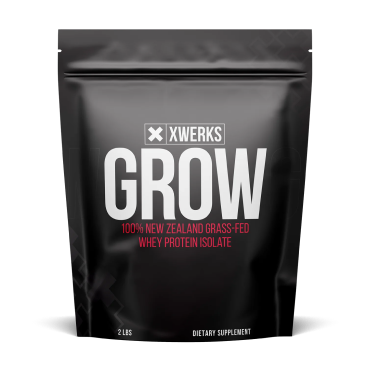
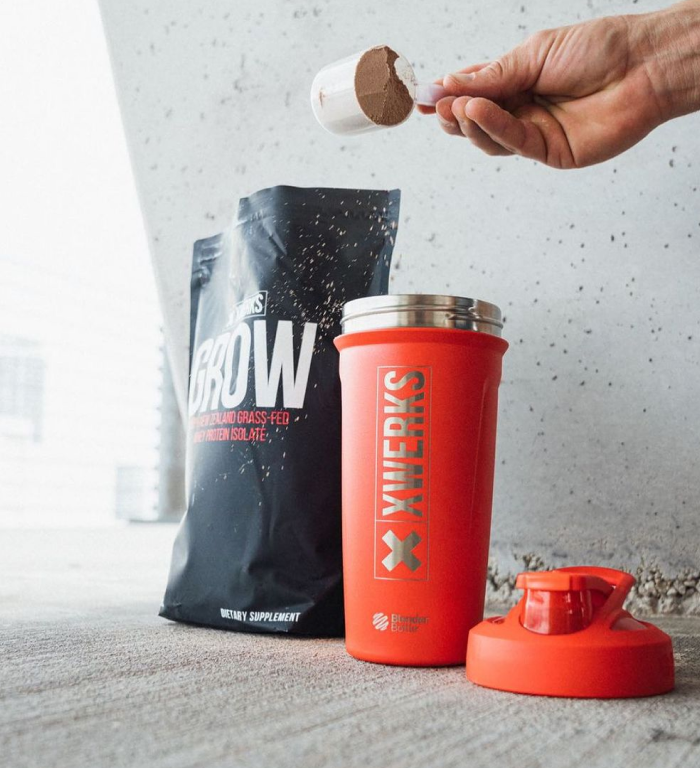
Xwerks Grow - 100% New Zealand grass-fed whey protein isolate.
Our protein is sourced from naturally raised grass-fed cows that naturally graze on the countryside of New Zealand, one of the strictest countries in the world when it comes to dairy quality. Meaning no hormones, antibiotics or pesticides that can be passed on to you.
Whey isolate means our whey is "isolated" through micro filtration to almost totally pure protein at25g of protein and over 6g of BCAA's per servingwith no lactose, carbs or fats (Peanut Butter contains 23g of Protein, 2g fat and 2g carbs). Our unique protein formula contains only whey protein isolate and is not blended with lesser quality whey.
Grow is naturally sweetened and flavored making it truly the cleanest protein available.
Made from grass-fed, pasture raised cows in New Zealand
100% whey protein isolate
Cold pressed, non ion-exchange filtering
No artificial sweetners, flavors or coloring
Soy and Gluten free
Processed acid and bleach free
Amazing rich flavor with no aftertaste
Raw whey is rich in protein substances, called native micro fractions. These include; alpha lactalbumin, beta-lactoglobulin, glycomacropeptide, immunoglobulins, serum albumin, lactoferrin, lactoperoxidase.
Our micro filtration process helps preserve these important biological nutrients while removing unwanted fats and carbohydrates (such as lactose).
This means our whey has the following benefits and more:
Muscle growth and repair
Strengthens and boosts the immune system
Anti-oxidant properties
Easily digestible, no bloat
Fantastic flavor
No clumping
FAQ
WHAT CAN I EXPECT FROM USING GROW
Increased muscle repair and recovery
No bloated feel
Great flavor with no after taste
Instant mixing with no clumping
HOW MANY SERVINGS IS GROW One bag contains 30 servings.
WHAT IS THE DIFFERENCE BETWEEN YOUR PROTEIN AND OTHERS We have a couple blog posts that may help answer that:
IS GROW DAIRY FREE No, but it does not contain lactose due to our microfiltration process.
DOES GROW CONTAIN SUGAR No, it is naturally sweetened with Stevia.
DOES GROW CONTAIN PEANUTS Only Peanut Butter PR contains peanuts.
WHAT IS GROW FLAVORED WITH Cocoa bean for Chocolate Cream, vanilla bean for Vanilla Victory and peanut butter powder and cocoa bean for Peanut Butter PR.
HOW MUCH IS SHIPPING $5, or free for orders over $75
IS GROW KETO FRIENDLY Yes it is, our low carb formula is perfect for anyone following the keto diet
Whey Protein Isolate vs. Hydrolyzed Whey: Is "Pre-Digested" Protein Worth the Premium?
Hydrolyzed whey is marketed as the "faster-absorbing, easier-digesting, more bioavailable" form of whey protein. It also costs significantly more and tastes noticeably worse. The question is whether the science supports the premium — and the honest answer is: for most people, it doesn't.
How They're Made
Whey protein isolate (WPI) starts as whey concentrate and undergoes additional filtration — either cross-flow micro-filtration (the gold standard) or ion exchange — to remove the vast majority of lactose, fat, and carbohydrates. The result is a powder that's 90-95% protein by weight, with less than 1% lactose, minimal fat, and a complete amino acid profile. When the filtration is done at low temperatures without chemical reagents (cold-processed, non-ion-exchange), the native protein structure is preserved — including bioactive fractions like immunoglobulins, lactoferrin, glycomacropeptides, and lactoperoxidase that play active roles in gut health and immune function.
Hydrolyzed whey (WPH) takes isolate or concentrate and subjects it to an additional step: enzymatic hydrolysis. Enzymes (or in some manufacturing processes, heat and acid) break the peptide bonds that hold amino acid chains together, producing shorter peptide fragments. This is marketed as "pre-digestion" — the claim being that because the protein chains are already partially broken down, your body can absorb and utilize them faster.
The question is whether this pre-digestion provides any meaningful advantage for a healthy person who already has a fully functional digestive system.
The "Faster Absorption" Claim
This is the central selling point of hydrolyzed whey, and the research doesn't support it the way the marketing suggests.
Whey protein is already one of the fastest-absorbing protein sources available. Standard whey isolate spikes blood amino acid levels within 40-60 minutes of consumption. It's classified as a "fast protein" in sports nutrition research precisely because it doesn't need additional processing to be rapidly absorbed.
A study published in the Journal of Science in Sport and Exercise (Farup et al., 2014) compared WPI and WPH in resistance-trained men and found no significant difference in muscle protein synthesis rates between the two forms. Both produced equivalent anabolic responses. A separate study by Lockwood et al. (2017) found no performance or body composition advantages from hydrolyzed whey over isolate during an 8-week resistance training program.
Even if we assume hydrolyzed whey absorbs marginally faster — and the data is inconsistent on this — the practical question is: does faster absorption produce better results? The answer, based on the available research, is no. Muscle protein synthesis is triggered by the total leucine and essential amino acid content of a protein dose, not by the speed at which those amino acids arrive. Both WPI and WPH deliver the same amino acids in the same quantities. The rate-limiting factor for muscle growth is total daily protein intake and training stimulus, not a 10-15 minute difference in absorption speed.
The Bioavailability Question
Whey protein already has a bioavailability of 96% or higher, as measured by the Protein Digestibility Corrected Amino Acid Score (PDCAAS). This is essentially at the ceiling of what's physiologically possible — your body absorbs and utilizes virtually all of the protein in a standard whey isolate serving.
There are no published studies demonstrating that hydrolyzed whey has a meaningfully higher bioavailability than isolate. Even if we granted hydrolyzed whey a hypothetical 100% bioavailability (an unrealistic assumption), the improvement would be less than 4% — roughly one additional gram of usable protein per scoop. That's the difference between 25g and 26g, which is nutritionally irrelevant.
What Hydrolysis Actually Costs You
The hydrolysis process doesn't just break down protein chains — it breaks down everything, including the bioactive protein fractions that provide health benefits beyond muscle building.
Immunoglobulins (IgG) — antibodies that support immune function. Partially or fully denatured by hydrolysis.
Lactoferrin — an iron-binding glycoprotein with antimicrobial, anti-inflammatory, and immune-modulating properties. Destroyed by hydrolysis.
Glycomacropeptides (GMP) — bioactive peptides that stimulate CCK release (promoting satiety and comfortable gastric motility), have prebiotic-like effects on gut bacteria, and may support dental health. Broken apart during hydrolysis.
Lactoperoxidase — an enzyme with antimicrobial activity in the gut. Inactivated by hydrolysis.
Cold-processed whey isolate (made via non-ion-exchange micro-filtration, like XWERKS Grow) preserves these fractions in their native, biologically active form. Hydrolyzed whey trades them away for a marginal absorption speed increase that produces no measurable difference in muscle protein synthesis.
The taste problem is real: Hydrolysis produces shorter peptide fragments that are inherently bitter. This is a known characteristic of enzymatically hydrolyzed proteins — the exposed hydrophobic amino acid residues taste unpleasant. To mask this bitterness, hydrolyzed whey products typically require heavy sweetening (sucralose, acesulfame K, or large amounts of sugar), artificial flavoring, and thickening agents. These additives can themselves cause GI discomfort in sensitive individuals — ironically undermining one of the supposed advantages of "pre-digested" protein.
When Hydrolyzed Whey Makes Sense
To be fair, there are specific clinical situations where hydrolyzed whey has a legitimate role:
Infant formula. Hydrolyzed whey is used in hypoallergenic infant formulas for babies with cow's milk protein allergy or intolerance. Infants have immature digestive systems and may not be able to break down intact whey proteins. This is a medical application, not a performance application.
Clinical malabsorption. Patients with severe digestive disorders (short bowel syndrome, severe Crohn's disease, post-surgical gut resection) who have genuinely impaired protein digestion may benefit from pre-digested protein. These are medical conditions managed by gastroenterologists, not scenarios applicable to healthy athletes.
Severe dairy protein sensitivity. Some individuals who react to intact whey proteins (not just lactose) may tolerate hydrolyzed whey because the allergenic epitopes have been broken down. However, this is rare — and people with true dairy protein allergy should work with an allergist rather than self-treating with hydrolyzed supplements.
For healthy adults with normal digestive function — which includes the vast majority of people shopping for protein powder — hydrolyzed whey offers no meaningful advantage over a quality whey isolate.
The Cost-Benefit Analysis
Hydrolyzed whey typically costs 30-60% more per serving than whey isolate. For that premium, you get a product that produces equivalent muscle protein synthesis (per the research), has lower or equivalent bioavailability, destroys the bioactive protein fractions that support immunity and gut health, tastes measurably worse, and requires more artificial additives to compensate for the bitterness.
The only measurable advantage — a potentially faster (by 10-15 minutes) amino acid peak — has not been shown to translate into any real-world performance or body composition benefit in any controlled study of healthy, training adults.
What Grow gives you instead: 25g of 100% grass-fed whey protein isolate from New Zealand, cold-processed via non-ion-exchange micro-filtration. Bioactive fractions (immunoglobulins, lactoferrin, GMP, lactoperoxidase) preserved. Less than 0.5g lactose. Naturally sweetened with stevia. No artificial flavors, colors, or thickeners. Soy-free, gluten-free, acid-free, bleach-free. Smooth taste with no bitterness — because the protein structure hasn't been destroyed.
The Bottom Line
Hydrolyzed whey is a solution to a problem that doesn't exist for healthy adults. Whey protein is already fast-absorbing (40-60 min peak), already highly bioavailable (96%+), and already well-tolerated when you choose a quality isolate with minimal lactose. The hydrolysis process adds cost, destroys bioactive fractions, creates bitterness that requires heavy sweetening to mask, and produces no measurable improvement in muscle protein synthesis or body composition in controlled studies.
For infants with dairy allergies or patients with severe malabsorption disorders, hydrolyzed whey has a clinical role. For athletes and fitness enthusiasts choosing their daily protein powder, cold-processed whey protein isolate is the better product — more bioactive compounds preserved, better taste, lower cost, and identical results where it matters: building and repairing muscle.
Better Protein. Not More Processing.
XWERKS Grow — 100% New Zealand grass-fed whey protein isolate. Cold micro-filtered to preserve what matters. Naturally sweetened. 25g protein, 4 flavors, zero compromise.
1. Farup J, et al. Whey protein hydrolysate augments tendon and muscle hypertrophy independent of resistance exercise contraction mode. Scand J Med Sci Sports. 2014;24(5):788-798.
2. Lockwood CM, et al. Comparison of two forms of hydrolyzed whey protein for recovery from resistance exercise. J Int Soc Sports Nutr. 2017;14:49.
3. Hoffman JR, Falvo MJ. Protein — which is best? J Sports Sci Med. 2004;3(3):118-130.
4. Boirie Y, et al. Slow and fast dietary proteins differently modulate postprandial protein accretion. Proc Natl Acad Sci. 1997;94(26):14930-14935.
5. Etzel MR. Manufacture and use of dairy protein fractions. J Nutr. 2004;134(4):996S-1002S.
6. Marshall K. Therapeutic applications of whey protein. Altern Med Rev. 2004;9(2):136-156.
7. Lahl WJ, Braun SD. Enzymatic production of protein hydrolysates for food use. Food Technol. 1994;48:68-71.
Unlock Exclusive Offers and Fitness Tips!
Subscribe to the XWERKS newsletter to stay in the loop with the latest product releases, exclusive offers, and expert fitness tips that will elevate your performance to new heights!