How Long Does Whey Protein Last?
Unopened whey protein powder typically lasts 12-24 months from the manufacturing date. Once opened, it stays good for 12-18 months when stored properly — cool, dry, and sealed. Whey protein isolate, because of its lower moisture and fat content, tends to outlast concentrate. Here's what actually determines shelf life, what happens when protein degrades, and how to tell if yours has gone bad.
How long does whey protein powder last?
Unopened: Most whey protein powders carry a "best by" date of approximately 2 years from manufacturing. This is a conservative quality estimate, not a hard safety cutoff. Properly stored, unopened whey protein can maintain its quality for the full printed date and often beyond it.
Opened: Once you break the seal, exposure to air and moisture begins the slow degradation process. At room temperature (~70°F / 21°C) with normal humidity, opened whey protein typically remains good for 12-18 months. At higher temperatures (~95°F / 35°C) or in humid environments, this can drop to as little as 9 months.
Mixed with liquid: A whey protein shake mixed with water or milk should be consumed within a few hours at room temperature. Refrigerated, it can last up to 24 hours. Beyond that, bacterial growth and protein denaturation make it unsuitable for consumption. Don't leave mixed shakes in your gym bag overnight.
Does whey protein actually expire?
Not in the way perishable foods do. Whey protein powder is a dry, low-moisture product, which means bacterial growth (the main cause of food spoilage) is extremely limited. It doesn't suddenly become unsafe on the "best by" date. Instead, protein powder undergoes gradual quality degradation — the protein slowly loses effectiveness, the flavor deteriorates, and the texture may change.
The primary degradation mechanism is the Maillard reaction — a chemical reaction between amino acids and any residual sugars in the powder. This reaction, which accelerates with heat and moisture, causes browning, flavor changes, and critically, the breakdown of the amino acid lysine. Lysine is one of the essential amino acids — once it degrades significantly, the protein is no longer nutritionally complete and its muscle-building effectiveness is reduced.
This is a gradual process, not a cliff. Protein powder that's a few weeks past its "best by" date is almost certainly fine. Powder that's years past its date may have meaningfully reduced amino acid content, even if it hasn't visibly spoiled.
What affects shelf life?
Temperature. This is the biggest variable. Whey protein stored at 70°F maintains quality for 18+ months. At 95°F, that drops to about 9 months. Heat accelerates the Maillard reaction, lipid oxidation, and moisture-related degradation. Don't store protein in your car, garage, or near your stove.
Moisture. Water is the enemy of dry powder. Even small amounts of moisture — a wet scoop, a steamy kitchen, a humid bathroom cabinet — can introduce enough water to promote clumping, bacterial growth, and accelerated chemical reactions. Always use a dry scoop, seal the bag or container immediately after use, and store in a low-humidity environment.
Protein type. Whey protein isolate has a longer shelf life than whey concentrate because isolate contains less fat and less lactose. Fat is susceptible to oxidation (going rancid), and lactose participates in the Maillard reaction with amino acids. Less of both means slower degradation. This is one of many reasons isolate is the preferred form.
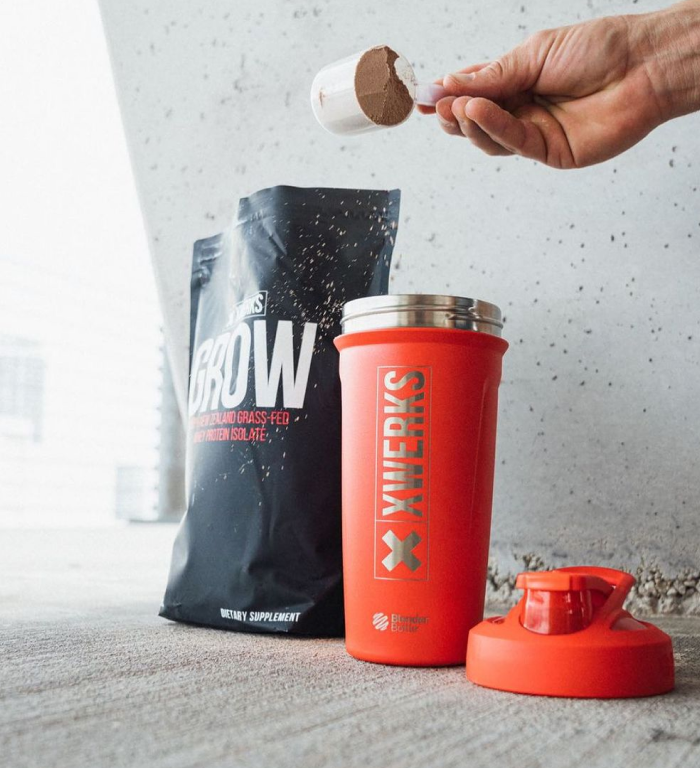
Ingredients and additives. Products with added fats (like peanut butter flavors with real peanut butter), milk-based creamers, or high sugar content degrade faster. Conversely, products with minimal ingredients and low moisture content tend to last longer. XWERKS Grow contains four ingredients — whey protein isolate, natural flavoring, stevia, and sunflower lecithin — with minimal fat, no added sugars, and very low moisture content, all of which support a longer, more stable shelf life.
Packaging. Sealed, airtight packaging protects against moisture and air exposure. Once opened, the quality of the resealable mechanism matters. Bags with zip-lock closures should be pressed flat to remove excess air before resealing. If your protein comes in a jar with a screw-top lid, ensure the lid is tightened fully after each use.
How to tell if your whey protein has gone bad
Smell it. Fresh whey protein has a neutral to mildly sweet/milky smell. A sour, acrid, or rancid odor — like spoiled milk — is the clearest sign of degradation. If it smells wrong, discard it.
Look at it. Any visible discoloration (darkening, yellowing), dark spots, or visible mold means the product should be discarded immediately. Minor clumping from humidity exposure is common and doesn't necessarily mean the protein is unsafe, but significant hard clumps suggest prolonged moisture exposure that may have compromised the product.
Taste it. If the smell check passes but you're uncertain, a small taste test is informative. Any bitter, sour, or significantly "off" flavor compared to what you're used to indicates degradation. The Maillard reaction produces distinct flavor changes — if your chocolate protein tastes more like burned caramel or cardboard, it's past its prime.
Check the texture. Properly stored whey protein should be a fine, loose powder that dissolves easily. If it's turned into a solid mass, has a gritty or grainy texture it didn't have before, or doesn't dissolve properly, moisture has likely compromised it.
How to maximize shelf life
Store in a cool, dry place. A pantry, kitchen cabinet, or closet away from heat sources is ideal. Room temperature (65-75°F) is fine. Avoid areas near the stove, dishwasher, or windows where temperature fluctuates.
Seal tightly after every use. Minimize air and moisture exposure by resealing immediately. If your bag's zip closure is damaged, transfer the protein to an airtight container.
Use a dry scoop. Never use a wet or damp scoop, and never scoop protein while your hands are wet. Even a few drops of water introduced into the bag can create localized moisture that accelerates degradation and clumping.
Don't refrigerate or freeze the powder. This seems counterintuitive, but refrigerators and freezers introduce condensation risk when you take the cold container into warm air. Temperature cycling (cold to warm, back to cold) creates condensation inside the container. Room temperature, dry, and sealed is the best approach for powder. (Refrigerating a mixed shake is fine — we're talking about the dry powder here.)
Buy quantities you'll use. If you go through a bag of protein every month, buying in bulk makes sense. If you use protein sporadically, buy smaller quantities so you're consuming it within the peak quality window. With Subscribe & Save, you can set a delivery schedule that matches your actual consumption rate — fresh protein arriving when you need it, not sitting in your pantry for months.
Quick Reference
Unopened: 12-24 months (follow "best by" date).
Opened, at room temperature: 12-18 months.
Opened, in warm/humid conditions: 9 months or less.
Mixed with liquid, room temp: Consume within 2-3 hours.
Mixed with liquid, refrigerated: Up to 24 hours.
Storage rule: Cool, dry, sealed, dry scoop, don't refrigerate the powder.
Spoilage signs: Sour/rancid smell, discoloration, mold, bitter taste, hard clumps.
The main degradation mechanism: Maillard reaction (amino acid + sugar → lysine breakdown → incomplete protein). Accelerated by heat and moisture.
Fresh Protein, Delivered on Your Schedule
XWERKS Grow — 100% NZ grass-fed whey protein isolate. Minimal ingredients. Maximum shelf stability. Subscribe & Save for automatic delivery timed to your consumption.
SHOP GROW →Further Reading
Whey Protein Isolate Benefits — Why isolate outlasts and outperforms concentrate.
Whey Protein: What It's Made Of — The amino acid and bioactive fraction profile.
Whey Protein for Sensitive Stomachs — Why isolate's low lactose content also means better shelf stability.
The History of Protein Powder — How 70 years of innovation got us from gritty liver powder to cold-processed isolate.
References
1. Dissanayake M, Vasiljevic T. Functional properties of whey proteins affected by heat treatment and hydrodynamic high-pressure shearing. J Dairy Sci. 2009;92(4):1387-1397.
2. Zhou P, Labuza TP. Effect of water content on the Maillard browning reaction in a whey protein model system. J Food Sci. 2007;72(1):E1-E7.
3. FDA. Dietary Supplement Labeling Guide: Chapter 1. General Dietary Supplement Labeling. U.S. Food and Drug Administration.
4. USDA. Food Safety and Inspection Service: Food Product Dating. U.S. Department of Agriculture.