Cardio does not automatically “kill” muscle gains. You can build muscle and strength while training your endurance. The tradeoff depends on which result you want to maximize, how demanding the combined program is, and whether you can recover between sessions. Explosive power deserves more caution than muscle size.
For lifters, the useful question is: Can I add this cardio while keeping my important lifting sessions productive? Here is how to make that decision without giving up conditioning.
What does the research say about cardio and muscle growth?
Average results are reassuring for whole-muscle size and maximal strength, but less reassuring for explosive strength. A 2022 systematic review pooled 43 studies in healthy adults. It compared supervised programs combining aerobic and strength training for at least four weeks with the same strength training alone. Adding cardio did not significantly reduce whole-muscle growth or maximal-strength gains, but it did modestly reduce improvements in explosive strength. See the Schumann et al. review.
That distinction matters: lifting the heaviest weight you can once, growing a larger muscle, and producing force quickly are different outcomes. A result about jumping or rapid force production should not be presented as proof that jogging prevents muscle growth.
The evidence is not perfectly uniform. A separate 2022 review of 15 studies measuring individual muscle fibers found a possible small reduction in fiber growth with concurrent training. Fiber measurements and whole-muscle measurements are not interchangeable. These findings support some uncertainty, rather than a claim that interference is impossible.
Experienced lifters may also need tighter programming. A 27-study review of lower-body strength found smaller strength improvements in trained participants combining both modes, particularly within the same session. Reviews use different eligibility criteria and outcome measures; their averages do not promise identical results for every athlete.
Choose your cardio schedule around your main goal
Protect the sessions that matter most to your current goal. The table below translates the evidence into practical scheduling choices; it is not a set of tested prescriptions.
| Main goal | Priority | Practical choice |
|---|---|---|
| Muscle growth | Consistent, progressive lifting | Start with manageable cardio and adjust if it repeatedly reduces the lifting work you can complete. |
| Maximal strength | Quality heavy sets | Lift before endurance work when sharing a session; experienced lifters may benefit from separating them. |
| Explosive power | Fast, fresh efforts | Give power training its own session when possible, separated from demanding endurance work. |
| Endurance performance | Key runs, rides, or intervals | Schedule lifting around important endurance sessions and accept that maximizing both simultaneously may require compromise. |
Should you do cardio before or after weights?
If strength is the priority and both must happen in one session, lift first. A meta-analysis of 10 studies lasting at least five weeks found better lower-body dynamic-strength improvements when resistance exercise preceded endurance exercise. Order did not significantly change hypertrophy or aerobic-capacity outcomes. This concerns a substantive endurance workout, not a brief easy warm-up.
For power-focused training, consider separate sessions. In the 43-study review, attenuation of explosive-strength gains was more apparent in same-session programs than programs separated by at least three hours. Three hours is a research grouping, not a guaranteed recovery deadline. A hard run can still affect how you feel later. Different days may be more practical, depending on your schedule and response.
Is running worse than cycling for gains?
There is no universal rule that lifters must avoid running. The whole-muscle review did not detect a significant running-versus-cycling difference in its moderator analyses. The muscle-fiber review found preliminary evidence of greater interference from running for type I fibers. That narrower finding does not establish that all running limits muscle growth.
Choose a mode you can sustain, then assess its effect on your lifting. If running repeatedly leaves your legs too sore for planned sets, reduce its duration or intensity, move it, or try cycling. A hard cycling session can also be demanding. The mode alone does not tell you the recovery cost.
How much cardio can you do while building muscle?
There is no evidence-based minute limit that applies to every lifter. Your starting fitness, lifting workload, endurance goal, and recovery all matter. For someone already lifting consistently but adding cardio for the first time, two easy 20–30-minute sessions can be a practical starting experiment. This is an illustrative starting dose, not a proven optimum, a ceiling, or a complete public-health exercise target.
For example, a lifter who already tolerates four lifting days could try:
- Monday: lower-body lifting.
- Tuesday: upper-body lifting, then 20 minutes of easy cycling.
- Wednesday: rest or comfortable everyday activity.
- Thursday: lower-body lifting.
- Friday: upper-body lifting.
- Saturday: 25 minutes of easy cycling or jogging at a conversational effort.
- Sunday: rest.
Keep your lifting program stable initially so you can judge the added work. If recovery and performance remain steady, increase one variable at a time. If endurance improvement is a main goal, use a more specific plan such as our VO2 max training guide instead of simply adding harder sessions to every available day.
What if your lifts start going backward?
A difficult workout is not proof of muscle loss. Look for a pattern across comparable sessions before blaming cardio. Use this checklist:
- Check the timeline. Did performance change after adding intervals, longer runs, extra lifting sets, or less sleep?
- Compare like with like. Record load, repetitions, rest periods, and effort. Our RPE and RIR guide explains how to track effort alongside the weight.
- Change the easiest problem first. Move or shorten the cardio session most likely to compromise your key lift, then reassess. Avoid changing the entire program at once.
- Review food and rest. Check whether your meal routine still matches the extra training and whether sleep has become inconsistent. A coach or sports dietitian can help when your goals compete.
Persistent, unexplained performance loss or fatigue deserves clinical assessment rather than automatically being labeled a training problem.
Can protein powder prevent cardio from interfering?
Protein powder can help fill a dietary protein gap; it cannot guarantee that an overloaded program will work. A meta-analysis of 49 trials in healthy adults performing resistance training for at least six weeks found that protein supplementation improved gains on average. Its analysis estimated a plateau near 1.6 grams of total daily protein per kilogram of body weight. That is a population estimate, not a universal maximum or a specific requirement for every concurrent-training athlete.
For an 80 kg lifter, 1.6 g/kg is about 128 g per day from all foods and supplements combined. Food can supply it all. If using a powder, count the protein shown for your actual flavor and serving; do not confuse grams of powder with grams of protein. No supplement replaces a manageable training schedule.
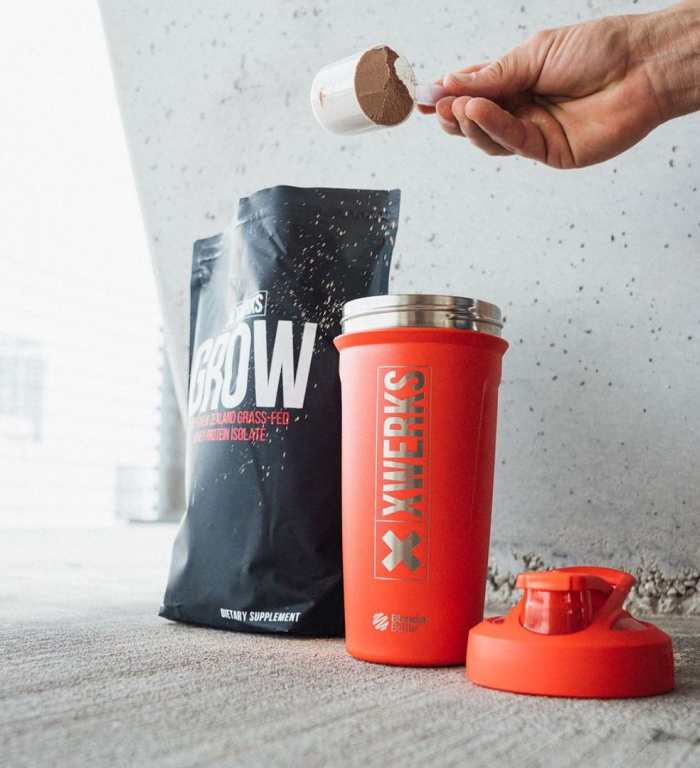
XWERKS Grow is a whey protein isolate option for filling that gap. It contains milk, and flavor ingredients vary. Check your selected flavor's label and allergens. The studies above did not test Grow as a way to prevent concurrent-training interference.