You can prepare a creatine drink the night before, but mixing shortly before use is the more conservative choice when you want the fewest questions about storage and the amount remaining. If advance preparation matters, use a clean, covered container, keep the drink refrigerated and follow the storage requirements of every ingredient. Research does not establish one universal overnight stability guarantee for every creatine-and-drink combination.
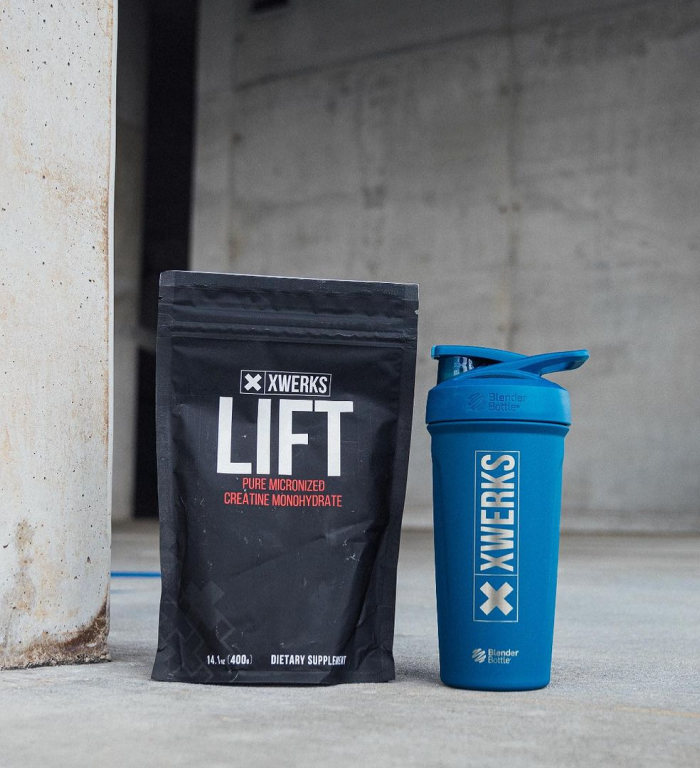
The important distinction is between dry creatine powder, creatine dissolved in liquid, and the food safety of the drink containing it. Those are separate questions. XWERKS sells Lift creatine monohydrate; the laboratory research discussed below did not test an overnight bottle of Lift.
What changes when creatine is mixed with water?
Dissolving creatine introduces storage conditions that do not apply in the same way to dry powder. Time, temperature, pH and formulation can affect what happens to creatine in solution.
Creatine can convert to creatinine in solution. That chemistry does not mean a freshly mixed drink immediately becomes useless, and it does not justify inventing a fixed percentage loss after one night. The relevant question is what was measured under conditions close to your own drink.
The primary stability study by Ganguly and colleagues examined an effervescent di-creatine citrate formulation stored at 25°C and 4°C over 45 days. The investigators measured substantial changes over that long storage period and found different behavior under refrigerated conditions. This was not a test of plain creatine monohydrate in a household shaker for eight hours. Original stability study.
Does the research prove that an overnight bottle loses its creatine?
Ganguly and colleagues' creatine stability study does not establish an overnight loss percentage for a homemade creatine drink. A long-term result in an acidic, effervescent formulation cannot simply be divided by the number of days to predict what happens overnight in another drink.
The study began with powder dissolved in deionized water, but the formulation changed the solution; the reported sample pH was acidic. Describing the experiment as ordinary creatine in neutral water would leave out an important detail. Different ingredient forms and drink compositions make broad extrapolation unreliable. Study methods and abstract.
The practical conclusion is modest: preparing fresh avoids a storage variable. If overnight preparation makes your routine easier, keep the storage interval short and the drink cold, while recognizing that the exact amount remaining has not been established for every recipe.
Does the type of drink matter?
The liquid used to mix creatine matters because acidity and food ingredients change the storage question. Plain water, an acidic sports drink and a milk-based shake should not be treated as identical recipes.
| Mixing choice | Main issue to consider | Conservative preparation choice |
|---|---|---|
| Plain water | Time and temperature after mixing | Mix close to use when practical |
| Juice or an acidic sports drink | Formulation and pH add uncertainty | Keep creatine dry until you are ready to drink |
| Milk or a protein shake | Food safety as well as creatine stability | Refrigerate promptly and follow ingredient storage directions |
| A drink carried all day in a warm bag | Uncontrolled time and temperature | Carry dry powder separately and mix later |
This table is a handling guide, not a laboratory ranking of percentage retained. It does not establish a safe storage period for any particular homemade mixture.
How should you handle a premixed protein-and-creatine shake?
Handle a protein-and-creatine shake as a perishable prepared drink when its ingredients require refrigeration. Creatine does not make milk or a mixed shake shelf-stable.
The FDA recommends keeping refrigerated foods at or below 40°F, or 4°C, and limiting time at room temperature for foods that need refrigeration to two hours—one hour above 90°F. Follow the product's own storage directions as well. These are food-handling rules, not measurements of creatine potency. FDA storage guidance.
A sealed commercial ready-to-drink shake and a powder mixed at home have different preparation and packaging histories. Do not use the shelf life of an unopened commercial carton as a storage rule for your homemade shake.
For a morning routine, refrigerate the prepared drink promptly in a clean, covered container and keep it cold until use. If the storage history is uncertain, do not rely on smell alone to establish food safety. A dry portion stored separately often solves the convenience problem with fewer variables.
What is the easiest alternative to premixing?
Pre-portioning dry creatine the night before gives you most of the convenience without storing it in liquid. Keep the portion sealed, dry and clearly identified, then add it to your drink when you are ready.
You can place a clean shaker beside breakfast items or pack the dry portion separately from a water bottle. Keep the scoop and storage container dry, and follow the product's storage directions. A small preparation habit can remove the morning measuring step without requiring a claim about overnight stability.
XWERKS Lift contains 5 g of creatine monohydrate per scoop and lists 80 servings per bag. Follow the current package directions for serving size rather than adding an extra scoop to compensate for an assumed storage loss. Lift label and directions.
Does sediment mean creatine has gone bad?
Visible sediment alone cannot tell you how much creatine remains or whether a mixed drink is safe. Undissolved powder, settling and chemical conversion are different possibilities that cannot be diagnosed by appearance alone.
Follow mixing instructions, use a clean container and avoid treating “completely clear” as a potency test. Similarly, a cloudy drink does not automatically prove the creatine has degraded. A laboratory assay and a household visual check answer very different questions.
If your main concern is how long an unopened or dry bag lasts, that is a separate topic from premixing. Read does creatine expire? for the dry-storage discussion.
Questions about preparing creatine ahead of time
Preparing creatine fresh is simple, while advance preparation requires attention to the whole drink and its storage. Avoid precise claims that the available experiment did not test.
Is an overnight creatine drink automatically useless?
Ganguly and colleagues' stability study does not show that every creatine drink stored overnight loses all its creatine. It also does not establish identical stability for every recipe.
Can I make a week's worth of creatine drinks at once?
For a week of creatine drinks, keeping multiple creatine servings dry and mixing each as needed is the more conservative approach. A longer liquid-storage interval adds uncertainty and can introduce food-safety concerns depending on the other ingredients.
Should I add more creatine after storing the drink?
Do not add extra creatine to a stored drink to compensate for an unmeasured loss. Use the product's directions and simplify storage rather than trying to correct a quantity you do not know.
Is timing the main reason creatine routines succeed?
For a daily creatine routine, consistency is more useful than making serving timing complicated. See creatine on rest days for maintaining a daily habit.