Best Creatine for Muscle Growth: Why Monohydrate Still Wins
Short answer: the best creatine for muscle growth is plain creatine monohydrate at 5g per day. It's the most-researched supplement in sports nutrition, and no "advanced" form (HCl, ethyl ester, buffered, liquid) has been shown to build more muscle. Save your money and buy the version the studies actually used.
Creatine is the most effective legal supplement for building muscle and strength — that part isn't controversial. What confuses people is the dozens of creatine types on the shelf, each claiming to be more "absorbable," "advanced," or "potent" than plain monohydrate. The reality: creatine monohydrate is the form used in the overwhelming majority of the 1,000+ studies, it's the form with the strongest evidence for increasing lean mass, and the fancier (more expensive) versions have never been shown to outperform it for muscle growth. Here's what actually matters.

TL;DR
- Creatine monohydrate is the best form for muscle growth — most-researched, most-effective, and cheapest. No other form has beaten it in head-to-head studies for building muscle.
- Dose: 5g per day, every day. Consistency (daily saturation) matters far more than timing. A loading phase (20g/day for 5-7 days) speeds saturation but isn't required.
- Micronized monohydrate is simply monohydrate ground into smaller particles for better mixing — same molecule, same effect, less grit. A quality-of-life upgrade, not a performance one.
- Ignore the "advanced" forms: creatine HCl, ethyl ester, buffered (Kre-Alkalyn), and liquid creatine cost more and have no evidence of superior muscle growth. Some (ethyl ester) actually perform worse.
- Creatine builds muscle indirectly: it lets you train harder and recover faster between sets, plus draws water into muscle cells. Paired with resistance training and adequate protein, it reliably increases lean mass.
How creatine actually builds muscle
Creatine doesn't build muscle the way protein does (by providing building blocks). It works through a few complementary mechanisms:
More training volume. Creatine replenishes ATP — your muscles' immediate energy currency — faster between sets. That means you can squeeze out an extra rep or two, or recover faster between heavy sets. Over weeks and months, that added training volume is a major driver of muscle growth.
Cell volumization. Creatine draws water into muscle cells, increasing their volume. Beyond the immediate "fuller" look, cell swelling appears to act as an anabolic signal that supports protein synthesis.
Direct effects on muscle biology. Research suggests creatine also influences satellite cell activity and certain growth-related pathways, contributing to greater muscle growth over time when combined with training.
The net effect, confirmed across many studies and meta-analyses: adding creatine to a resistance training program produces meaningfully greater gains in lean mass and strength than training alone.
Why monohydrate beats the "advanced" forms
The supplement industry has strong incentive to sell you something more expensive than plain monohydrate. But when the alternative forms are actually tested, they don't deliver more muscle:
| Form | Evidence vs monohydrate | Verdict |
|---|---|---|
| Monohydrate | The reference standard | Best choice |
| Micronized monohydrate | Same molecule, better mixing | Equal (nicer to use) |
| Creatine HCl | No superior muscle-growth data | Overpriced |
| Buffered (Kre-Alkalyn) | No advantage in head-to-head study | Overpriced |
| Ethyl ester | Performed worse in studies | Avoid |
| Liquid creatine | Unstable, degrades in solution | Avoid |
See the full breakdown: creatine monohydrate vs HCl
What "micronized" means
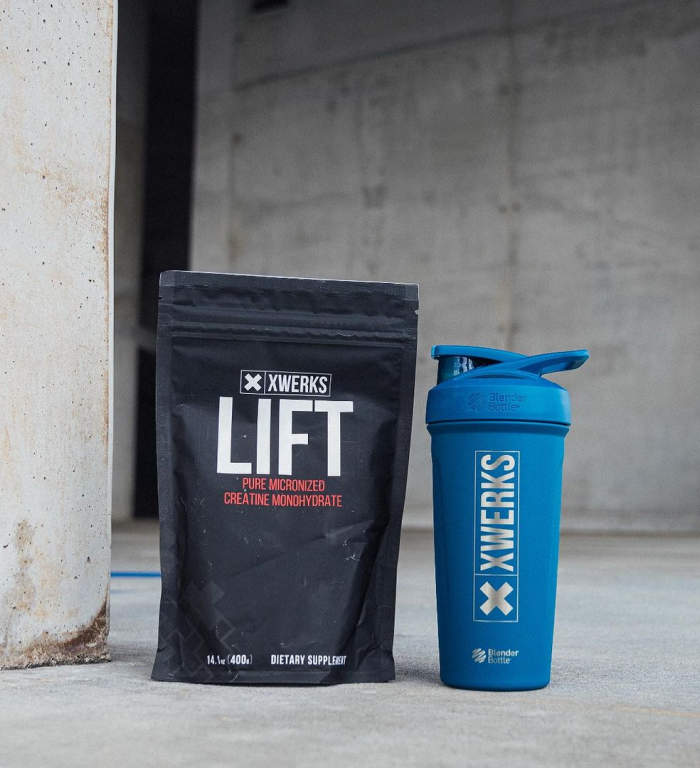
Micronized creatine monohydrate is exactly the same molecule as regular monohydrate — it's just been processed into smaller particles. This makes it mix more easily (less grit at the bottom of the glass) and may slightly improve how it stays in suspension. It does not change the effect on muscle growth. Think of it as a quality-of-life improvement, not a performance one. XWERKS Lift uses micronized monohydrate for exactly this reason. (More detail: what is micronized creatine.)
How to dose creatine for muscle growth
The simple protocol: 5g every day. Take it at any time — timing doesn't meaningfully affect results because creatine works by saturating your muscles over time, not through an acute pre-workout effect. Consistency is everything. Miss occasional days and you're fine; skip weeks and your muscle stores gradually decline.
Optional loading phase: 20g/day (split into 4 doses) for 5-7 days saturates your muscles faster, so you feel the effects within a week instead of 3-4 weeks. It's not required — taking 5g/day reaches the same full saturation, just more gradually. If you're patient, skip loading; if you want results faster, load.
Common questions
Does creatine cause water retention / bloating?
Creatine draws water into muscle cells, which is part of how it works — this is intramuscular, not the subcutaneous "puffy" water that makes you look soft. Some people notice a small scale increase in the first week (1-3 lbs of water), which is normal and not fat gain. It stabilizes quickly.
Do I need to cycle creatine?
No. There's no evidence you need to cycle off creatine, and no benefit to doing so. Your body doesn't stop producing its own creatine in any lasting way, and continuous daily use is both safe and more effective for maintaining saturation.
Is creatine safe long-term?
Creatine is one of the most extensively studied supplements in existence, with a strong long-term safety record in healthy individuals at the standard 3-5g/day dose. It does not damage the kidneys in healthy people (a persistent myth). If you have pre-existing kidney disease, check with your doctor.
Gummies or powder?
Both work identically — same molecule. Powder is cheaper and more flexible; gummies are more convenient. See creatine gummies vs powder.
The Bottom Line
The best creatine for muscle growth is plain creatine monohydrate at 5g per day. It's the form used in the overwhelming majority of the research, it has the strongest evidence for increasing lean mass and strength, and it's the cheapest option on the shelf. The "advanced" forms — HCl, buffered, ethyl ester, liquid — cost more and have never been shown to build more muscle. Some perform worse.
Micronized monohydrate is the same molecule with better mixing — a nice quality-of-life upgrade, not a performance one. Take 5g daily, be consistent, pair it with resistance training and adequate protein, and creatine will reliably do its job.
XWERKS Lift is pure micronized creatine monohydrate at the research-backed 5g dose — one ingredient, no gimmicks, no marketing markup. The exact form the studies used.
The Form the Research Uses
XWERKS Lift — 5g pure micronized creatine monohydrate per scoop, unflavored, 80 servings. No proprietary blends, no "advanced" markup. Just the creatine that builds muscle.
Shop LiftFurther Reading
What Is Micronized Creatine? — Why micronized dissolves better than standard powder.
Creatine Monohydrate vs HCl — Why monohydrate remains the gold standard.
Creatine Gummies vs Powder — Same molecule, different format.
Best Protein Powder for Muscle Gain — The other half of the muscle-building stack.
References
1. Kreider RB, et al. International Society of Sports Nutrition position stand: safety and efficacy of creatine supplementation. JISSN. 2017;14:18.
2. Antonio J, et al. Common questions and misconceptions about creatine supplementation. JISSN. 2021;18(1):13.
3. Branch JD. Effect of creatine supplementation on body composition and performance: a meta-analysis. Int J Sport Nutr Exerc Metab. 2003;13(2):198-226.
4. Jagim AR, et al. A buffered form of creatine does not promote greater changes in muscle creatine content, body composition, or training adaptations than creatine monohydrate. JISSN. 2012;9:43.
5. Spillane M, et al. The effects of creatine ethyl ester supplementation combined with heavy resistance training on body composition, muscle performance, and serum and muscle creatine levels. JISSN. 2009;6:6.