Whey Protein for Preventing Muscle Loss with Age
TL;DR
- Older adults experience "anabolic resistance" — a blunted muscle protein synthesis (MPS) response to protein. They need roughly 40g of high-quality protein per meal to match what younger adults achieve with 20g.
- Whey protein isolate is the most effective protein for older adults because of its leucine content (~11-13%) — the highest of any common protein source. Leucine is the primary trigger for MPS.
- Daily target for older adults: 1.6-2.2g of protein per kg body weight, distributed across 3-4 meals (Mamerow 2014: even distribution produces ~25% more daily MPS than skewed patterns).
- Cermak 2012 meta-analysis confirmed: protein supplementation + resistance training in older adults significantly increases muscle mass and strength compared to training alone.
Older adults face a specific biological challenge: anabolic resistance — a blunted muscle protein synthesis response to dietary protein. While a 25-year-old reaches near-maximal MPS at 20g of protein per meal, a 65-year-old needs roughly 40g of high-quality protein in the same meal to produce a comparable response. Without compensation through higher protein intake, daily protein synthesis falls below daily breakdown — leading to net muscle loss (sarcopenia). Whey protein isolate is the single most effective tool for older adults to overcome anabolic resistance because it has the highest leucine content of any common protein source (~11-13%), and leucine is the primary molecular trigger for muscle protein synthesis. Daily target: 1.6-2.2g protein per kg body weight, distributed across 3-4 meals throughout the day.
Anabolic resistance: the central problem of aging muscle
The single most important concept for understanding muscle loss in aging adults is anabolic resistance. Here's what it means:
Muscle protein synthesis (MPS) is the process by which your body builds new muscle protein. It's stimulated by amino acids in the bloodstream, particularly leucine. In a young adult, a moderate protein meal (containing ~2g of leucine, roughly 20g of high-quality protein) produces a strong MPS response — the muscle "turns on" anabolic signaling and builds new protein.
In older adults, the same protein meal produces a significantly smaller MPS response. The muscle is "resistant" to the normal anabolic signal. To produce a comparable MPS response, an older adult needs roughly 3g of leucine per meal — equivalent to about 40g of high-quality protein.
This isn't a small difference. It means older adults trying to maintain muscle on the same protein intake that worked in their 30s will fall short. Daily protein synthesis won't keep pace with daily protein breakdown, and muscle will progressively be lost over months and years.
Why whey protein is uniquely effective for older adults
1. Highest leucine content of any common protein
Whey protein contains approximately 11-13% leucine by weight — higher than any other common protein source. For comparison: casein is ~9% leucine, soy is ~7%, pea is ~8%, beef is ~8%. A 25g serving of whey isolate provides approximately 2.5-3g of leucine — right at the threshold needed to maximally stimulate MPS in older adults.
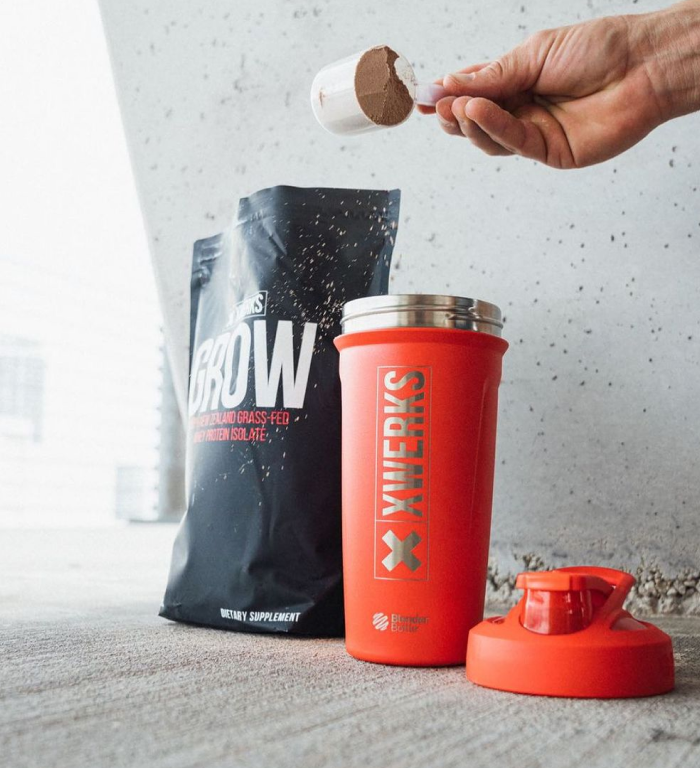
XWERKS Grow uses NZ grass-fed whey isolate, providing 25g protein and ~2.5-3g leucine per scoop.
2. Fast digestion and absorption
Whey is rapidly digested, producing a quick spike in blood amino acids — the kind of stimulus that most strongly triggers MPS. Slower-digesting proteins (casein, whole-food proteins) produce a more sustained but smaller MPS response. For older adults trying to overcome anabolic resistance, the fast spike from whey is particularly valuable.
3. Complete amino acid profile
Whey contains all nine essential amino acids in proportions well-suited to human muscle building. The high cysteine content also supports glutathione production (the body's master antioxidant), which is particularly relevant given that oxidative stress increases with age.
4. Convenient way to add 25-50g of high-quality protein per serving
For older adults, hitting protein targets through whole food alone is logistically difficult — particularly given that appetite often declines with age. A whey shake adds 25-50g of high-quality protein with minimal effort, making it possible to hit daily targets that would otherwise require very large meals.
5. Strong evidence base in older adults
Cermak et al. 2012 meta-analysis pooled data from 22 RCTs and found that protein supplementation combined with resistance training in older adults produced significantly greater gains in muscle mass and strength than training alone. The effect was robust across multiple study designs and populations.
Bauer et al. 2013 PROT-AGE position paper formally recommended 1.0-1.2g/kg as a baseline for older adults, with 1.2-1.5g/kg for those with acute or chronic disease, and 1.6g/kg+ for older adults engaged in resistance training. Subsequent research has pushed these recommendations upward, with many researchers now suggesting 1.6-2.2g/kg for active older adults.
How much whey protein older adults actually need
Daily total protein target: 1.6-2.2g per kg body weight
Practical breakdown:
150 lb (68 kg) older adult: 110-150g protein per day
180 lb (82 kg) older adult: 130-180g protein per day
200 lb (91 kg) older adult: 145-200g protein per day
Per-meal target: Each of 3-4 daily meals should contain ~30-50g of high-quality protein, with each meal hitting at least 3g of leucine (≈ 30-40g of high-quality protein).
Whey supplementation strategy: Use whey to either supplement low-protein meals or as a standalone meal/snack to hit total daily targets. Most older adults benefit from 1-3 scoops of whey per day depending on their whole-food protein intake.
Protein distribution: the Mamerow finding
One of the most important practical findings in aging muscle research is from Mamerow et al. 2014, which compared two protein patterns in healthy adults consuming the same total daily protein (~90g):
Even distribution: ~30g protein at each of 3 meals
Skewed distribution: ~10g breakfast, ~15g lunch, ~65g dinner (typical American eating pattern)
The result: the even distribution group had 25% higher 24-hour muscle protein synthesis than the skewed distribution group, despite identical total daily protein. The skewed pattern wasted much of the dinner protein — once you exceed the per-meal MPS ceiling, additional protein at that meal doesn't add to MPS.
For older adults dealing with anabolic resistance, this finding is critical: distributing protein evenly across 3-4 meals matters as much as hitting the daily total.
Practical even-distribution example for 180 lb (82 kg) man targeting 145g protein
Breakfast (8am): 4 eggs + 1 scoop whey in coffee = 40g protein
Lunch (12pm): 6 oz chicken breast + Greek yogurt = 50g protein
Pre-workout shake (4pm): 1 scoop XWERKS Grow + milk = 35g protein
Dinner (7pm): 6 oz salmon + cottage cheese side = 35g protein
Daily total: ~160g protein, comfortably above target, evenly distributed, every meal above the leucine threshold.
Why whey beats other proteins for older adults specifically
vs. Casein
Casein has a slower digestion profile (good for sustained amino acid release), but lower leucine content (9% vs whey's 11-13%) and a smaller acute MPS response. Casein has a role — particularly before bed for overnight protein delivery — but whey is superior for triggering MPS in older adults.
vs. Plant proteins (pea, soy, rice)
Plant proteins have lower leucine content and lower digestibility. Older adults using plant protein need to consume larger total amounts to reach the leucine threshold. Pea protein has ~8% leucine vs whey's 11-13%, meaning a 25g serving of pea provides ~2g leucine vs whey's ~2.5-3g. For older adults specifically, plant proteins are workable but require larger doses.
vs. Whole-food proteins
Whole foods (meat, eggs, dairy) are excellent protein sources. The issue isn't quality — it's quantity and convenience. A 6 oz chicken breast provides ~50g of protein, which is great if you can eat that volume. Many older adults have reduced appetite and can't consistently hit per-meal protein targets through whole food alone. Whey supplements the gap.
vs. BCAAs alone
BCAAs (branched-chain amino acids) provide leucine but lack the other essential amino acids needed to actually build muscle protein. Jackman et al. 2017 found BCAAs alone produced only 22% of the MPS response of complete whey protein. Skip BCAAs as a standalone — eat more whey instead.
The combined strategy: whey + creatine + resistance training
Whey protein doesn't work alone. The complete muscle preservation strategy for older adults includes:
1. Resistance training 2-4x per week. Heavy compound movements with progressive overload. Provides the stimulus for MPS that whey then enables.
2. Whey protein supplementation. 1-3 scoops daily to hit 1.6-2.2g/kg target with proper meal distribution.
3. Creatine monohydrate. 5g daily. Provides muscle and cognitive benefits. Combination of whey + creatine + training is significantly more effective than any single component.
4. Adequate sleep and recovery. Growth hormone peaks during deep sleep; muscle protein synthesis is largely a nighttime process.
5. Vitamin D3 sufficiency. 25(OH)D blood levels at 40-60 ng/mL. Vitamin D directly supports muscle function.
6. Omega-3 fatty acids. 2-3g EPA+DHA daily. Smith 2011 found omega-3s enhanced MPS response in older adults — directly addressing anabolic resistance.
Common mistakes older adults make
Eating too little protein at breakfast. Most older adults consume 10-15g protein at breakfast — well below the threshold to stimulate MPS. Adding whey to breakfast (in coffee, in yogurt, in oatmeal, or as a standalone shake) is one of the highest-impact changes you can make.
Saving most protein for dinner. Skewing protein toward dinner wastes much of the protein you eat (once you exceed the per-meal MPS ceiling, additional protein at that meal doesn't build more muscle). Distribute evenly.
Relying on protein bars and "protein-enhanced" foods. Many "high-protein" packaged foods provide only 10-20g per serving and are heavily processed. Whey shakes are cleaner and more efficient.
Using inferior protein sources due to digestive concerns. Whey isolate is roughly 90% protein with virtually no lactose — well-tolerated even by mildly lactose-intolerant adults. Don't avoid whey unnecessarily; isolate solves most digestive issues that older adults attribute to dairy.
Following the outdated 0.8g/kg RDA. The federal RDA was set as the minimum to prevent deficiency in average adults — not the optimal for older adults dealing with anabolic resistance. Researchers across multiple disciplines have called for updated recommendations.
The Bottom Line
Older adults need more protein per meal than younger adults — roughly 40g of high-quality protein vs 20g — to overcome anabolic resistance and stimulate muscle protein synthesis. This is biology, not guesswork.
Whey protein isolate is uniquely effective because of its high leucine content (~11-13%), fast digestion, and complete amino acid profile. A single 25g scoop provides ~2.5-3g leucine, right at the threshold needed for older adult MPS.
Daily target: 1.6-2.2g protein per kg body weight, distributed across 3-4 meals (Mamerow 2014 showed even distribution produces 25% more daily MPS than skewed patterns).
Combined with resistance training and creatine, whey supplementation in older adults significantly preserves muscle mass and strength (Cermak 2012 meta-analysis confirmed). The strategy works — but it requires consistency.
25g of NZ Grass-Fed Whey Per Scoop
XWERKS Grow — premium grass-fed whey isolate from New Zealand. 25g protein, ~2.5-3g leucine per scoop. The most effective single tool for overcoming anabolic resistance in older adults.
SHOP GROW →Further Reading
Supplements for Muscle Preservation After 50
Sarcopenia Prevention Supplements
Protein Intake for Longevity Research
Best Supplements for Healthy Aging Men
How Much Protein Can Your Body Absorb?
References
1. Cermak NM, et al. Protein supplementation augments the adaptive response of skeletal muscle to resistance-type exercise training: a meta-analysis. Am J Clin Nutr. 2012;96(6):1454-1464.
2. Bauer J, et al. Evidence-based recommendations for optimal dietary protein intake in older people: a position paper from the PROT-AGE Study Group. J Am Med Dir Assoc. 2013;14(8):542-559.
3. Mamerow MM, et al. Dietary protein distribution positively influences 24-h muscle protein synthesis in healthy adults. J Nutr. 2014;144(6):876-880.
4. Moore DR, et al. Protein ingestion to stimulate myofibrillar protein synthesis requires greater relative protein intakes in healthy older versus younger men. J Gerontol A Biol Sci Med Sci. 2015;70(1):57-62.
5. Morton RW, et al. A systematic review, meta-analysis and meta-regression of protein supplementation on resistance training-induced gains in muscle mass and strength. Br J Sports Med. 2018;52(6):376-384.
6. Smith GI, et al. Dietary omega-3 fatty acid supplementation increases the rate of muscle protein synthesis in older adults: a randomized controlled trial. Am J Clin Nutr. 2011;93(2):402-412.