Grass-Fed Whey Protein: Is It Worth the Extra Cost?
TL;DR
- Grass-fed whey typically costs 20-40% more than conventional whey — roughly $1.80-2.20 per serving vs. $1.00-1.50 for mass-market powders.
- The extra cost buys cleaner sourcing (no hormones, antibiotics, or pesticide-treated feed), higher omega-3 and CLA content, and fewer contaminants.
- For muscle-building purposes alone, conventional and grass-fed whey perform similarly — the amino acid profile and leucine content are nearly identical.
- Grass-fed is worth the premium if you prioritize clean sourcing, environmental and animal welfare standards, and reduced contaminant exposure. For pure performance economics, it's a quality-of-life upgrade rather than a necessity.
Grass-fed whey protein typically costs 20-40% more than conventional whey — roughly $1.80-2.20 per serving compared to $1.00-1.50 for mass-market powders. The premium pays for cleaner sourcing (no hormones, antibiotics, or pesticide residue), a modestly better fatty acid profile (higher omega-3s and CLA), and reduced contaminant exposure. For pure muscle building, the amino acid and leucine content of grass-fed and conventional whey are nearly identical — so if that's your only concern, you're paying a premium for quality-of-life benefits rather than performance. If you care about clean sourcing, environmental standards, and reduced exposure to additives and residues, grass-fed is worth the extra cost.
What does "grass-fed" actually mean?
Grass-fed whey comes from dairy cows that graze on pasture rather than being fed a grain-based diet in confinement feedlots. The specifics vary by region and certification standard, but the general principle is the same: cows eat what cows evolved to eat (grass and forage), rather than corn, soy, and grain-based feed.
The highest-quality grass-fed whey comes from countries with strict dairy standards:
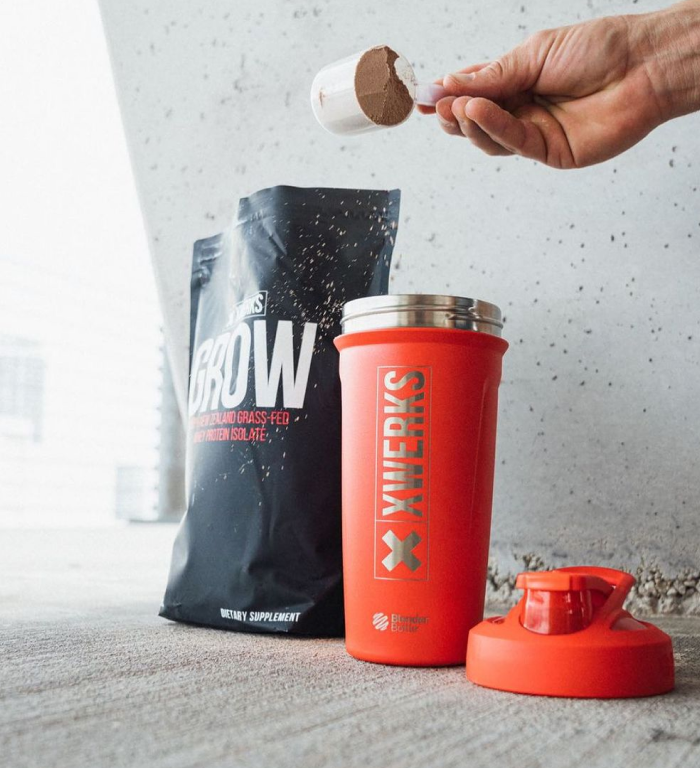
New Zealand — Arguably the gold standard. NZ dairy cows spend the vast majority of their lives on pasture year-round due to the country's mild climate. Strict regulations prohibit growth hormones (like rBST), routine antibiotic use, and GMO feed. XWERKS Grow sources from New Zealand specifically for these reasons.
Ireland — Similar pasture-based system with strict EU standards.
United States — Grass-fed standards vary. True 100% grass-fed (American Grassfed Association certification) is meaningful. "Grass-fed" without certification can mean as little as partial pasture access.
The distinction matters because a lot of "grass-fed" marketing in the US is loose. If you're paying a premium for grass-fed whey, verify the sourcing country and any certifications on the label.
The real differences: what you're paying for
1. Cleaner input — no hormones, antibiotics, or pesticide residue
Conventional dairy operations often use recombinant bovine growth hormone (rBST/rBGH) to boost milk production, routine antibiotics to manage infection in crowded feedlot conditions, and grain feed grown with pesticides. Trace residues from these inputs can end up in the final whey product.
Grass-fed dairy — especially from New Zealand or certified sources — avoids these inputs entirely. The cows are healthier, the milk is cleaner, and the whey powder that results has fewer unwanted residues. This is the single biggest practical reason to choose grass-fed whey.
2. Modestly better fatty acid profile
Grass-fed dairy contains higher levels of omega-3 fatty acids (particularly ALA) and conjugated linoleic acid (CLA) compared to grain-fed dairy. Research published in Nutrition Journal and elsewhere has consistently found grass-fed dairy to have roughly 2-5x more omega-3s and 2-3x more CLA than conventional dairy.
Important caveat: Whey protein isolate is specifically filtered to remove fats, so most of these fatty acid benefits actually end up in the cream and butter fractions rather than the isolate itself. The benefit is more pronounced in whey concentrate and full-fat dairy products. For pure isolate, the fatty acid advantage is real but modest. Don't buy grass-fed isolate specifically for omega-3s — if that's your goal, eat fatty fish or take fish oil.
3. Reduced heavy metal and contaminant risk
Contaminant testing on commercial protein powders has repeatedly found concerning levels of heavy metals (lead, cadmium, arsenic, mercury) in low-quality products. The Clean Label Project's 2018 protein powder report found detectable heavy metals in a majority of tested products, with wide variation by brand and sourcing.
The raw material matters. Cows grazing on clean pasture in environmentally controlled regions (like New Zealand) produce milk with lower contaminant loads than cows in intensive feedlot operations. Combined with microfiltration processing and third-party testing, grass-fed whey isolate from reputable sources is among the cleanest protein options available.
4. Animal welfare and environmental standards
Grass-fed, pasture-raised dairy operations generally involve better animal welfare (cows live more naturally, with less confinement stress) and lower environmental impact in some metrics (no concentrated feedlot waste, healthier soils from rotational grazing). For many consumers, these ethical considerations matter independent of nutritional differences.
This isn't a universal win — grass-fed systems require more land per unit of milk production, so the environmental calculation is nuanced. But the animal welfare difference between pasture-raised and intensive feedlot operations is substantial.
5. Often paired with cleaner overall formulation
This isn't a property of grass-fed whey itself, but it's a practical observation: brands that pay for grass-fed sourcing almost always also invest in cleaner formulations — fewer artificial sweeteners, no artificial colors, minimal fillers, natural flavoring. You're not just paying for the raw material; you're paying for the overall product philosophy.
Conversely, cheap mass-market whey is usually packaged with cheap formulations: artificial sweeteners, thickeners, fillers, synthetic colors, and "proprietary blends" that obscure what's actually in the powder.
What grass-fed whey doesn't do (the honest part)
To be fair about this, there are several claims about grass-fed whey that don't hold up to scrutiny:
Grass-fed whey isn't dramatically better for muscle building. The amino acid profile and leucine content of grass-fed and conventional whey isolate are nearly identical. If your only goal is maximal muscle protein synthesis, both will work about equally well. The Morton et al. 2018 meta-analysis on protein supplementation doesn't distinguish between sourcing types because the effect on muscle gain is driven by total protein and leucine dose, not sourcing.
Grass-fed whey isn't meaningfully "more bioavailable." You'll see marketing claims that grass-fed whey is more absorbable or better utilized. This is mostly unsupported — whey isolate from any quality source is already 90%+ digestible with high biological value.
Grass-fed whey doesn't provide meaningful extra omega-3s once filtered. As noted above, whey isolate is stripped of most fat during processing. The omega-3 and CLA advantages of grass-fed dairy largely end up in butter, cream, and full-fat dairy products — not isolate powder.
So what are you paying extra for? Cleaner sourcing, reduced contaminant exposure, better animal welfare, fewer additives in the overall formulation, and the confidence of knowing what went into the raw material. These are real benefits — just not the "explosive muscle growth" claims some marketing implies.
The cost breakdown: how much more does grass-fed actually cost?
Rough market pricing for whey protein isolate (30-serving bag, 25g protein per serving):
Cheap mass-market whey concentrate: $25-35 per bag ($0.80-1.15 per serving)
Mid-tier conventional whey isolate: $40-55 per bag ($1.30-1.85 per serving)
Quality grass-fed whey isolate (like XWERKS Grow): $55-70 per bag ($1.85-2.35 per serving)
Premium specialty whey (single-origin, heavily certified): $70-100+ per bag ($2.35-3.35+ per serving)
The grass-fed premium is roughly $0.50-1.00 per serving compared to cheap conventional whey — or about $15-30 per 30-serving bag. Over a year of daily use (365 servings), that's $180-365 in extra cost for grass-fed sourcing.
Whether that premium is worth it depends on your priorities. If you're spending $200+ per month on groceries anyway and you care about food quality, an extra $15-30 per month on protein is a minor line item. If you're a broke college lifter trying to maximize every dollar, cheap conventional whey will build muscle just as effectively.
When grass-fed whey makes the most sense
You prioritize clean sourcing across your diet. If you're already buying grass-fed beef, pasture-raised eggs, and wild-caught fish, it's consistent to choose grass-fed whey. You're optimizing the quality of your protein sources throughout your diet.
You have digestive sensitivity to dairy. Grass-fed whey isolate (microfiltered) is often better tolerated than cheap concentrate. Less lactose, fewer additives, and cleaner processing can reduce bloating, gas, and GI discomfort. Many people who "can't tolerate whey" actually can tolerate high-quality grass-fed isolate.
You're concerned about hormone and antibiotic residues. If this is a meaningful priority for you, grass-fed sourcing from countries with strict standards (NZ, Ireland) is the most direct way to address it.
You value animal welfare and environmental standards. Pasture-raised dairy operations are generally better for both cows and certain environmental metrics than intensive feedlots. This is a values-based choice, not a performance one.
You want a clean ingredient list throughout the product. Grass-fed whey brands almost always pair their clean sourcing with clean formulation (no artificial colors, minimal sweeteners, naturally flavored). You get more than just grass-fed dairy — you get a whole-product quality upgrade.
When cheap conventional whey is fine
To be honest about this: if your goals are pure muscle building and performance, and you're on a tight budget, conventional whey protein will still work. It's not as clean, not as well-sourced, and probably contains more additives — but it has the amino acids your muscles need.
The question isn't "which one builds more muscle" (both do fine). It's "which one do you want to put in your body every day, 365 days per year, for the rest of your training career." That's a values and priorities question, not just a performance one.
If you're choosing cheap conventional whey, at least:
Pick whey isolate over concentrate — more protein per gram, less lactose, fewer fillers.
Avoid "proprietary blends" — you should know exactly what's in your powder.
Check for third-party testing — even cheap powders can be tested by independent labs. Look for NSF, Informed Sport, or Labdoor verification.
Avoid artificial colors and minimize sweeteners — the fewer additives, the better, regardless of sourcing.
Why XWERKS Grow costs what it does
XWERKS Grow is priced at the upper end of the grass-fed market for specific reasons:
100% New Zealand grass-fed sourcing. Not "partial pasture access" or "grass-fed blend." The entire whey supply comes from NZ dairy operations.
Whey isolate only — no concentrate blend. Many "grass-fed whey" products cut the cost by blending isolate with cheaper concentrate. Grow is 100% isolate.
Cold microfiltration. Preserves the native whey protein fractions (alpha-lactalbumin, beta-lactoglobulin, lactoferrin, immunoglobulins) while removing lactose and fat. This is a more expensive process than high-heat processing.
Minimal ingredient list. Whey protein isolate, natural flavors, xanthan gum, stevia. That's it. No artificial colors, no proprietary blends, no fillers.
25g of protein per scoop with 6g+ of BCAAs. Full serving size, full dose — enough to cross the leucine threshold and maximally stimulate muscle protein synthesis in a single scoop.
The price reflects the sourcing, processing, and formulation quality. Is it more expensive than cheap mass-market whey? Yes. Is it cheaper than some premium single-origin specialty brands? Also yes. For most people, it's in the sweet spot of quality vs. price.
The Bottom Line
Grass-fed whey costs 20-40% more than conventional whey — roughly $1.80-2.20 per serving vs. $1.00-1.50. The premium buys cleaner sourcing, fewer additives, and reduced contaminant exposure.
For pure muscle building, the performance difference is minimal. Amino acid profiles and leucine content are nearly identical. Total protein and leucine dose matter more than sourcing for muscle growth.
Grass-fed is worth the premium if you prioritize clean sourcing across your diet, have digestive sensitivity to cheap whey, care about animal welfare and environmental standards, or want to minimize exposure to hormones, antibiotics, and pesticide residues.
It's a quality-of-life upgrade, not a necessity. If you're budget-limited, cheap whey isolate will still build muscle. If you have the budget and value clean food, grass-fed whey is one of the more meaningful upgrades you can make to your daily nutrition.
The Grass-Fed Standard — XWERKS Grow
100% New Zealand grass-fed whey protein isolate. 25g of protein per scoop, 6g+ BCAAs, microfiltered, naturally sweetened with stevia. No hormones, antibiotics, artificial colors, or fillers.
SHOP GROW →Further Reading
Is Protein Powder Good for You?
How Much Protein Can Your Body Absorb
References
1. Benbrook CM, et al. Enhancing the fatty acid profile of milk through forage-based rations, with nutrition modeling of diet outcomes. Food Sci Nutr. 2018;6(3):681-700.
2. Davis H, et al. Nutritional benefits from fatty acids in organic and grass-fed beef. Foods. 2022;11(5):646.
3. Morton RW, et al. A systematic review, meta-analysis and meta-regression of protein supplementation on resistance training-induced gains in muscle mass and strength. Br J Sports Med. 2018;52(6):376-384.
4. Jäger R, et al. International Society of Sports Nutrition position stand: protein and exercise. J Int Soc Sports Nutr. 2017;14:20.
5. Clean Label Project. Protein powder study. 2018.