Can creatine protect thinking after lost sleep? The evidence is mixed. One 2026 trial found less deterioration on several cognitive tests during prolonged wakefulness. Another found no significant benefit after a night restricted to three hours in bed. Neither establishes creatine as a substitute for sleep.
Headlines can make two experiments sound like direct contradictions. Here, the participants, supplementation schedules, and sleep challenges were different. Reading those details is more useful than picking the headline you prefer.
Two studies, different questions
| Feature | Prolonged wakefulness trial | Restricted-sleep trial |
|---|---|---|
| Participants | 29 healthy adults | 8 adults |
| Creatine protocol | One dose of 0.2 g/kg | 20 g/day for 7 days |
| Sleep challenge | 21 hours of wakefulness | One night with 3 hours in bed |
| Main result | Less decline on several cognitive measures | No significant cognitive or physiological benefit detected |
The trial that found benefits
In the April 2026 Nutrients study, participants received creatine or placebo in a double-blind crossover design. Testing followed a single 0.2-gram-per-kilogram dose during prolonged wakefulness.
Creatine reduced deterioration on measures including logical and numerical tasks, language-related processing speed, and psychomotor vigilance. The findings suggest a possible role under acute sleep stress, but do not show that all aspects of cognition were restored or that participants were fully rested.
The trial that did not find a significant benefit
The October 2026 Sleep and Vigilance study tested eight people in a crossover protocol. They took 20 grams daily for seven days before a night limited to three hours in bed.
The researchers did not detect a significant benefit across the cognitive and physiological outcomes examined. With only eight participants, the study had limited ability to detect some effects. A null result is important evidence, but it is not proof that every possible benefit is exactly zero.
Why neither result cancels the other
A single dose during sustained wakefulness and a week of supplementation before partial sleep restriction are not interchangeable exposures. Nor does sleeping briefly necessarily create the same testing conditions as staying awake continuously.
The most useful conclusion is therefore specific: a potential benefit appeared under one protocol and was not established under another. A larger study that directly compares these conditions would help distinguish an effect of dose, timing, sleep challenge, or chance.
This is also why a supplement headline should identify the task being measured. A faster response on a laboratory test does not automatically establish safer driving, better decisions at work, or better athletic recovery.
What the research doses mean
A weight-based dose changes with the participant. At 80 kilograms, 0.2 g/kg equals 16 grams. That calculation describes the experimental protocol; it is not a recommendation to take a large dose after a bad night.
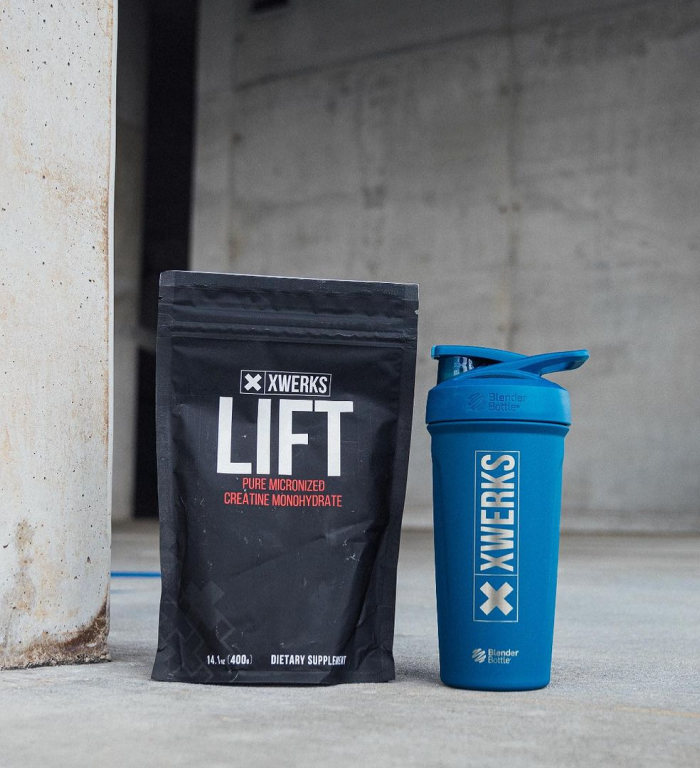
XWERKS Lift provides 5 grams of creatine monohydrate per serving. Neither trial demonstrates that one serving produces the reported acute cognitive effects. Both studies used substantially different regimens, and neither tested Lift as a finished product.
What should you do after a poor night?
Protect the next opportunity to sleep and adjust demanding activities to how alert you actually are. Do not use a supplement as reassurance that you can drive safely while sleepy. For persistent or unexplained sleep problems, seek an appropriate assessment rather than trying progressively larger supplement doses.
For the broader research context, read creatine and brain function. For routine use, our creatine dosage guide explains the distinction between ordinary supplementation and research protocols.