Yes. Creatine supplementation can change a DEXA scan's lean-mass estimate, partly because changes in body water can affect the measurement. A higher lean-mass reading soon after starting creatine does not prove that the entire increase is new muscle tissue. It also does not mean the scan is useless or that creatine cannot support training adaptations.
The most useful comparison comes from consistent preparation and a clear record of what changed between scans.
What does a DEXA scan measure?
DXA, commonly written DEXA, uses dual-energy X-ray absorptiometry. In a body-composition report, it estimates fat mass, lean soft tissue, and bone mineral. Lean soft tissue includes water and other nonfat tissues; it is not a direct inventory of contractile muscle protein.
That distinction matters when you compare two numbers labeled “lean mass.” If water or glycogen changes between visits, the reading can change even when the amount of newly built muscle is smaller than the total increase suggests.
Researchers have specifically examined how manipulating muscle creatine and glycogen affects DXA estimates. Their work supports treating scan conditions as part of the measurement, rather than assuming every lean-mass change has one cause. Read the study on muscle creatine, glycogen, and DXA body-composition estimates.
How creatine can affect the result
Creatine supplementation can alter body water as muscle creatine stores change. In research involving female collegiate dancers, supplementation changed total body water and DXA lean-mass estimates. The finding is relevant to interpretation, but it does not supply a universal correction factor for every person, dose, or scanner. See the study of creatine, body water, and DXA in collegiate dancers.
Three processes can overlap during a training block:
- Changes in water associated with starting or changing creatine use.
- Changes in glycogen and the water stored with it.
- Training adaptations that develop over time.
A scan by itself cannot assign an exact share of an increase to each process. It is especially difficult to interpret an early scan taken soon after a new supplement, a different diet, and a new training program all begin together.
How to interpret common scan comparisons
| What changed between scans? | What the result can suggest | What it cannot prove alone |
|---|---|---|
| You started creatine shortly before the second scan. | Some of the change may involve water associated with supplementation. | That every added pound of lean mass is new muscle. |
| Your creatine routine stayed consistent across a longer training block. | The comparison is easier to interpret alongside training progress. | An exact amount of muscle growth without measurement uncertainty. |
| Carbohydrate intake, hydration, or recent exercise differed substantially. | Preparation differences may contribute to the change. | That the entire difference reflects the program's success or failure. |
| You used a different facility or machine. | You have another body-composition estimate. | That it is interchangeable with the previous measurement. |
Should you stop creatine before a DEXA scan?
Do not make a last-minute change simply to chase a “cleaner” number. Stopping creates another change in the conditions you are trying to compare. For routine progress tracking, document your usual creatine intake and follow the scanning facility's preparation instructions.
If you want to study what happens when you begin creatine, a scan before starting provides a baseline. A later scan still needs interpretation: an early change and a longer-term training change answer different questions. If the scan is part of medical care or a formal study, the clinician's or research team's protocol takes priority.
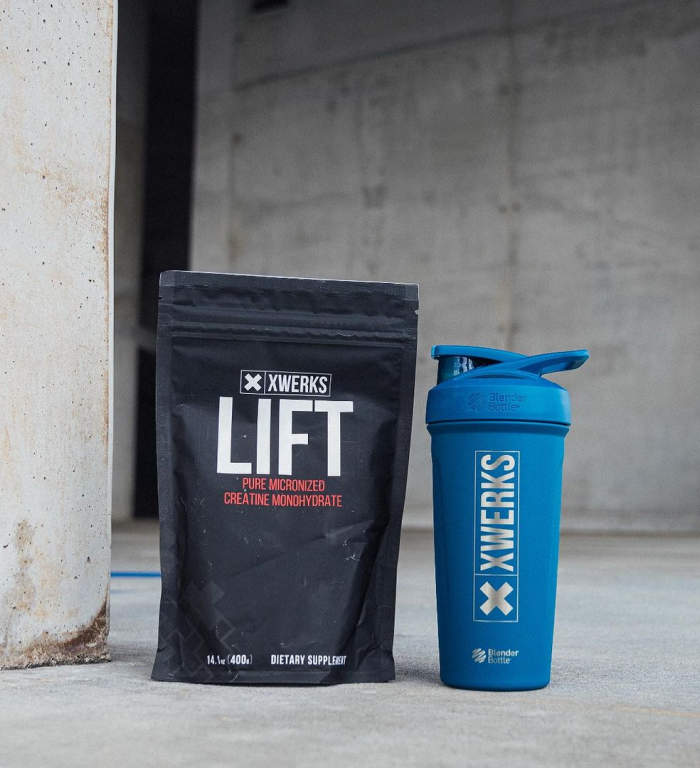
Xwerks Lift contains creatine monohydrate, with 5 g per serving. Record the amount you actually use and any changes in your routine; the brand name alone is not enough information for comparing measurements.
A repeat-scan preparation checklist
- Use the same facility and machine when possible.
- Ask for the facility's instructions on meals, fluid, exercise, clothing, and timing.
- Record creatine use, including recent starts, stops, or loading phases.
- Keep your normal hydration routine consistent; do not deliberately dehydrate for the scan.
- Note unusually hard training, travel, illness, or major dietary changes before either visit.
- Interpret the result with strength, training performance, and other relevant measurements over time.
This checklist improves the comparison; it does not remove all measurement variability. If the numerical change is small, ask the facility how it assesses repeat-measurement precision before drawing a large conclusion.
Does this mean creatine gains are only water?
No. The measurement issue and the training question are different. Creatine use alongside resistance training has been studied over longer periods, while a short-term change in a scan may include water. Neither observation cancels the other.
For the broader training context, read the complete guide to creatine monohydrate and how creatine relates to muscle-building progress.
Frequently asked questions
Can I subtract a fixed amount for creatine water weight?
No reliable universal subtraction exists. Water changes vary, and DXA does not identify a separate “creatine water” compartment that you can remove from the report.
Will creatine always lower my reported body-fat percentage?
No. A percentage depends on the relationship between estimated compartments, and the direction and size of changes are not guaranteed. Review the absolute measurements and preparation conditions as well as the percentage.
Is a smart scale an easy way around this issue?
Not necessarily. Bioelectrical impedance estimates also depend on body water and the method used. Switching devices does not create a direct muscle measurement. See research comparing body-composition responses to creatine across measurement methods.