TL;DR
- Endurance athletes need a different pre-workout than lifters. The bodybuilding-style "pump and tingles" formula — huge stimulants, high beta-alanine, big pump ingredients — is mostly wrong for long aerobic efforts.
- What actually helps endurance: a moderate caffeine dose, carbohydrate availability, electrolytes/hydration, and possibly nitrate (beetroot) and citrulline. What doesn't: mega-stim doses, loading up on beta-alanine pre-session, or anything that spikes then crashes.
- The single most evidence-backed pre-endurance ingredient is caffeine — roughly 3-6 mg per kg body weight, taken ~45-60 min before — with strong research for endurance performance. But more isn't better; over-caffeinating hurts.
- For sessions over ~60-90 minutes, fueling during the workout (carbs + electrolytes) matters more than anything you take before it. That's where a product like Motion fits, alongside a moderate-stim pre-workout like Ignite.
- The honest framework: keep the stimulant moderate, prioritize carbs and electrolytes for longer efforts, and don't use a lifter's pre-workout for an endurance session.
Most pre-workouts are built for the weight room — high stimulants for intensity, beta-alanine for short high-rep buffering, and big "pump" ingredients for the mirror. For endurance athletes — runners, cyclists, triathletes, rowers, Hyrox competitors, long-format CrossFit — that formula is largely the wrong tool. Endurance performance is limited by different things than a heavy set of squats, so the supplement approach should be different too. The honest picture: the ingredients that genuinely help endurance are a moderate caffeine dose, carbohydrate availability, electrolytes and hydration, and possibly nitrate (beetroot) and citrulline — while the mega-stimulant, high-beta-alanine, pump-focused formulas that dominate the pre-workout shelf offer little for long aerobic efforts and can actively work against you. This guide covers what endurance athletes actually need before and during training, what the evidence supports, what to skip, and how to build a simple, effective approach without the bodybuilding-pre-workout baggage.
Why endurance needs a different approach than lifting
A heavy lifting session and a two-hour bike ride are limited by completely different things, so the supplements that help each are different:
What limits a lifting session: maximal force production, short bursts of high-intensity effort, neural drive, and the ability to grind out a few hard reps. This is where high stimulants, beta-alanine (for the 60-240 second buffering window), and pump ingredients have their place.
What limits an endurance session: sustained aerobic energy production, fuel availability (glycogen and blood glucose), hydration and electrolyte balance, thermoregulation, and perceived effort over time. None of those are meaningfully helped by a big pump or a 350mg caffeine bomb.
The practical implication: using a bodybuilding pre-workout for an endurance session gives you a lot of ingredients you don't need, a stimulant dose that's often too high, and nothing for the things that actually limit you (carbs, electrolytes, sustained energy). It's the wrong tool, even if it's the most heavily marketed one.
What actually helps endurance — the evidence
Caffeine — the strongest evidence
~3-6 mg/kg, 45-60 min beforeCaffeine is one of the most well-researched and effective endurance aids there is. It reduces perceived effort, can improve time-to-exhaustion and time-trial performance, and works across running, cycling, and other endurance modalities. The research-supported dose is roughly 3-6 mg per kg of body weight — for a 70kg athlete, that's about 210-420mg, though many people get benefits at the lower end. Taken about 45-60 minutes before the session. Crucially, more is not better — higher doses increase jitter, heart rate, and GI distress without improving (and sometimes worsening) performance. This is why a moderate-caffeine pre-workout suits endurance better than a mega-stim one. See how caffeine works and how long it lasts.
Carbohydrate availability — the foundation for longer efforts
Before and especially during sessions 60-90+ minFor anything beyond about an hour, fuel availability becomes the dominant performance factor. Going into a long session with topped-up glycogen, and taking in carbohydrate during longer efforts, has strong evidence for maintaining pace and delaying fatigue. This is where a fast-digesting, low-GI-distress carb source matters — and where most pre-workouts offer nothing at all. A carbohydrate like Cluster Dextrin (highly branched cyclic dextrin) is designed for exactly this: steady energy without the sugar spike-and-crash or the GI heaviness of simple sugars.
Electrolytes and hydration — underrated and critical
Sodium-forward, especially in heat or long effortsEndurance athletes lose meaningful water and electrolytes through sweat — and sodium is the one that matters most. Dehydration and electrolyte depletion degrade performance, impair thermoregulation, and in extreme cases pose real health risks. Proper hydration with adequate sodium (and secondary potassium and magnesium) is one of the most impactful and most overlooked endurance levers. This matters far more for endurance than for a 45-minute lifting session. See electrolyte powders vs sports drinks.
Nitrate (beetroot) — modest but real
~2-3 hours before, for some athletesDietary nitrate, most commonly from beetroot, can improve oxygen efficiency and modestly benefit endurance performance, particularly in recreational and sub-elite athletes. Effects are real but modest, and it typically needs to be taken a few hours before (or loaded over days), not right at warmup. See beetroot juice and endurance. A reasonable optional addition, not a must-have.
Citrulline — plausible, secondary
Clinical dose 6-8g if usedL-citrulline supports nitric oxide and blood flow and has more evidence in resistance and high-intensity contexts than pure endurance, but there's a plausible case for it in endurance via blood flow and oxygen delivery. If your pre-workout includes a clinical citrulline dose, it's a reasonable bonus — not a primary endurance driver. See benefits of citrulline.
What to skip (or de-prioritize) for endurance
• Mega-dose stimulants (300-400mg+ caffeine, plus other stims): too much caffeine for endurance increases heart rate, jitter, and GI distress without improving performance. The high-stim arms race is built for the weight room, not a long run. A moderate dose beats a massive one here.
• High beta-alanine as a pre-session driver: beta-alanine works by raising muscle carnosine over weeks of daily use — it buffers acid in the ~60-240 second high-intensity window. It's not an acute endurance aid, and the pre-workout "tingles" do nothing for a two-hour effort. (It can still be worth taking daily for repeated high-intensity surges, but that's a chronic strategy, not a pre-endurance one.) See beta-alanine explained.
• Big "pump" ingredient megadoses: a skin-stretching pump is irrelevant to endurance performance. Blood flow has a plausible minor role, but pump-maximizing formulas are aesthetic, not aerobic.
• Anything that spikes then crashes: high-sugar or proprietary-stimulant-blend pre-workouts that give a sharp rush followed by a crash are particularly bad for endurance, where you need sustained, even energy across a long effort.
• Stimulant stacking close to a long session in heat: high stimulant doses raise heart rate and core temperature — a poor combination with endurance work in hot conditions.
How to build your endurance pre-workout approach
For shorter or higher-intensity endurance (under ~60 min):
• A moderate caffeine dose (~3-6 mg/kg) 45-60 min before
• Adequate hydration with some electrolytes, especially in heat
• You generally don't need in-session carbs for efforts under an hour if you're well-fueled going in
For longer endurance (60-90+ min):
• The same moderate caffeine dose before
• In-session carbohydrate becomes the priority — a fast-digesting, low-GI-distress carb taken during the effort
• Electrolytes throughout, sodium-forward, scaled to sweat rate and conditions
• Optional: nitrate (beetroot) a few hours before
The mindset shift: for lifting, the action is all before the session (the pre-workout). For endurance, the longer the effort, the more the action shifts to during the session (fuel and fluids). A pre-workout gets you started; in-session fueling gets you to the finish.
Where XWERKS fits for endurance

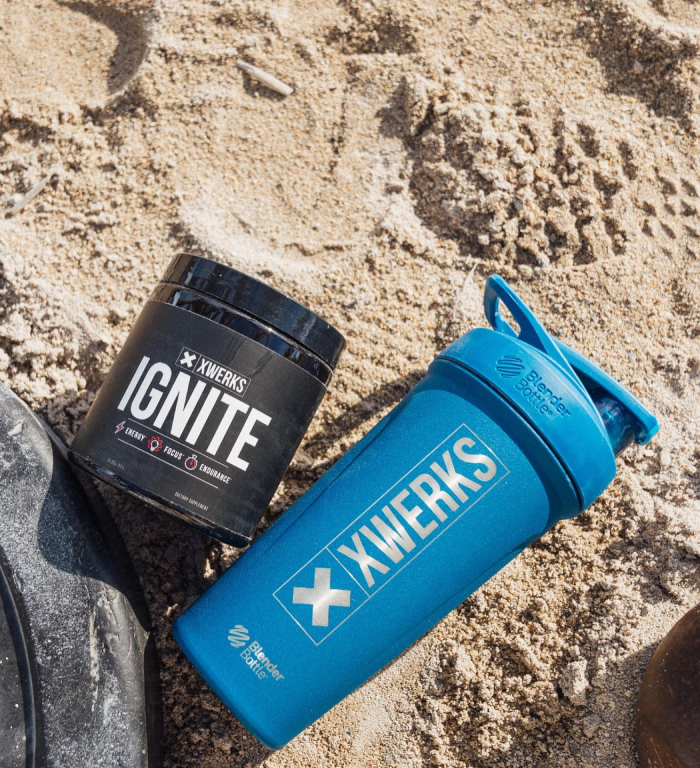
XWERKS Ignite — a moderate 150mg caffeine dose
150mg caffeine (not a 350mg bomb), plus citrulline, tyrosine, and rhodiola for focus without the over-stimulation and crash that work against endurance efforts. The moderate-stim profile suits aerobic training far better than a high-stim lifting pre-workout.
Shop Ignite →Ignite works as the "before" piece precisely because its caffeine dose is moderate (150mg) rather than the 300mg+ found in high-stim lifting pre-workouts. For endurance, that moderate dose is a feature, not a compromise — it delivers caffeine's well-supported endurance benefit and focus without pushing heart rate, jitter, and GI distress in the wrong direction. The added citrulline, tyrosine, and rhodiola support focus and perceived effort without turning it into a stimulant bomb.

XWERKS Motion — carbs + electrolytes for the effort itself
25g of Cluster Dextrin® (a fast-digesting, low-glycemic carbohydrate) plus electrolytes and BCAAs — built for steady in-session energy without the spike, crash, or GI heaviness of simple sugars. For endurance efforts over an hour, this matters more than any pre-workout.
Shop Motion →Motion is the more important product for true endurance work — because for efforts over an hour, in-session fueling outweighs anything you took beforehand. Its Cluster Dextrin delivers steady carbohydrate energy without the spike-and-crash of simple sugars, and the electrolytes address the hydration side that plain water misses. For a long ride, run, or session, sipping Motion throughout does more for your finish than any pre-workout does for your start.
• Before: Ignite (moderate caffeine + focus), 45-60 min out
• During (60-90+ min efforts): Motion (Cluster Dextrin carbs + electrolytes), sipped throughout
• Optional: beetroot/nitrate a few hours before, if you've tested it and like it
That covers the actual endurance limiters — a moderate stimulant to start, then sustained fuel and fluids to finish — without the mega-stim, beta-alanine, pump baggage of a lifting pre-workout.
Practical tips for endurance pre-workout
Test everything in training first
Never try a new pre-workout, caffeine dose, carb source, or electrolyte product for the first time on race day or during a key session. GI tolerance to carbs and caffeine during endurance varies a lot between individuals. Dial in your approach in regular training so race day is familiar.
Mind your caffeine timing and total dose
Caffeine peaks around 45-60 minutes after intake and has a long half-life. For evening sessions, a pre-workout's caffeine can disrupt sleep — a real concern for athletes whose recovery depends on sleep. Account for all caffeine sources across the day, not just the pre-workout. See how long caffeine lasts.
Scale carbs and fluids to duration and conditions
A 45-minute tempo run needs far less in-session fuel than a 3-hour ride. Longer and hotter means more carbohydrate and more electrolytes (especially sodium). Match intake to the demand — under-fueling a long effort is a common, avoidable mistake.
Don't out-supplement poor training or fueling
No pre-workout compensates for inadequate base training, chronic under-fueling, or poor sleep. Supplements are the margin, not the foundation. Get the training, daily nutrition, and recovery right first — then optimize the pre/during-session approach.
The Bottom Line
Endurance athletes need a different pre-workout approach than lifters. The high-stim, high-beta-alanine, pump-focused formulas that dominate the shelf are built for the weight room and offer little for long aerobic efforts — and the mega-stimulant doses can actively work against you.
What actually helps endurance: a moderate caffeine dose (~3-6 mg/kg, 45-60 min before — the single strongest-evidence aid), carbohydrate availability (especially during efforts over an hour), electrolytes and hydration (sodium-forward), and optionally nitrate (beetroot) and citrulline.
What to skip: mega-dose stimulants, beta-alanine as an acute pre-session driver, big pump megadoses, and anything that spikes then crashes.
The key mindset shift: for lifting, the action is all before the session. For endurance, the longer the effort, the more it shifts to fueling during the session. A moderate-stim pre-workout like Ignite gets you started; in-session carbs and electrolytes like Motion get you to the finish — and for long efforts, the second matters more than the first.
Test everything in training, mind your caffeine timing, scale fuel to duration, and don't try to out-supplement the fundamentals.
Dig deeper: Cluster Dextrin explained · electrolyte powders vs sports drinks · beetroot and endurance · beta-alanine explained · how long caffeine lasts · benefits of citrulline